

What Should Be in an Enterprise Website Statement of Work?
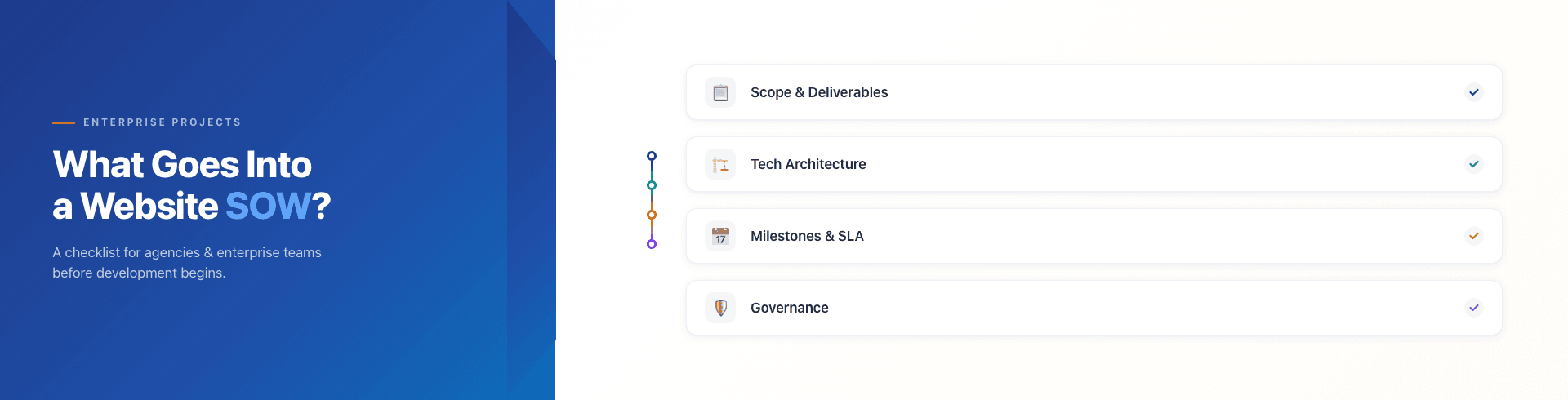


A website proposal can describe an ambitious transformation while leaving important delivery questions unanswered. Who supplies the content? Which integrations are included? What counts as an approved design? Who decides whether the finished platform is ready to launch? An enterprise website statement of work (SOW) turns those questions into agreed responsibilities, deliverables, and acceptance criteria.
For UAE and GCC organisations, that agreement may need to cover multiple business units, Arabic and English content, existing search visibility, and dependencies across marketing, IT, procurement, and external suppliers. This guide explains what an enterprise website SOW should contain, with examples that help teams review scope before delivery begins.
Business Objectives, Project Scope, and Deliverables
Open with the business outcome: consolidate brands, improve qualified lead flow, replace a legacy CMS, expand across the GCC, support ecommerce, or reduce publishing cost. Then name the domains, brands, markets, languages, audiences, journeys, templates, platforms, and environments included. State exclusions such as apps, intranets, campaign microsites, CRM rebuilds, or data work.
Website Deliverables and Scope Boundaries
“A new website” is not an acceptable deliverable. Break the work into sitemap, wireframes, design system, templates, component library, content model, migrated content, new copy, image guidance, code, configuration, integrations, documentation, training, test evidence, and launch support. Include quantities or coverage where practical: template count, language count, migration batches, design rounds, environments, or training sessions. Where quantity cannot be fixed, define a prioritisation rule and decision gate.
Discovery Outputs and Decision Gates
Discovery should produce decisions, not only presentations. List workshops, stakeholder interviews, analytics review, technical assessment, content inventory, search research, competitor review, and risk analysis. For each activity, describe the output and approver. Useful outputs include a prioritised requirements backlog, journey model, information architecture, content model, technical architecture, integration map, measurement plan, and delivery roadmap. Distinguish recommendations from committed implementation and record which assumptions will be tested before the solution is finalised.
Governance, Content, and Bilingual Delivery
Responsibilities and Approval Ownership
Enterprise delivery slows down when responsibility is implied. Include a responsibility matrix for sponsor, product owner, marketing, content, legal, compliance, security, IT, data, agency, development, platform, and analytics teams. Define who recommends, decides, reviews, and accepts. List client dependencies such as analytics access, subject-matter experts, brand assets, legal wording, product data, translation reviewers, CRM documentation, security contacts, and timely feedback. Add review response times and the effect of missed dependencies.
Content Production and Information Architecture
Content scope covers what is created and governed. Specify content types, page families, navigation, taxonomy, metadata, internal linking, search, redirects, and archive rules. For migration, classify URLs as keep, merge, redirect, rewrite, or retire. Clarify who writes, edits, translates, approves, uploads, and maintains each type. Include subject-matter review for regulated or technical claims. Define the format, quality threshold, and date for client-supplied content.
Analytics and Arabic–English Content Requirements
Define measurement before launch. Map business outcomes to events, conversions, qualified leads, content engagement, search visibility, and operational metrics. Specify analytics ownership, consent behaviour, QA, and reporting cadence. For Arabic and English sites, define shared, translated, adapted, and market-specific content; assign native-language review, terminology, layout QA, metadata, hreflang, URLs, forms, and email requirements. Do not assume literal translation represents search demand or buyer language.
Design, Technology, and Quality Requirements
UX, Design, and Accessibility
Explain how experience quality will be judged: audiences, journeys, responsive breakpoints, design-system coverage, component states, forms, errors, empty states, loading states, search, navigation, and content density. Name browsers, devices, and assistive technologies. Specify the WCAG target and test method, including keyboard behaviour, focus, semantics, contrast, captions, alternative text, form labels, motion preferences, automated scans, manual checks, user testing, remediation, and evidence. Bound design concepts and consolidated feedback rounds.
Platform Architecture and Integration Scope
List CMS, front end, hosting, environments, deployment, repositories, third-party services, authentication, search, forms, CRM, marketing automation, analytics, consent management, payments, product data, and feeds. For each integration define system of record, data fields, direction, frequency, error handling, retries, monitoring, credentials, test data, and acceptance evidence. State whether the delivery team coordinates vendors or only implements the website side. Align with the web development company in Dubai and infrastructure owner.
Performance, Security, and Operational Requirements
Cover performance, security, privacy, availability, scalability, backup, recovery, logging, monitoring, and maintainability. Use measurable targets when the organisation can support them. Identify security reviews, penetration tests, architecture boards, and lead times. State who provides test environments and who fixes findings. For a GCC enterprise, include language, regional hosting, consent, data residency, and support assumptions where relevant, with legal and security owners named rather than implied.
SEO, Migration, and Launch Planning
SEO Deliverables and Ownership
SEO should be part of delivery, not a launch checklist. Include keyword and intent research, page mapping, headings, metadata, structured data, internal links, canonical rules, XML sitemaps, robots directives, accessible content, redirects, analytics, and post-launch monitoring. An SEO company in Dubai can connect these requirements to commercial journeys. Protecting organic visibility requires decisions in architecture and migration, not only optimised copy.
Migration Checks and Launch Responsibilities
A redesign or platform change can lose search equity when migration is late. Cover URL inventory, redirect mapping, canonical checks, metadata migration, structured data, analytics continuity, sitemap updates, robots review, staging controls, crawl testing, and post-launch monitoring. Include content freeze, backup, deployment, DNS or CDN changes, form testing, analytics validation, accessibility smoke checks, security checks, rollback conditions, and named contacts. A website migration audit can protect a live site with valuable visibility.
Acceptance Criteria, Commercial Terms, and Support
Evidence Required for Acceptance
Group acceptance criteria by content, design, functionality, integration, accessibility, SEO, performance, security, analytics, and documentation. Each criterion should describe the expected result and the test method. A form may need valid submission, accessible validation, correct CRM payload, confirmation state, and measurable conversion. Define review windows, rejection rights, defect severity, and response targets. Distinguish defects from change requests so acceptance does not become a negotiation every sprint.
Fees, Dependencies, and Change Requests
State fees, milestones, expenses, taxes, third-party costs, licensing, hosting, translation, testing, and assumptions. Tie milestones to outputs or decisions. Change control should capture request, reason, scope, schedule, cost, dependencies, and risk, then name the approver. Set a threshold for minor changes and require written variation for larger ones. Keep an assumptions log so the team can see whether a change came from new evidence or poor planning.
Support and Ownership After Launch
Launch is the start of operations. Specify hypercare duration, support hours, severity levels, response targets, monitoring, warranty, defect remediation, content training, technical training, and documentation. Clarify post-launch ownership. For an enterprise CMS, define roles, approval workflows, publishing permissions, backup ownership, plugin or dependency governance, release management, and security patching. A hybrid WordPress approach may fit some organisations, but only when its operating model is explicit.
For example, “CRM integration completed” leaves too much open to interpretation. A testable requirement identifies the form, destination system, field mapping, validation rules, failure handling, and evidence needed for approval. The team can then demonstrate that a valid enquiry reaches the agreed CRM record and that a failed submission produces a useful error without losing the visitor’s data.
The same principle applies to content migration. Identify the agreed inventory, the fields to transfer, the approach to redirects, and the person who checks the migrated pages. A sample review and a recorded issue list make acceptance more manageable than a broad promise that every page will be “SEO ready”.
How Procurement Teams Can Review a Website SOW
A strong SOW makes proposals comparable. Ask each bidder to map its approach to the same outcomes, deliverables, assumptions, staffing, implementation responsibilities, testing, and support. Require named senior people and show their time. Separate fixed commitments from optional work. Ask what the client must provide and what happens when a dependency is late. This prevents a low headline fee from hiding missing implementation or governance.
A reviewer should be able to open the SOW and answer five questions quickly: what outcome matters, what will be delivered, who must act, how completion will be tested, and how uncertainty will be controlled. If any answer requires a chain of informal emails, the document is not yet doing enough work. Use a summary table for milestones, a responsibility matrix for ownership, an assumptions log for uncertainty, and an acceptance register for evidence. These simple artefacts make the agreement easier to operate during busy delivery weeks.
Keep the document readable for two audiences. Procurement and leadership need a clear commercial and risk view; designers, writers, developers, analysts, and reviewers need enough operational detail to do their work. Put detailed requirements in appendices or linked registers when necessary, but keep the governing decision and its owner in the main SOW. That balance prevents the document becoming either a vague sales narrative or an unreadable technical dump.
Finally, review the SOW at the project gates. Discovery may change the architecture, content model, or integration plan. Design may reveal accessibility or component requirements. Testing may expose data or performance constraints. A living change log, approved by the named decision maker, keeps the SOW accurate without silently rewriting the commercial agreement.
Before signing, walk through one realistic change with the proposed delivery team: a business unit requests a new page template after design approval. The SOW should make it possible to identify the owner, assess the effect on cost and timing, record approval, and update the acceptance criteria. If the process is unclear, resolve it while scope and responsibilities are still being agreed.
If your enterprise website project needs a statement of work that connects strategy, scope, governance, SEO, integrations, accessibility, acceptance, and launch risk, speak with Element8 about structuring the delivery plan. A well-defined SOW gives procurement a fair comparison, gives delivery teams a usable boundary, and gives leadership a clearer path from investment to measurable outcome.
FAQs
What is the purpose of an enterprise website statement of work?
It defines the work, deliverables, responsibilities, assumptions, acceptance criteria, dependencies, commercial terms, and change process for a complex website project. It creates a shared reference for procurement, delivery, approvals, and escalation.
Should SEO be included in the website SOW?
Yes. The SOW should include information architecture, metadata, internal linking, redirects, canonicals, structured data, sitemaps, analytics, accessibility-friendly content, and post-launch monitoring so organic visibility is protected from the start.
How detailed should acceptance criteria be?
They should be detailed enough to test the expected result without prescribing every implementation choice. Group criteria by content, design, functionality, integrations, accessibility, SEO, performance, security, analytics, and documentation.
What is the difference between a defect and a change request?
A defect means the delivered work does not meet the approved requirement or acceptance criterion. A change request introduces new scope, behaviour, content, or assumptions after approval and should be assessed for its impact on cost, time, dependencies, and risk.