

UAE PDPL Website Checklist: What to Fix First in Forms, Cookies, CRM & Analytics



If someone has told you your website needs to be “PDPL compliant,” the hard part is usually not understanding the headline. It is knowing what to change on the live site first.
For most UAE businesses, the biggest website-level PDPL risks sit in four places: forms, cookies, CRM integrations, and analytics or ad tracking. The good news is that many of the highest-risk fixes are practical and can be addressed quickly if you work in the right order.
This guide is built for marketing teams, website managers, and business owners who need a technical, execution-focused checklist rather than a broad legal explainer. It is designed to help you prioritize the fixes that matter most now, then work toward a more complete compliance posture over time.
This article is technical guidance, not legal advice. Because regulatory interpretation and implementation details can evolve, you should confirm your final compliance position with qualified legal counsel.
What UAE PDPL Actually Requires From Your Website
The UAE Personal Data Protection Law, Federal Decree-Law No. 45 of 2021, applies to organizations that process personal data relating to people in the UAE. For websites, that usually means more than contact-form submissions. It can also include cookie identifiers, IP addresses, CRM records, remarketing data, and analytics signals tied to individual users.
In practical terms, if your website collects, stores, transfers, or tracks user information, PDPL should already be part of how you think about forms, consent, retention, vendor tools, and tracking behavior.
If you are a DIFC-registered entity, your website may fall under a separate regime. In that case, see our DIFC data protection guide for websites for the framework specific to DIFC entities.
Does PDPL Apply to Your Website?
If your site has any of the following, PDPL likely applies to your website activity:
- A contact form
- A newsletter signup
- Live chat or WhatsApp lead capture
- CRM integration
- Google Analytics or ad pixels
- Cookie-based tracking
- Candidate or job application forms
If a UAE visitor can submit personal information or be tracked through your site, company size does not remove that obligation.
The Fix-First Framework
Most compliance content gives you a long list of obligations. That is useful for legal review, but not for the person who has to open the CMS, inspect the tags, and decide what to change this week.
So this checklist is organized into three practical priority tiers:
- Fix This Week: highest-risk, fastest technical fixes
- Fix This Month: implementation work that needs planning or coordination
- Fix This Quarter: governance, vendor, and documentation work that usually takes longer
If you work through forms, cookies, CRM, and analytics in that order, you will usually close the biggest website-level exposure first.
5-Minute Self-Audit
If you answer “yes” to any of these, your website should be reviewed for PDPL-related fixes:
- Your forms collect names, emails, phone numbers, CVs, or business details
- Your cookie banner loads analytics or marketing tags before consent
- Your CRM receives leads automatically from the website
- Your site uses Google Analytics, Meta Pixel, TikTok Pixel, or LinkedIn Insight Tag
- Your privacy notice is outdated or hard to find at the point of collection
- Your teams are unsure where website lead data is stored or how long it is retained
Forms: What to Fix First
Forms are often the fastest place to improve compliance because many websites were built for conversion first and consent second.
Fix This Week
Separate service-related intent from marketing consent. If a user submits a form to request a quote, book a demo, or ask a question, that does not automatically mean they have agreed to receive marketing messages. Those two purposes should be clearly separated.
Remove any pre-ticked consent boxes. Consent should be a real action taken by the user, not a default state.
Do not bundle marketing permission into broad acceptance wording such as “I agree to the Terms” or “I accept the privacy policy.” If you want marketing consent, ask for it separately and clearly.
Fix This Month
Add a visible privacy notice link at the point of collection, not only in the footer. Users should be able to understand what happens to their data before they submit the form.
Review how form submissions are stored. Many businesses discover the same lead exists in the form database, the website inbox, a CRM, and sometimes a spreadsheet. That creates unnecessary retention risk. Define where records should live, who needs access, and when old submissions should be deleted.
This is one reason businesses often involve a web development company in Dubai when they begin PDPL remediation. The issue is usually not the existence of the form itself. It is how the form, storage, notifications, and downstream systems are configured.
Cookies: What to Fix First
This is the area most businesses ask about first, and it is also where many websites get compliance wrong in the most obvious way.
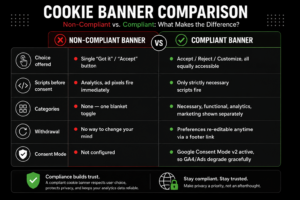
A banner that simply says “We use cookies” is not enough if analytics and marketing scripts still fire immediately on page load. If users are not given a genuine choice before non-essential tracking starts, the setup is difficult to defend.
Fix This Week
Audit what loads before consent. Check whether analytics tags, remarketing tags, or other non-essential scripts are firing before the user has made a choice.
Block non-essential scripts by default until consent is granted. This usually applies to analytics, advertising, retargeting, and similar tools that are not strictly necessary for the site to function.
Fix This Month
Categorize cookies properly. At a minimum, most websites should distinguish between strictly necessary, functional, analytics, and marketing categories.
Replace a static banner with a real consent management setup if needed. That is what allows you to record preferences properly and control scripts based on user choice.
If you rely on Google tools, make sure the implementation supports Consent Mode in a way that aligns tracking behavior with the visitor’s consent state. This helps reduce the common gap between compliance goals and reporting needs.
If your current setup is unclear, a technical review by Element8 or an SEO company in Dubai that understands consent-aware tracking can help you avoid breaking performance reporting while you fix compliance issues.
CRM & Marketing Tools: What to Fix First
A website rarely processes user data in isolation. Most lead data flows into a CRM, marketing automation platform, or other third-party tools within seconds.
That means your compliance exposure does not stop at the form. It extends into the systems that receive, store, enrich, or route that data.
Fix This Month
Confirm which tools receive data from the website. For many businesses this includes HubSpot, Salesforce, Zoho, Mailchimp, Meta, Google, or workflow tools like Zapier.
Check that you have appropriate agreements in place with those vendors and that your team understands where the data is hosted. A platform can be globally popular and still require internal review for your specific use case.
Map your website data flow clearly. A simple diagram from website form to CRM to email automation to reporting tools can reveal hidden data-sharing points that were never reviewed properly.
Fix This Quarter
Review cross-border transfer exposure where relevant. If personal data collected through the site is processed outside the UAE, you should understand what safeguards, vendor terms, and contractual protections are being relied on.
Formalize vendor governance. That means knowing which third parties touch personal data, who approved them, what data they receive, and whether those arrangements are still current.
This is also where website compliance overlaps with security practice. Our enterprise website security checklist is useful alongside this article because access control, vendor review, logging, and data handling rarely sit in separate silos in real operations.
Analytics & Ad Pixels: What to Fix First
Many marketing teams still think of analytics and ad pixels as “just reporting tools,” but they often process identifiers that can be tied back to an individual or device.
That makes analytics configuration a compliance issue, not just a marketing setup issue.
Fix This Week
Audit your tag behavior. Check whether Google Analytics, Meta Pixel, TikTok Pixel, LinkedIn Insight Tag, or other tracking tools are firing before consent is captured.
Inspect Google Tag Manager carefully if you use it. A banner may appear compliant on the front end while tags still load too early underneath.
Fix This Month
Gate analytics and advertising tags behind the appropriate consent state. If a user declines non-essential tracking, those tools should not behave as though consent was granted.
Review whether your analytics setup collects more than you actually need. Data minimization is not just a legal concept. It is a sensible way to reduce unnecessary risk.
Where possible, limit excessive identifier collection and keep the configuration lean. Many websites collect more tracking data than the business genuinely uses.
What Happens If You Do Not Fix This?
The regulatory risk matters, but for many businesses the first visible impact is operational.
A broken consent setup can affect campaign tracking quality, retargeting performance, and trust on high-intent landing pages. A weak form setup can create avoidable retention and governance problems. An unclear CRM flow can leave teams unable to explain where customer data travels after submission.
So even before legal enforcement becomes the board-level concern, poor implementation can already be affecting conversion, reporting reliability, and brand credibility.
That is why this topic should not be treated as a policy-page exercise. It is a live website execution issue.
PDPL vs DIFC vs GDPR: Quick Comparison
| Regime | Typical scope | Website impact |
|---|---|---|
| UAE PDPL | UAE mainland and processing involving personal data in the UAE | Forms, cookies, CRM handling, analytics, consent, retention |
| DIFC Data Protection | DIFC-registered entities | Similar website obligations, but under a distinct legal regime |
| GDPR | EU/EEA-related personal data processing scenarios | Often influences multinational setups, especially if the website serves wider markets |
If your business sits in or serves multiple jurisdictions, do not assume one framework automatically covers the others. That is exactly why our DIFC data protection guide for websites exists as a separate resource.
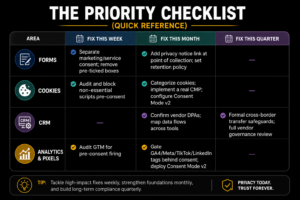
Priority Checklist
| Area | Fix This Week | Fix This Month | Fix This Quarter |
| Forms | Remove pre-ticked boxes, separate marketing consent | Add privacy notice link, define retention handling | Formalize deletion workflow and ownership |
| Cookies | Block non-essential scripts before consent | Categorize cookies and improve consent controls | Review consent logs and governance process |
| CRM | Identify all receiving systems | Check vendor terms, hosting, and data flows | Review transfer safeguards and vendor governance |
| Analytics | Audit pre-consent tag firing | Gate tracking tools by consent state | Reduce unnecessary collection and review controls |
Why This Matters for Element8 Clients
For businesses investing in a high-performing website, compliance fixes should not sit apart from web strategy. Form UX, consent handling, CRM routing, and analytics governance all affect trust, lead quality, and operational clarity.
That is also why these conversations often connect naturally to broader website architecture, hosting, and performance decisions. If you have not read our UAE-region hosting guide, it is a useful companion piece for understanding how compliance, control, and infrastructure choices intersect. And if you are still relying on fragile low-cost setups, our piece on why cheap hosting fails enterprise websites explains why technical shortcuts usually create bigger downstream risk.
For teams comparing implementation partners, the right fit is not just a vendor who can install a cookie banner. It is a team that can make the whole data-collection journey more reliable. That is the difference between a generic fix and a durable solution, and it is part of the work we support through our web development company in Dubai engagements.
For proof of how Element8 approaches high-stakes digital delivery, see our Alef Education case study.
If the site also needs a broader structural refresh, our website redesign without losing SEO checklist is a useful companion to this compliance review.
Conclusion
Most website-level PDPL exposure is not hidden in abstract policy language. It is sitting in forms, cookies, CRM flows, and analytics tags.
If you fix those areas in the right order, you can reduce risk quickly without turning the project into a months-long compliance rebuild. Start with the items that create immediate exposure, then move into vendor review, governance, and longer-term controls.
If you need a practical remediation plan rather than another generic compliance article, Element8 can help you assess what is happening on the live site, what should be fixed first, and how to align compliance work with conversion and performance goals.
FAQs
Does UAE PDPL apply to small businesses and startups?
Yes. If your website processes personal data relating to people in the UAE, the law is still relevant even if your business is small. Website size and company size do not remove the need to review how data is collected and handled.
Do I need a cookie banner if I only use Google Analytics?
In most practical website setups, analytics still needs to be reviewed as a non-essential tracking activity. If the tool sets identifiers or tracks behavior, it should not simply run without considering consent requirements.
Is a privacy policy the same as PDPL compliance?
No. A privacy policy is only one part of the picture. Real compliance also depends on how your forms work, whether cookies are controlled properly, how data moves into your CRM, and how tracking tools behave in practice.
Can I use HubSpot or Salesforce and still be PDPL compliant?
Yes, potentially. The key issue is not the tool name alone. It is how the tool is configured, what data it receives, where that data is processed, and what safeguards and agreements support that use.
How long do I have to fix my website after finding a compliance gap?
That depends on the issue and your legal position, but from a practical standpoint, obvious website-level gaps should be addressed as quickly as possible. The highest-risk form, cookie, and tracking issues are often fixable much faster than teams expect.
Do I need a Data Protection Officer for a small marketing website?
Not automatically. That depends on the scale and nature of the processing activity. It is best treated as a legal and compliance question rather than a web-only question.
What to Fix First If You Only Have One Week
If your team can only tackle a few changes right away, start with the collection points that create the most risk. That usually means forms, consent wording, cookie behavior, and the systems that receive website data after submission.
| Priority | What to Review | Why It Matters |
|---|---|---|
| 1 | Forms and privacy notices | They are the clearest collection points and the easiest place to remove avoidable risk |
| 2 | Cookies and tracking scripts | They can collect identifiers before users have made an informed choice |
| 3 | CRM and third-party routing | They determine where website data actually goes after submission |
| 4 | Retention and access controls | They shape auditability and reduce operational risk |
If you want implementation help, compare this checklist with our enterprise website security guidance and talk to Element8 about the fastest fixes first.