

Why Dubai Businesses Are Moving to UAE-Region AWS & Azure Cloud Infrastructure


For many companies in Dubai, hosting decisions used to revolve around cost. The basic server, the fastest deployment, and a basic shared hosting plan were often considered “good enough.” But that mindset has changed dramatically as businesses rely more heavily on digital platforms to generate leads, process transactions, and build trust with customers.
Today, enterprise organizations across the UAE are prioritizing performance, governance, security, and reliability when choosing hosting infrastructure. As a result, the UAE region hosting on AWS or Azure has become the preferred option for enterprises seeking scalable, secure, and compliant infrastructure.
Whether you’re running a government portal, SaaS platform, financial services application, or a high-traffic e-commerce site, the choice of enterprise website hosting in Dubai can significantly influence search visibility, user trust, and overall operational resilience. In this guide, we explore why enterprises are increasingly investing in UAE cloud hosting and how infrastructure decisions shape performance, compliance, and long-term digital success.
What “UAE-Region Hosting” Actually Means (And What It Doesn’t)
When businesses refer to the UAE region hosting on AWS or Azure in Dubai, they typically mean deploying their applications on cloud infrastructure physically located in the United Arab Emirates.
Major cloud providers now operate local data centers, including:
- AWS UAE region hosting infrastructure
- Azure UAE region hosting, including Azure UAE North and Azure UAE Central
These local cloud regions enable businesses to host their applications physically within the UAE while maintaining the scalability and flexibility of global cloud platforms.
What the UAE Region Hosting Provides
- Data Residency within the UAE
For many enterprises, data residency hosting in the UAE is a strategic requirement. Hosting within local cloud regions helps ensure that sensitive business data remains inside national boundaries, which is particularly important for financial institutions, government agencies, and regulated industries.
- Lower Latency for UAE & GCC Users
Hosting closer to your users significantly reduces network latency. Low-latency hosting in the UAE improves website responsiveness, reduces page load times, and creates a smoother user experience for customers accessing services from Dubai, Abu Dhabi, or the broader GCC.
- Local Infrastructure with Global Scalability
While your workloads run locally, you still benefit from the global cloud ecosystem, advanced monitoring, scalable compute resources, and distributed storage.
What UAE Hosting Does NOT Automatically Guarantee
However, UAE cloud hosting for businesses is not a silver bullet.
Hosting locally does not automatically guarantee:
- Global performance optimization
- Regulatory compliance by default
- Complete privacy protection without correct configuration
Infrastructure must still be properly architected, secured, and monitored to deliver enterprise-grade outcomes.
The Real Reasons Dubai Enterprises Pay Extra for UAE Hosting
For many enterprise organizations, secure website hosting in Dubai is not merely an IT decision—it’s a risk-management and business-continuity strategy.
Reliability & Accountability
Enterprise organizations expect far more than basic uptime.
Modern enterprise hosting Dubai environments include:
- Real-time monitoring and observability
- automated scaling infrastructure
- proactive health checks
- incident response protocols
These capabilities allow teams to detect performance degradation before it impacts customers. Cloud providers also offer defined service-level agreements (SLAs) to ensure operational accountability.
Unlike traditional hosting providers, enterprise cloud infrastructure enables companies to maintain consistent availability even during spikes in traffic or infrastructure failures.
Security Controls That Actually Matter
Security threats targeting websites and cloud platforms continue to evolve rapidly. Enterprises require layered defenses to protect customer data, internal systems, and critical applications.
Enterprise-grade website security hosting UAE typically includes:
- Identity and access management (IAM) controls
- Web Application Firewalls (WAF)
- DDoS protection for hosting the UAE infrastructure
- Centralized logging and monitoring
- Encryption and key management systems
These security capabilities help organizations meet governance requirements while protecting websites against common vulnerabilities, including brute-force attacks, injection exploits, and malicious traffic spikes.
Disaster Recovery That Isn’t a Fantasy
Many companies assume backups alone protect them from disasters. In reality, enterprise resilience requires much more sophisticated recovery planning.
Cloud-based managed cloud hosting Dubai environments typically include:
- automated backup policies
- infrastructure redundancy
- snapshot-based recovery systems
- geographically separated failover options
Organizations must define RPO (Recovery Point Objective) and RTO (Recovery Time Objective) policies to determine how quickly systems can be restored after a failure.
Without these mechanisms, downtime can cause severe financial and reputational damage.
Performance in the UAE (Speed Affects Conversions More Than People Admit)
Website performance plays a crucial role in both user experience and search visibility. Website performance is influenced not only by the hosting location but also by the platform’s development and optimization. Partnering with a professional web development company in Dubai helps businesses implement performance-focused architecture that supports fast load times and improved user experiences.
Large-scale digital platforms require infrastructure capable of maintaining consistent performance even under heavy user demand. For example, Element8 helped build the Swift Teach digital platform, designed to support modern learning experiences with scalable architecture and optimized performance.
When websites are hosted outside the region—often in Europe or Asia—UAE users experience higher latency due to longer network travel times.
Deploying infrastructure in the UAE region, which hosts AWS and Azure in Dubai, significantly reduces this latency.
Why Speed Matters for Business Outcomes
Fast websites contribute to measurable improvements in:
- ecommerce conversion rates
- lead generation form submissions
- user session duration
- bounce rate reduction
- search engine rankings
Search engines increasingly factor performance signals into ranking algorithms. This makes low-latency hosting in the UAE an indirect but meaningful contributor to SEO success.
Even beyond technical metrics, speed influences brand credibility. When a website loads instantly, users perceive the business as more professional and trustworthy.
Want a quick performance and SEO audit of your current website? Element8 can provide a prioritized improvement plan for speed, hosting, and infrastructure.
Data Protection Reality (UAE PDPL + DIFC) — Why Hosting Becomes Strategic
As data privacy regulations evolve, infrastructure decisions are becoming increasingly tied to governance requirements.
The UAE has introduced modern privacy frameworks, including:
- UAE Personal Data Protection Law (PDPL)
- DIFC Data Protection Law
These regulations emphasize the responsible handling of personal data collected from customers, employees, and partners.
Organizations must demonstrate proper governance over how personal information is:
- stored
- processed
- transferred
- protected
This makes cloud hosting for UAE data governance an important consideration.
However, it is important to understand that UAE PDPL-compliant hosting does not occur automatically simply because servers are located in the country.
Compliance requires additional operational controls such as:
- secure data storage policies
- restricted access permissions
- audit trails and logging
- encrypted communication channels
Hosting infrastructure serves as the foundation for governance—but companies must still implement the right security and data management practices.
AWS vs Azure for UAE-Hosted Websites (Enterprise View)
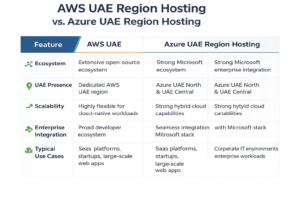
Choosing between AWS and Azure UAE region hosting largely depends on an organization’s existing technology ecosystem, internal expertise, and overall operational priorities.
Below is a simplified enterprise comparison.
When Azure Makes More Sense
Azure UAE region hosting often works best for organizations that rely heavily on Microsoft technologies.
Typical environments include:
- Active Directory-based authentication
- Microsoft SQL Server databases
- enterprise hybrid cloud infrastructure
Azure provides strong integration with existing Microsoft enterprise ecosystems.
When AWS Is a Better Fit
Hosting on AWS in the UAE region is often preferred by companies building cloud-native platforms.
Common scenarios include:
- SaaS platforms
- containerized applications
- open-source stacks
- high-scale digital platforms
AWS offers a vast ecosystem of developer tools and services optimized for flexible application architectures.
Stack-Based Recommendations (WordPress / PHP / Django / Strapi)
Different technology stacks require different hosting strategies to achieve optimal performance and governance. Large organizations often require customized infrastructure to support complex digital platforms. A good example is Element8’s work with Alef Education, where scalable architecture and performance optimization were implemented to support a high-demand education platform used across the UAE.
WordPress
Enterprises running WordPress platforms should consider:
- WordPress hosting on AWS UAE infrastructure
- integrated CDN + WAF protection
- hardened server configurations
- automated backups and staging environments
These safeguards improve performance while reducing security risks.
PHP Applications
Custom PHP platforms benefit from:
- scalable compute instances
- managed database services
- CI/CD pipelines for deployment automation
- strict access control policies
Optimized PHP application hosting in UAE environments allows development teams to release updates safely without downtime.
Python Django
Django applications often require containerized infrastructure.
Recommended setup includes:
- container orchestration platforms
- observability tools for monitoring
- background job processing systems
Cloud-native Django hosting in the UAE cloud environments allows engineering teams to scale workloads dynamically as traffic grows.
Strapi
Headless CMS architectures like Strapi benefit from API-driven hosting environments.
Best practices include:
- Strapi hosting in the UAE with API optimization
- media delivery through CDN
- role-based access control
This architecture supports modern composable digital platforms.
Why “Low-Cost Hosting” Is a Bad Deal for Enterprise Websites
Low-cost hosting may appear attractive initially, but it often creates hidden risks. Slow hosting environments can damage search rankings and user experience. Businesses looking to recover lost visibility often consult a professional SEO company in Dubai to audit technical issues and improve site performance.
Enterprise organizations cannot afford unreliable infrastructure or inconsistent performance. Many companies instead invest in scalable digital platforms built on secure cloud environments. For example, Element8 worked with Al Arabia to deliver a high-performance digital platform designed to support business growth and reliable user experiences.
Common issues include:
- Noisy Neighbor Performance
Shared hosting environments host multiple websites on a single server. Heavy traffic on one site can degrade performance for others.
- Weak Security Controls
Budget hosting providers rarely offer robust security tools such as enterprise WAFs, advanced monitoring, or threat detection.
- Limited Scalability
Traffic spikes during marketing campaigns or peak sales events can overwhelm basic infrastructure.
- Poor Disaster Recovery
Many low-cost providers lack reliable backup systems and recovery planning.
- SEO and Conversion Damage
Slow, unreliable websites directly impact:
- search rankings
- customer trust
- sales performance
In the long term, low-cost hosting often becomes more expensive due to downtime, lost revenue, and reputational risk.
Quick Decision Checklist
Organizations considering the UAE region for hosting AWS Azure in Dubai should evaluate the following scenarios:
- Website downtime directly impacts revenue
- Paid marketing campaigns rely on fast landing pages
- Enterprise-level security requirements exist
- Systems integrate with CRM or ERP platforms
- Website traffic volumes are growing rapidly
- Regulatory expectations require strong governance
If multiple items on this list apply, investing in enterprise hosting in Dubai infrastructure becomes a strategic decision rather than a technical upgrade.
Final Thoughts
For enterprises operating in the UAE, hosting decisions are increasingly tied to performance, governance, and digital competitiveness.
Platforms running on UAE cloud hosting for business infrastructure—whether in the AWS UAE region or the Azure UAE region—benefit from reduced latency, improved reliability, and stronger governance frameworks.
By prioritizing secure website hosting in Dubai, companies can build digital platforms that scale confidently while protecting both user experience and regulatory compliance.
Need an enterprise-grade website that’s fast, secure, and built for SEO? Talk to Element8
FAQs
-
What is the UAE region hosting, and why do businesses in Dubai use it?UAE region hosting refers to hosting websites or applications on cloud infrastructure located within the UAE, such as the AWS UAE region or Azure UAE region. Businesses choose UAE cloud hosting for its improved website speed, reduced latency for local users, support for data residency requirements in the UAE, and better infrastructure reliability for enterprise websites.
-
Is AWS or Azure better for enterprise hosting in the UAE?Both AWS and Azure UAE region hosting offer enterprise-grade infrastructure. AWS is often preferred for cloud-native applications and scalable SaaS platforms, while Azure works well for organizations using Microsoft enterprise ecosystems such as Active Directory, .NET, and Microsoft SQL Server. The best option depends on the organization’s existing technology stack and integration requirements.
-
Does hosting a website in the UAE improve SEO performance?Yes. Low-latency hosting in the UAE improves page load times for local users, positively impacting SEO and user experience. Faster websites typically experience lower bounce rates, higher engagement, and improved conversion rates, making Dubai enterprise website hosting a strategic advantage for businesses targeting customers in the UAE and GCC.
-
Does hosting in the UAE guarantee compliance with UAE data protection laws?Hosting in the UAE helps meet data residency requirements, but it does not automatically guarantee compliance. Organizations must still implement governance practices aligned with regulations such as the UAE Personal Data Protection Law (PDPL) and DIFC data protection frameworks, including encryption, access control, monitoring, and secure data management policies.
-
Why is low-cost hosting risky for enterprise websites in Dubai?Low-cost hosting often lacks the infrastructure required for secure website hosting in Dubai. Common risks include slow performance due to shared servers, weak security protections, limited scalability, and unreliable uptime. For enterprise websites handling high traffic, customer data, or integrated systems, enterprise hosting in Dubai infrastructure provides better reliability, security, and long-term cost efficiency.
-
Does hosting a website in Dubai make it faster for UAE users?Yes. Low-latency hosting in the UAE significantly improves website performance for users in Dubai, Abu Dhabi, and other GCC locations. When websites are hosted locally instead of overseas, page load times decrease, which improves user experience, SEO performance, and conversion rates.
-
Is cloud hosting in the UAE important for data protection and compliance?Yes. UAE cloud hosting for businesses can support compliance with data governance frameworks such as the UAE Personal Data Protection Law (PDPL) and DIFC data protection regulations. Hosting data within the UAE helps organizations maintain better control over data residency and security practices.
-
What type of hosting should enterprises in Dubai choose for high-traffic websites?Enterprises typically choose enterprise hosting in Dubai, on platforms like AWS or Azure in the UAE regions. These cloud platforms provide scalable infrastructure, advanced security controls, WAF and DDoS protection, automated backups, and monitoring systems needed to support high-traffic business websites and applications.