

Website Governance for Large Organizations: Who Should Approve What?
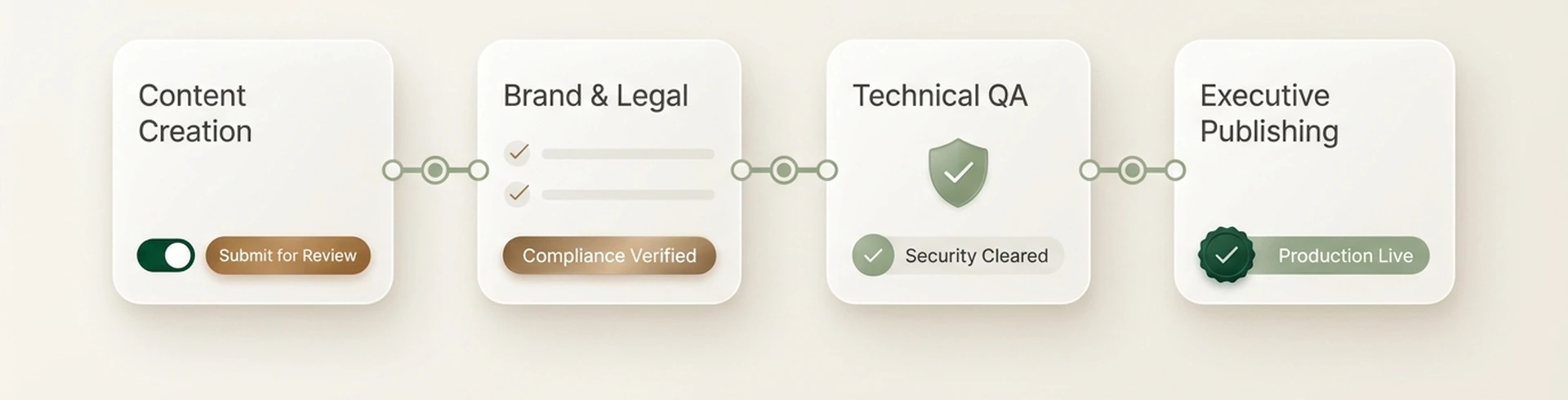


A website governance framework makes decision ownership clear. When a large organisation manages several websites, brands, markets, and delivery partners, decisions can become harder to trace than the work itself. A page change may touch brand standards, accessibility, security, analytics, search visibility, legal review, and a release window. If nobody knows who can decide each issue, teams either wait for a senior committee or make inconsistent choices without the right review.
A website governance framework is the practical system that assigns those decisions, defines the evidence needed, and explains how exceptions are handled. Good governance does not require every edit to travel through the same approval chain. It gives routine work a clear path and reserves deeper review for decisions that can materially affect customers, risk, cost, or the organisation’s reputation.
Website Governance Framework: Scope and Decision Boundaries
Begin by agreeing what the website estate must accomplish. Typical outcomes include consistent brand presentation, reliable publishing, qualified demand, accessible customer journeys, safe handling of information, and controlled operating cost. Then define which properties, languages, regions, platforms, and third-party services are covered. If the boundary is unclear, governance discussions quickly become arguments about who owns a system rather than what decision needs to be made.
Write down the important boundaries: which teams own global standards, which teams own local content, what is centrally managed, and which suppliers operate particular components. A useful inventory records each site’s purpose, audience, business owner, technical owner, content lead, critical integrations, and support route. This is also a sensible starting point for a website brief that aligns stakeholders and delivery teams.
Governance should connect to the organisation’s actual website programme. If a redesign, CMS consolidation, or regional expansion is underway, agree the decision model during discovery. The governance decisions in an enterprise website rebuild affect requirements, migration, ownership, and release planning; leaving them until launch creates avoidable rework.
Map decisions before assigning approvers
A role chart is not a decision model by itself. First list recurring decisions, then identify who proposes, advises, approves, executes, and monitors each one. This avoids the common mistake of naming a large group as “responsible” while leaving the actual decision owner unclear.
Separate decisions by subject. Content owners may approve factual accuracy and tone. Brand leads may review identity, naming, and campaign deviations. Digital product or UX owners may approve journey changes. Technical architecture owners decide platform patterns and integrations. Security, privacy, and legal specialists assess issues within their remit. SEO owners review changes that affect URLs, indexability, structured data, or major templates. A publishing operations lead controls the workflow and confirms required evidence is attached.
For each decision, name one accountable approver or a clearly defined role that can make the call. Advisors should provide input within a stated window; they should not silently become extra approvers. The person implementing the decision should be distinct from the person approving high-risk changes where practical. This separation improves accountability without forcing a committee to inspect every routine task.
WordPress already distinguishes roles and capabilities, including the ability to edit, review, and publish content. Use those permissions as an implementation layer for the organisation’s decision model, not as a substitute for it. The WordPress roles and capabilities guide explains the built-in role model, while the organisation still needs to decide who should receive each capability and why.
Set approval thresholds around impact and risk
Not every change deserves the same control. A typo correction on an established page has a different risk profile from a new lead form, a change to consent language, a URL migration, or a script that sends customer data to another system. Define a small number of change classes and state what review each class requires.
A practical model might allow authorised content owners to publish low-risk corrections after editorial checks. A new landing page may require content, brand, and accessibility review. A new integration, tracking technology, authentication flow, or collection of personal information may require technical and security review, with privacy or legal input where applicable. A major template, domain, or URL change may also require SEO and release approval. These examples are starting points; adapt them to actual policy, regulations, contracts, and customer impact.
Make the thresholds observable. Define the triggers, not vague labels such as “important change.” Triggers might include adding a new data field, changing a canonical URL, introducing a new third-party script, altering a conversion step, publishing a claim that requires substantiation, or changing a shared component used by several sites. Each trigger should point to the required reviewer, evidence, and approval record.
Security controls should follow the principle that access is granted for a defined purpose and reviewed as responsibilities change. The OWASP Authorization Cheat Sheet recommends a deny-by-default approach and checking permissions on each request. For a website programme, translate that into approved role assignments, limited publishing rights, appropriate authentication, and periodic access reviews rather than broad access for convenience.
Choose a central, federated, or hybrid operating model
A central team can maintain shared components, design standards, security controls, and publishing policy. This works well when consistency and risk reduction matter across many properties. Its weakness is capacity: if all content and routine approvals flow through a small central team, local teams may wait or create unofficial workarounds.
A federated model gives business units or regions more authority within shared guardrails. It can better support local knowledge, language, and campaign timing, but only if teams understand the boundaries and have the skills to meet them. Without common standards, similar pages may behave differently, accessibility quality can vary, and reporting becomes difficult to compare.
Many large organisations need a hybrid. Central owners set non-negotiable controls and reusable patterns; local owners manage approved content and market-specific requirements. Define which decisions can be made locally, which need central consultation, and which require central approval. For multilingual sites, align translation with localisation and governance: the Arabic-English website structure for GCC organisations illustrates why content hierarchy, language behaviour, and market ownership need to be decided together.
Make the workflow easy to follow and prove
Document the request, decision, evidence, and release in the same workflow wherever possible. A request should state the goal, affected pages or sites, audience, owner, deadline, dependencies, and risk triggers. Reviewers should be able to see the proposed change, relevant tests, and the decision history without searching through separate email threads.
Define service expectations for each review class. For example, routine content review can have a short response target, while a security or architecture review may need a more detailed intake and a longer window. When a reviewer is unavailable, specify a delegate. When a decision is blocked, explain who can resolve the conflict and what information that person needs. An escalation path should reduce ambiguity, not simply transfer every difficult decision to the most senior executive.
Keep an auditable record: requester, approver, decision date, rationale, conditions, evidence, and any exception expiry. For releases, link the approval to the tested build, rollback plan, and monitoring owner. The WordPress release management workflow shows how staging, quality checks, rollback, and release ownership fit together. If the organisation has a formal statement of work, place governance responsibilities and acceptance requirements in it; see what to include in a website scope of work.
Give vendors clear authority limits
Agencies and platform partners often carry out work but should not be left to infer the organisation’s decision rights. Contracts and delivery plans should identify who can request, approve, implement, and release changes. State which production actions require client approval, which environments vendors can access, how incidents are escalated, and how evidence is handed over.
Set boundaries for shared accounts, credentials, source code, analytics, and customer data. Require named users where feasible, remove access when assignments end, and specify how the organisation receives documentation and operational knowledge. Procurement should test whether proposed governance is realistic: review the website RFP mistakes that lead to weak agency proposals before comparing bids, and make approval responsibilities explicit in the final agreement.
Measure whether governance is helping
Governance is working when teams make sound decisions with less avoidable delay and fewer unowned risks. Track a small set of measures: time from complete request to decision, percentage of changes with named owners and evidence, release failure and rollback rates, overdue access reviews, accessibility defects found after release, and the number of exceptions that remain open past their expiry date.
Interpret the measures together. A fast approval time is not success if defects and emergency rollbacks are rising. A high number of reviews may indicate stronger controls, or it may reveal that the thresholds are too broad. Ask teams where they wait, where they bypass the process, and which decisions are repeatedly reopened. Use these findings to refine the model rather than add more forms by default.
Implementing Your Website Governance Framework
Start with the decisions that have the greatest reach or risk: publishing rights, security-sensitive changes, shared design components, URL and analytics changes, and production releases. Map current owners and failure points. Agree decision classes and escalation routes with the people who will use them. Then configure CMS permissions, forms, documentation, and supplier processes to reflect those decisions.
Pilot the model on a representative group of sites or a live programme. Observe whether routine work moves without unnecessary escalation and whether high-impact changes receive the right scrutiny. Adjust thresholds, response targets, and evidence requirements before expanding. Review the model on a fixed cadence and whenever the organisation changes its platform, brands, regional structure, or risk profile.
For a governance review, bring together the website inventory, current user roles, approval records, release process, vendor responsibilities, and a sample of recent changes. Element8 can help large organisations map decision rights to their website estate, identify unclear ownership, and turn the findings into a practical operating model for teams and suppliers. Speak with our team about your website governance requirements.
Frequently asked questions
What is website governance for a large organisation?
It is the operating model for deciding who owns website standards, content, access, risk reviews, releases, and exceptions across the organisation’s sites and teams.
Who should approve website changes?
The approver depends on the change’s impact. Content owners can handle routine edits, while changes affecting security, privacy, accessibility, brand, SEO, integrations, or shared templates should receive review from the relevant accountable owner.
How can website governance avoid slowing publishing?
Use clear risk-based change classes, delegate routine decisions to trained owners, set response targets, and reserve central approval for changes that cross agreed thresholds.
How often should website governance be reviewed?
Review it on a regular schedule and after significant changes to the organisation, website estate, platform, suppliers, markets, or risk profile.
What should a website governance policy include?
It should define scope, decision rights, approval thresholds, roles, publishing permissions, evidence and recordkeeping, escalation paths, exception handling, review cadence, and ownership of shared standards.