

How to Redesign a Website Without Losing SEO: 2026 Checklist



Yes, you can complete a website redesign without losing SEO — but only if search visibility is treated as a launch requirement, not an afterthought. Protecting your rankings comes down to four disciplines: auditing what currently ranks, mapping and 301-redirecting every URL, preserving high-performing content, and monitoring closely after go-live.
TLDR: A website redesign can affect SEO if URLs, content, internal links, metadata, canonicals, redirects, or crawl settings change without a clear migration plan. To redesign without losing traffic, audit the current site, protect top-performing pages, map every important URL, set up 301 redirects, preserve search-focused content, test before launch, and monitor Google Search Console after go-live.
Redesigning a website is necessary for businesses that want to improve user experience, update their brand, or adopt modern technologies. However, one of the biggest concerns for businesses has always been losing SEO rankings, organic traffic, and leads in the process. Many businesses begin this journey by evaluating professional website design services to modernize their digital presence and improve performance.
That fear is not unfounded. Many companies experience a sudden drop in search rankings after launching a redesigned website due to broken URLs, missing redirects, poor site structure, or lost content. The good news: SEO losses during a website redesign are not inevitable. With proper planning, technical SEO implementation, and a strategy-driven approach, a redesign can actually improve your search visibility.
In this guide, we explain how a website redesign affects SEO, walk through a step-by-step website redesign SEO checklist, and share the best practices we use on enterprise redesign projects — including what matters for businesses in Dubai and the wider UAE.
Does a Website Redesign Affect SEO?
Yes — a website redesign can affect SEO both positively and negatively. It offers a golden opportunity to boost long-term rankings through improved user experience, cleaner architecture, and faster load times, but it also carries the risk of a sharp, temporary drop in traffic — sometimes between 20–50% — if the technical migration is handled poorly.
Search engines rely on consistent signals such as URL structure, content relevance, and internal linking to rank your site, so any sudden shift can disrupt how your brand is indexed. If the transition is not managed carefully, businesses often face several critical setbacks:
- Broken link equity: Changing URLs without mapping them correctly “breaks” your existing backlinks, causing you to lose years of built-up authority.
- Loss of keyword relevance: Deleting or heavily rewriting high-performing content can cause your pages to disappear from Google results entirely.
- Crawlability issues: Complex new designs or restructured navigation can make it difficult for search engine bots to find and index your most important pages.
- Performance dips: A heavy, unoptimized new design can slow page load times, triggering a penalty in search rankings.
None of these are inevitable. A successful migration simply needs to integrate SEO into the process from day one — audit and preserve your top pages, master the 301 redirect map, test everything in a staging environment, and monitor Google Search Console closely after launch. Each of these is covered in detail below.
When Is It Time to Redesign Your Website?
A website redesign is more than a “digital coat of paint.” In an era where user expectations transform at lightning speed, your website should serve as a high-performance engine for business growth. While aesthetics matter, the decision to redesign should be driven by performance data, security needs, and user experience.
Generally, a website remains competitive for 2 to 5 years. Depending on your industry, that timeline can shift:
- Tech & e-commerce: Every 18–24 months to keep up with rapid innovations.
- SMEs: Typically every 2–3 years.
- Stable sectors: Every 3–5 years.
Here are the critical indicators that it’s time for a strategic overhaul of your digital presence.
1. Declining Performance & Conversion Rates
If you are seeing healthy traffic but your lead generation has stalled, your website is failing its primary mission. High bounce rates and low conversion rates often signal that visitors are frustrated or confused.
- The fix: A redesign focused on Conversion Rate Optimization (CRO), streamlining the user journey and clarifying your calls to action (CTAs).
2. A “Mobile-Second” Experience
With mobile users now making up the majority of web traffic, “mobile-friendly” is no longer enough. If your site is difficult to navigate on a smartphone or fails to adapt to different screen sizes, you are losing both customers and SEO rankings.
- The impact: Search engines prioritize mobile-responsive sites; a poor mobile experience directly correlates to lower search visibility.
3. Technical Debt and Slow Load Times
Outdated code, broken links, and bloated plugins don’t just annoy users — they are security risks. If your site feels sluggish or fails to meet Core Web Vitals benchmarks, it’s time for a technical refresh.
- The warning sign: If you can’t update a simple blog post without specialized IT help, your current Content Management System (CMS) is a bottleneck to your growth.
4. Your Brand Has Outgrown Its Shell
Businesses are dynamic. If you have expanded your services, entered new markets, or undergone a total rebrand, your website should be the first place that reflects this evolution.
- Credibility gap: An outdated aesthetic can make your brand appear inferior to competitors, even if your services are superior. A redesign aligns your digital identity with your current market position.
5. Poor Usability & Navigation
If visitors cannot find what they need within seconds, they will leave. Confusing navigation and disorganized page structures are “silent killers” of user retention.
- The goal: A redesign allows you to rethink your information architecture, ensuring that the user’s path from landing page to checkout is frictionless.
A redesign is an investment in your brand’s future. If your website is no longer meeting your business goals or feels like a liability rather than an asset, it’s time to evolve.
Key SEO Elements Affected During a Redesign
- URL structure: Changing page URLs without proper redirects can result in broken links and lost rankings.
- Content structure: Removing or significantly modifying existing content can affect keyword relevance and rankings.
- Internal linking: Changes in navigation or internal links can alter how search engines crawl and understand your website.
- Crawlability and indexing: Technical errors during redesign may prevent search engines from properly crawling the new website.
- Website performance: A redesign often improves page speed and Core Web Vitals, which can positively impact SEO.
SEO Considerations for a Website Redesign: Pre-Launch Planning
A successful website redesign starts long before the first wireframe is drawn. Without a strategic SEO roadmap, you risk discarding years of search equity and “link juice” that your brand has worked hard to build.
Many redesign projects require coordination between SEO experts, designers, and teams providing website development services to ensure that the new site structure supports both performance and search visibility.
From our experience managing website redesign and migration projects for growing businesses, early SEO planning is one of the most critical factors in protecting rankings during a redesign.
Conduct a Full SEO Audit
Analyze the existing website to understand:
- current rankings
- organic traffic
- backlink profile
- top-performing pages
Benchmark Current SEO Performance
Before redesigning your website, record key metrics such as:
- organic traffic
- keyword rankings
- conversion rates
- page performance
Crawl the Existing Website
Use SEO crawling tools to map all existing URLs so nothing is lost in the transition.
Identify Top-Performing Pages
Focus on protecting pages that generate strong traffic, conversions, and backlinks — these are the assets your migration plan must preserve.
How to Redesign a Website Without Losing SEO
Redesigning a website without sacrificing your hard-earned rankings needs a structured, SEO-first approach. By combining technical planning with content preservation, you can launch a modern site that protects your current search equity while paving the way for future growth.
A successful SEO-friendly redesign ensures that search engines can easily navigate your new structure while maintaining the “link juice” that keeps you on the first page.
Pre-Redesign SEO Preparation
Before starting the redesign, it is important to build a clear SEO migration strategy.
- Perform an SEO audit: Analyze your current site’s technical health and keyword rankings. Use Google Search Console to identify your “VIP” pages — those that drive the most traffic, conversions, and high-value backlinks.
- Map existing URLs: Use tools like Screaming Frog to create a master list of every active URL. This list is your insurance policy; it ensures no page is accidentally deleted or forgotten during the transition.
- Identify keyword targets: Ensure every important page has a clear keyword target. If a page is already ranking well, carry over its existing title tags, meta descriptions, and header structure (H1–H6) to the new site.
- Full data backup: Always keep a complete backup of your old site’s content and data. If something goes wrong post-launch, you’ll need this reference to restore missing information.
If you’re planning a redesign, working with experienced website redesign services can help ensure your new site improves performance while preserving existing SEO rankings and organic traffic.
SEO-First Website Redesign Process
The redesign process should align SEO strategy with UX improvements.
- Keyword mapping: Ensure existing keywords are mapped to new pages, so no ranking page loses its target.
- Content preservation: High-performing content should be preserved and improved, never discarded for aesthetics alone.
- UX and SEO alignment: The new website should balance user experience with search optimization — the two reinforce each other when planned together.
Technical SEO During a Website Redesign
Technical SEO plays a critical role in preventing ranking losses during a website redesign. Even small technical mistakes during migration can lead to indexing issues, broken pages, or significant drops in organic traffic.
Implement 301 Redirects
One of the most important steps during a redesign is setting up proper 301 redirects. If page URLs change, redirecting the old URLs to their new equivalents ensures both users and search engines are directed to the correct pages. Without proper redirects, search engines may treat new pages as entirely different content, resulting in lost rankings and traffic.
Preserve Canonical Tags
Canonical tags help search engines understand which version of a page should be indexed. During a redesign, canonical tags must be reviewed and updated to avoid duplicate content issues and ensure that the correct pages retain their SEO value.
Update the XML Sitemap
After launching the redesigned website, the XML sitemap should be updated to reflect the new structure of the site. Submitting the updated sitemap through Google Search Console helps search engines discover and index the new pages faster.
Review Robots.txt
The robots.txt file should be carefully checked during migration to ensure that important pages are not accidentally blocked from search engines. It is common for staging environments to block crawlers, so these restrictions must be removed before the new website goes live.
Improve Page Speed and Core Web Vitals
A redesign offers a great opportunity to improve technical performance. Optimizing images, reducing code bloat, improving server response times, and implementing modern frameworks can significantly improve Core Web Vitals — important ranking signals for search engines.
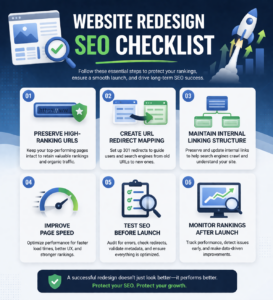
Website Redesign SEO Checklist
Use this website redesign SEO checklist to keep the migration on track from planning through post-launch monitoring.
Before the redesign:
- Conduct a full SEO audit of the existing website.
- Benchmark organic traffic, rankings, and conversions.
- Crawl and export a master list of all existing URLs.
- Identify and protect high-performing pages and backlinks.
During the redesign:
- Map existing URLs to the new site structure.
- Prepare 301 redirects for every changed URL.
- Preserve important content, metadata, and keyword relevance.
- Rebuild internal links to point directly at new URLs.
At launch:
- Remove staging “noindex” tags and robots.txt blocks.
- Verify canonical tags and structured data.
- Submit the updated XML sitemap in Google Search Console.
- Test crawlability, mobile experience, and page speed.
After launch:
- Monitor rankings, traffic, 404 errors, and indexing daily for the first weeks.
- Fix redirect chains and broken links as they surface.
- Compare performance against your pre-redesign benchmarks.
Website Redesign Best Practices for Modern SEO
A successful redesign in 2026 demands more than a fresh look; it requires a strategy that aligns with evolving search technologies and changing user behaviors. Modern websites must be fast, secure, and structured to thrive in an era of AI-driven search and diverse device usage.
By integrating performance-first development with advanced optimization techniques, businesses can ensure their new site is a high-ranking asset for years to come.
High-Performance Architectures: Headless & Beyond
To achieve the speed and flexibility required for modern SEO, many organizations are moving away from traditional, “monolithic” setups in favor of decoupled architectures.
- Headless WordPress development: This approach separates the front-end presentation layer from the back-end content management. The result is a lightning-fast user experience with the familiar ease of the WordPress CMS.
- Scalable headless solutions (Strapi): For businesses requiring ultimate customization, Strapi development offers a scalable way to deliver content via APIs. This ensures websites are faster, more secure, and capable of providing seamless digital experiences across any platform.
Optimizing for the AI Era: AEO & GEO
Traditional keyword stuffing is obsolete. Today, content must be structured for Answer Engine Optimization (AEO) and Generative Engine Optimization (GEO).
- AEO (Answer Engine Optimization): Search engines now prioritize “zero-click” results. By structuring your content to provide clear, concise answers to specific user queries, you increase your chances of appearing in featured snippets.
- GEO (Generative Engine Optimization): As AI-powered search tools become mainstream, they increasingly rely on authoritative, well-structured data. A redesign is the perfect time to implement schema markup and structured data to help AI engines interpret your content accurately.
The Pillar of Credibility: E-E-A-T
Google’s evaluation of content quality centers on E-E-A-T (Experience, Expertise, Authoritativeness, and Trust). Your redesign should make these signals obvious:
- Experience & expertise: Showcase detailed case studies, author bios, and deep-dive technical insights.
- Authoritativeness & trust: Ensure your site architecture highlights reviews, certifications, and secure, transparent business information.
Technical Design Best Practices
To complement your content strategy, your technical foundation must be flawless:
- Logical header structure: Use a clear hierarchy (H1 → H2 → H3) so users and search bots can skim and understand your page’s purpose.
- Media optimization: Use lazy loading and modern image formats (like WebP) to keep page load times under 2 seconds.
- Internal link integrity: Don’t just rely on redirects; update your site’s internal navigation to point directly to new URLs, minimizing the number of “hops” for the crawler.
Website Redesign SEO in Dubai & the UAE: What’s Different?
The fundamentals of an SEO-safe redesign are universal, but enterprise redesigns in the UAE add a few considerations that global checklists often miss. In our experience delivering enterprise redesigns for organizations in Dubai and across the GCC, these are the areas that most often protect — or quietly erode — regional rankings:
- Bilingual content parity: Most UAE enterprise sites run English and Arabic versions. Every Arabic URL needs the same redirect mapping discipline as its English counterpart, and RTL templates must be rebuilt without breaking heading hierarchy or internal links.
- Hreflang and regional targeting: If you operate country versions (for example, UAE and KSA sites), hreflang tags and regional targeting must be carried over precisely, or you risk the wrong version ranking on google.ae after launch.
- Performance for Gulf users: Hosting location and CDN coverage in the region directly affect Core Web Vitals for your primary audience. A redesign is the right moment to fix latency for UAE and GCC visitors.
- Compliance without SEO side effects: UAE data protection (PDPL) consent banners and third-party scripts should be implemented so they don’t block rendering or drag down page speed scores.
- Stakeholder-heavy timelines: Government and enterprise redesigns involve longer approval cycles. Freeze URL structures and metadata early so late-stage content changes don’t invalidate your redirect map.
Treat these as an extension of the core checklist above — the same principles, applied to a multilingual, multi-market context.
Website Redesign Timeline & Cost
Businesses often ask two key questions when planning a redesign.
For a broader pricing breakdown, see our guide to website design cost in Dubai.
How Long Does a Website Redesign Take?
The timeline depends on:
- website size
- design complexity
- development requirements
- SEO migration planning
What Influences Website Redesign Cost?
Several factors impact website redesign costs, including:
- custom design
- development complexity
- CMS migration
- SEO planning
For a detailed breakdown of build budgets in the UAE market, see our guide to website development cost in Dubai. SEO-focused redesigns typically deliver better long-term ROI by protecting existing traffic and improving performance.
Benefits of an SEO-Focused Website Redesign
When SEO is integrated into the redesign process, businesses gain several strategic advantages beyond improved rankings.
- Improved search rankings: A well-planned redesign improves site architecture, internal linking, and content structure. These improvements help search engines better understand the website, which can lead to higher rankings for important keywords.
- Higher quality traffic: Optimizing the website during the redesign process helps target the right search intent. As a result, businesses attract visitors who are actively searching for their services or solutions.
- Better user experience: Redesigning the website often improves navigation, layout, and usability. These improvements reduce bounce rates, increase engagement, and encourage users to spend more time on the website.
- Increased conversions: A modern website design combined with optimized user journeys can significantly improve lead generation and conversion rates.
- Long-term digital growth: An SEO-focused redesign creates a strong foundation for long-term digital marketing success. Businesses can build new content, improve search visibility, and scale their digital presence more effectively.
Common Website Redesign Mistakes That Destroy SEO
Even with the best intentions, a website redesign can backfire if SEO isn’t at the forefront of the technical execution. At Element8, we’ve seen that the difference between a traffic surge and a ranking collapse often comes down to a few overlooked technical details.
To ensure your new site delivers a high return on investment, avoid these critical mistakes that frequently derail redesign projects.
The “Redirect Ghost”: Launching Without 301 Mapping
Perhaps the most damaging error is changing URL structures without setting up 301 redirects.
- The consequence: When you move a page from URL-A to URL-B without a permanent redirect, search engines see a “404 Not Found” error. This immediately kills your ranking and severs the link equity (the “SEO juice”) you’ve built up over the years.
- The fix: Create a comprehensive redirect map that accounts for every single old URL before the new site goes live.
The Invisible Launch: Forgetting “Noindex” Tags
During development, it is standard practice to use robots.txt or “noindex” tags to block crawlers from indexing your staging site.
- The consequence: If these tags aren’t removed upon launch, your brand-new website will be invisible to search engines. We’ve seen businesses wonder why their traffic plummeted to zero, only to find their developers accidentally left the “Search Engine Visibility” box checked.
- The fix: Conduct a post-launch technical audit to ensure your site is fully crawlable.
Deleting Your “Star” Content
In the quest for a “cleaner” or more “minimalist” look, businesses often delete old blog posts or condense text-heavy service pages.
- The consequence: If those pages were your primary source of organic traffic, deleting them is like closing your store’s front door. Significant changes to keyword-rich content can cause your rankings to vanish overnight.
- The fix: Use your pre-redesign audit to identify high-performing content and ensure it is either preserved or improved upon, rather than discarded.
Ignoring the “Mobile-First” Reality
A design that looks stunning on a 27-inch monitor but fails on a 6-inch smartphone is a failure in Google’s eyes.
- The consequence: Because Google uses mobile-first indexing, if your new site is slow, clunky, or non-responsive on mobile, your desktop rankings will suffer as well.
- The fix: Prioritize mobile usability and load speeds during the design phase, not as an afterthought.
Technical Bloat and Slow Load Times
High-resolution hero images and complex JavaScript animations can make a site look “modern,” but they often lead to technical debt.
- The consequence: Large, unoptimized assets increase load times. If your page takes more than 2 seconds to load, bounce rates will spike, and search engines will penalize your performance scores.
- The fix: Optimize all media, use lazy loading, and minimize heavy code to keep the site lean and fast.
Redesign “Don’ts” Checklist
- Don’t change internal link structures without updating navigation paths.
- Don’t neglect your metadata; ensure optimized title tags and H1s are carried over.
- Don’t launch without a final performance test in a live staging environment.
Expert insight: A redesign should be a step forward, not a reset. By avoiding these common pitfalls, you ensure that your website’s new look is backed by a technical foundation that search engines love.
Why Element8 Is the Strategic Choice for Website Redesign & SEO
Redesigning a website without losing SEO requires a strategy-led approach that integrates SEO, UX, and performance optimization.
Businesses planning a redesign often benefit from professional website redesign services that combine design expertise with technical SEO knowledge.
At Element8, every redesign is approached with an SEO-first mindset, ensuring that your existing search authority is protected while unlocking new growth opportunities. From the earliest wireframing stage, key elements such as URL structures, metadata, and content hierarchy are carefully maintained and enhanced. Through structured 301 redirects and content integrity checks, the transition safeguards your rankings and ensures continuity in organic visibility.
Beyond strategy, Element8 focuses on building a strong technical foundation that aligns with modern search engine requirements. With performance now a key ranking factor, the team develops fast, scalable websites using clean code practices and advanced architectures like headless CMS. This ensures optimal Core Web Vitals performance and seamless user experiences across devices. Every design decision is backed by real user data, allowing for refined user journeys that eliminate friction and improve conversion rates, turning traffic into measurable business results.
What truly sets Element8 apart is its future-ready approach and end-to-end migration management — proven on enterprise redesigns for organizations in Dubai, the UAE, and across the GCC. Websites are built to scale, allowing easy integration of new technologies such as AEO and GEO while adapting to evolving digital trends. During the critical go-live phase, continuous monitoring through tools like Google Search Console ensures that indexing and performance issues are resolved in real time. The result is not just a redesigned website, but a high-performance digital asset that strengthens your search presence, supports long-term growth, and delivers sustained competitive advantage.
Conclusion
A successful website redesign should not only improve design but also strengthen SEO performance, ensuring that businesses retain their existing rankings while creating new opportunities for growth.
A website redesign is an opportunity to improve your brand, user experience, and digital performance. However, without proper planning — the audit, the URL map, the redirects, and the post-launch monitoring covered in this checklist — it can result in lost rankings and traffic.
Planning a website redesign? Integrating professional SEO services from auditing and strategy to development and launch can help ensure your new website preserves rankings and supports long-term digital growth.
If you’re planning an enterprise redesign in Dubai or anywhere in the UAE, talk to Element8’s team for an SEO-first migration plan tailored to your site.
FAQs
Does a website redesign affect SEO rankings?
Yes. A website redesign can affect SEO rankings if URLs, content, or technical elements change without proper planning. However, with a full audit, correct 301 redirects, and content preservation, rankings can be maintained — and often improved thanks to better architecture and faster performance.
How can I redesign my website without losing SEO traffic?
You can preserve SEO traffic by performing a full SEO audit, mapping existing URLs, implementing proper 301 redirects, maintaining content relevance, and testing technical SEO in a staging environment before launch. Close monitoring in Google Search Console during the first weeks after go-live is equally important.
What is a website redesign SEO checklist?
A website redesign SEO checklist covers tasks across four phases: auditing and benchmarking before the redesign, URL mapping and redirect preparation during it, removing noindex tags and submitting sitemaps at launch, and monitoring rankings, 404s, and indexing after launch.
How long does an SEO-friendly website redesign take?
The timeline depends on the complexity of the project, website size, and development requirements. Smaller websites may take weeks, while large enterprise or multilingual websites can take several months, particularly when SEO migration planning and stakeholder approvals are involved.
How much does a website redesign cost with SEO?
Costs vary depending on design complexity, development work, SEO strategy, and content requirements. SEO-focused redesigns typically deliver stronger long-term ROI because they protect existing traffic. For UAE market benchmarks, see our guides on website design and development costs in Dubai.
What SEO considerations are important during a website redesign?
Important SEO considerations include preserving high-ranking pages, implementing 301 redirects, maintaining internal linking, optimizing site structure, and improving page speed. For UAE businesses, bilingual English–Arabic URL mapping and hreflang continuity are additional priorities.