
Real Estate Website Design Dubai: Guide for Developers & Brokers
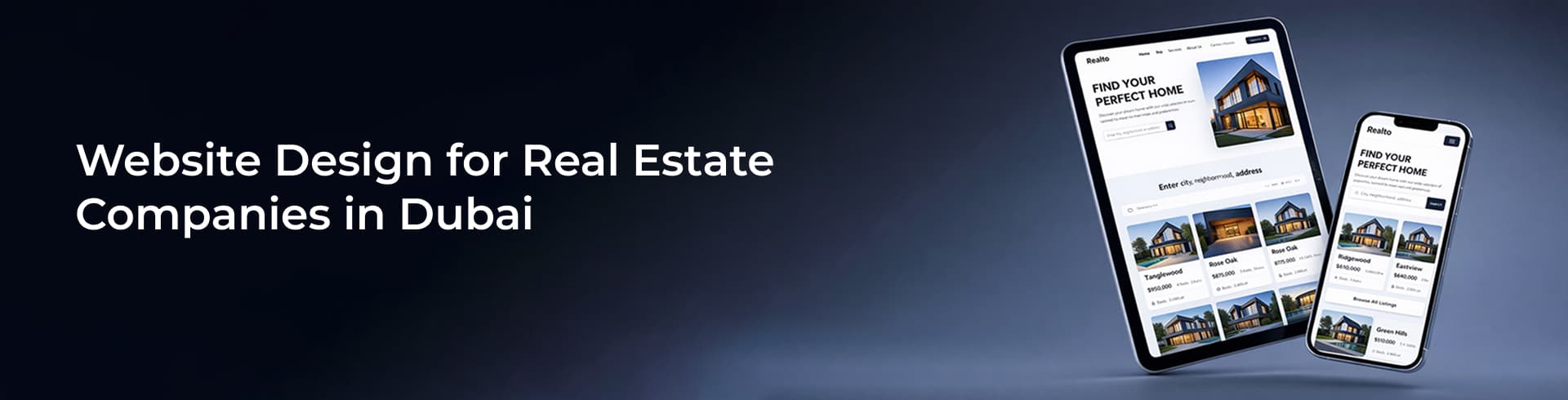


Real estate website design in Dubai is no longer about producing a branded brochure site — it is about building a live sales platform for your projects. A high-performing real estate website combines a scalable listing engine, CRM-connected lead capture, Arabic-English UX, and campaign-ready landing pages that convert both local and international buyers. For major developers and large property groups, a weak site does not just reduce enquiries; it slows campaign execution, fragments lead data, and creates inconsistency across projects, portals, and sales teams.
TLDR: Real estate website design in Dubai should help developers, brokers, and property brands turn project interest into qualified enquiries. A strong property website needs fast mobile UX, advanced search, CRM-connected forms, Arabic-English content, clear project pages, map-based discovery, WhatsApp or call options, and SEO-friendly structure for local and international buyers.
A modern real estate & property website design in Dubai strategy should therefore be treated as platform architecture, not decorative design. Enterprise real estate websites in Dubai need to handle listing scale, off-plan inventory, CRM workflows, bilingual content, performance under campaign traffic, and the expectations of local and international investors evaluating high-value developments.
Why Real Estate Companies in Dubai Need Professional Website Design
For enterprise real estate brands in Dubai, the question is not whether a website should look premium. It is whether the platform can support complex commercial operations without creating friction for buyers or internal teams.
- Trust at project scale
Large developers and master-planned communities need a digital presence that reflects institutional credibility across multiple projects, investor audiences, and sales touchpoints. - Lead capture with routing logic
Enterprise platforms should do more than collect forms. They should route leads by project, geography, budget, language, and sales stage into the right CRM or internal team. - Support for off-plan and multi-project portfolios
Developers often market multiple communities, towers, or phases at once. The website should make those assets easy to navigate without turning into a cluttered catalogue. - Integration with CRM and portal ecosystems
Real estate teams in Dubai often rely on HubSpot, Zoho, Salesforce, Property Finder feeds, Bayut workflows, or custom sales environments. The website must fit that operating model cleanly. - Performance across paid and organic traffic
Project launches, campaigns, and media pushes can create sudden traffic spikes. Enterprise platforms need stable performance, fast mobile rendering, and structured landing-page architecture.
Essential Features of Property Listing Website Design in Dubai
For enterprise developers, the required feature set is less about novelty and more about operational usefulness.
- Advanced search and project filtering
Users should be able to filter by project, community, property type, status, bedroom count, price band, handover timeline, and investor-oriented criteria such as yield potential or payment-plan structure. - Immersive property and project viewing
High-resolution galleries, interactive floor plans, drone footage, 3D walkthroughs, and masterplan views are essential when marketing premium developments or off-plan inventory to overseas buyers. - Map-based discovery
Interactive maps should help users understand project location, nearby infrastructure, landmarks, schools, and accessibility rather than simply pinning an address. UAE buyers are already accustomed to map-led search on the major property portals, so developer and brokerage sites that offer the same map-first discovery keep users engaged on their own platform. - Arabic and English delivery
Bilingual support should include proper RTL behavior, localized navigation, translated project content, and form handling that works smoothly for both audiences. - CRM, ERP, and portal integration
Enterprise websites should sync enquiry data into the sales stack, connect with campaign systems, and support listing updates without forcing manual duplication across teams. - Lead qualification tools
Mortgage calculators, brochure downloads, callback requests, appointment booking, and investor enquiry forms can help segment intent before a sales rep gets involved.
How to Design a Real Estate Website in Dubai (Step-by-Step)
The process should be treated as enterprise platform planning, not basic website setup.
- Define the business model and project structure
Start by identifying whether the platform serves a single flagship development, a portfolio of projects, or a broader corporate real estate group. This affects navigation, data structure, and lead routing. - Map integrations early
Before design begins, define how the site will connect with CRM tools, listing feeds, analytics platforms, WhatsApp workflows, and internal reporting systems. - Choose a scalable platform architecture
Depending on the volume of listings and integration complexity, the right solution may be WordPress, a more customized CMS build delivered by an experienced web development company in Dubai, or a decoupled architecture designed for larger real estate ecosystems. - Design for campaign conversion and browsing
Enterprise real estate sites need to support both high-intent landing pages and broader project discovery journeys. The UI should work for launch campaigns, investor research, and repeat visits. - Build multilingual SEO and content structure
Instead of targeting only generic search terms, the content model should support project pages, community pages, Arabic equivalents, downloadable assets, and structured search visibility — ideally planned with an SEO company in Dubai that understands bilingual keyword demand in the UAE market. - Test real workflows before launch
QA should cover form routing, CRM sync, listing updates, mobile performance, Arabic rendering, redirect behavior, and analytics tracking before traffic is pushed to the site.
If the project is part of a wider brand or corporate website upgrade, working with a web design company in Dubai helps connect real estate UX, lead generation, content structure, and technical SEO from the start.
Cost of Real Estate Website Design in Dubai
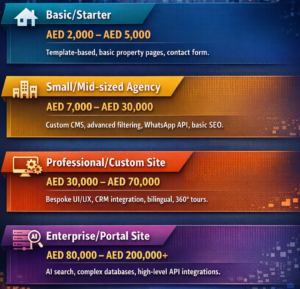
The cost of a real estate website in Dubai depends less on visual design alone and more on platform complexity, integration depth, and operational requirements. For enterprise teams, the real question is not “what does a website cost?” but “what level of platform is required to support project marketing, lead management, and long-term scalability?”
In practice, costs vary based on:
- number of projects or listings managed
- CRM and third-party integrations
- bilingual content requirements
- interactive map and search capabilities
- 3D media and floor-plan experiences
- hosting, security, and support expectations
- custom dashboards, permissions, or internal workflows
For larger developers, a better budgeting lens is total cost of ownership: initial build, integration work, content operations, hosting, maintenance, performance optimization, and future rollout of additional developments or landing pages.
Real Estate Website Design Trends Dubai (2026)
While real estate website design trends still matter, enterprise real estate brands in Dubai should prioritize the shifts that affect conversion, operations, and buyer confidence.
- Off-plan experience design
Dedicated project hubs with floor plans, construction updates, amenities, and payment-plan information are becoming standard for major launches. - Performance-led media delivery
Rich visuals remain important, but they now need to be delivered without compromising Core Web Vitals or mobile responsiveness. - Smarter search and personalization
Recommendation logic, saved preferences, and better filtering can improve discovery across larger property portfolios. - Data transparency
Buyers increasingly expect clearer information on unit types, project status, location context, and downloadable sales material. - Integrated enquiry flows
Platforms are moving away from generic contact forms toward structured lead journeys that connect directly with sales teams and follow-up systems.
Mobile-Friendly Real Estate Websites in Dubai: Why UX Matters
In Dubai, mobile UX is not just about convenience. It shapes discoverability, campaign performance, and lead quality. Many prospects first encounter a development through paid media, organic search, WhatsApp sharing, or property portal referrals on mobile devices.
For enterprise real estate platforms, strong UI/UX design should make it easy to move from interest to action: browse a project, review floor plans, request a brochure, book a viewing, or submit an enquiry without friction. If those journeys break on mobile, conversion efficiency drops across the entire marketing funnel.
How to Choose the Best Real Estate Website Design Company in Dubai
Whether you are shortlisting a specialist Dubai real estate web design company or a broader digital agency, vendor selection should be framed around delivery capability rather than generic creativity.
- Real estate platform experience
The partner should understand developer-led sales models, off-plan launches, multi-project navigation, and the difference between a simple broker site and a scalable real estate platform. - Integration capability
A capable real estate website development company should be able to handle CRM connections, property portal sync, analytics setup, and custom lead-routing logic. - Bilingual execution quality
Arabic support should go beyond translation. The agency should be able to deliver proper RTL layouts, localized UX, and content governance for both languages. - Performance and SEO discipline
The site should be built for speed, indexing, structured content, and campaign landing-page growth, not just visual impact. - Long-term scalability
Enterprise teams need a partner that can support new launches, project additions, maintenance, security, and future platform evolution — real estate website solutions should grow with the portfolio, not be rebuilt for every launch.
Why Choose Element8?
As a web design company in Dubai, Element8 helps real estate brands build platforms that do more than present listings attractively. We design digital ecosystems that support project marketing, multilingual delivery, CRM integration, lead capture, and the performance standards expected by high-value property buyers in the UAE.
For developers and enterprise real estate groups, that means combining premium UI/UX with scalable architecture, conversion-focused landing pages, and the technical infrastructure needed to manage campaigns, listings, and buyer journeys across multiple projects.
FAQs
What is an enterprise real estate website platform?
It is a real estate website built to support multiple projects, structured listings, multilingual delivery, lead routing, CRM integration, and campaign-scale performance rather than functioning as a simple brochure site.
How is a developer website different from a broker website?
A developer platform usually needs to manage off-plan inventory, project storytelling, investor communication, downloadable sales assets, and multi-project navigation. A broker site is typically narrower and more listing-led.
What integrations should a real estate website in Dubai support?
Most enterprise platforms should be ready for CRM integration, portal feeds, analytics, WhatsApp workflows, brochure capture, and in some cases internal reporting or ERP-connected processes.
Which real estate portals have advanced map search features in the UAE?
Major UAE portals such as Property Finder, Bayut, and Dubizzle offer map-based property search alongside filters for community, price, and property type. Developer and brokerage websites are increasingly bringing similar map-led discovery in-house so buyers can explore projects and nearby infrastructure without leaving the brand’s own platform.
Should you choose a custom real estate website or a template?
Templates can work for small broker sites, but developers and enterprise brokerages usually outgrow them quickly. Custom real estate web design supports tailored search, project hubs, CRM routing, bilingual UX, and portal integrations — avoiding the performance and flexibility limits generic property templates impose at scale.
What affects the cost of an enterprise real estate website?
The main factors are project volume, custom search and filtering, multilingual content, third-party integrations, media complexity, hosting requirements, and the level of ongoing support.
Why is bilingual UX important in Dubai real estate?
Because enterprise real estate brands often market to both Arabic- and English-speaking audiences. Strong bilingual UX improves credibility, accessibility, and conversion across investor and end-user segments.
Planning a new property platform or a redesign? Talk to Element8’s Dubai team for a practical review of your current site, integrations, and conversion journeys.