

SEO in Dubai (2026): What Actually Drives Qualified Leads


Ranking alone is not the benchmark for SEO success. For most UAE businesses, the real objective is not traffic; it is a qualified pipeline that brings in the right audience, a stronger client fit, and consistent inbound opportunities that directly impact revenue. In 2026, SEO in Dubai has evolved far beyond keyword targeting. Search engines now evaluate intent, authority, experience, and real user behavior, including how users engage and convert. Businesses that still treat SEO as a publishing exercise are falling behind, while those approaching it as a structured, intent-driven growth system are building predictable lead generation.
Qualified leads today come from precision, and not volume. High-performing strategies focus on hyper-local, intent-driven content that targets long-tail, transaction-focused searches rather than broad keywords. At the same time, Google’s emphasis on E-E-A-T (Experience, Expertise, Authoritativeness, Trustworthiness) demands credible, expert-backed content, especially in competitive industries. A video-first approach is now essential for increasing engagement and visibility, while culturally relevant content strengthens performance in markets like Dubai. Equally critical is the rise of comparison and trust-driven content, helping users make confident decisions at the final stage of the buying journey.
The real differentiator, however, lies in execution. SEO success in 2026 depends on mobile-first experiences, fast-loading websites, and seamless conversion pathways, with tools like WhatsApp enabling instant engagement. A strong technical foundation ensures content performs, while Arabic-English content alignment allows brands to connect with Dubai’s diverse audience. Most importantly, SEO no longer works in isolation; it performs best as part of an integrated ecosystem with PPC and social media, amplifying reach and accelerating the generation of qualified leads. If your SEO isn’t delivering results, the issue isn’t visibility; it’s strategy alignment.
Why Most SEO Strategies in Dubai Fail
-
Misaligned Keyword Strategy
Many businesses chase high-volume keywords that look attractive in reports but deliver little to no business value. Instead of targeting high-intent, long-tail queries, they attract users who are not ready to convert, resulting in traffic without leads.
-
Lack of Structured Content Strategy
Publishing blogs or pages without a clear topical and intent-driven framework weakens authority. Without aligning content with the full buyer journey, SEO efforts remain scattered and fail to build momentum or achieve rankings that matter.
-
Ignoring Local Search Behavior
Dubai is a hyper-local market, yet many brands fail to optimize for Google Business Profile, location-based keywords, and local intent signals. This leads to missed opportunities to capture nearby, high-conversion users actively searching for services.
-
No Connection Between Traffic and Conversion
SEO is often measured by vanity metrics such as impressions and rankings, with little focus on conversion pathways. Without clear funnels, CTAs, or tools like WhatsApp integration, traffic does not translate into actual business outcomes.
-
Weak Internal Linking & Page Authority Flow
Poor internal linking structures prevent authority from flowing to key service pages. As a result, even well-performing content fails to support pages that drive revenue.
-
Neglecting Technical SEO
Many websites look visually appealing but are technically flawed, with slow loading speeds, poor mobile responsiveness, and crawl/indexing issues. These directly impact rankings, user experience, and conversion rates.
-
Treating SEO as a One-Time Activity
SEO is often approached as a “set it and forget it” task. In reality, it needs continuous optimization, updates, and adaptation to algorithm changes and competitive shifts, especially in a fast-moving market like Dubai.
-
Ignoring Content Quality, Context & E-E-A-T
Generic, surface-level content no longer performs. Search engines now prioritize experience, expertise, authority, and trust, especially in industries like finance, legal, and healthcare. Without depth and credibility, content fails to rank and convert.
-
Lack of Bilingual (English–Arabic) Strategy
Dubai’s diverse audience requires culturally and linguistically relevant content. Ignoring Arabic-English alignment limits reach and reduces resonance with a large segment of potential customers.
-
Failure to Adapt to AI-Driven Search (AEO)
With the rise of AI-powered search and answer engines, businesses that don’t optimize for conversational queries and featured responses lose visibility in zero-click and voice-driven environments.
What SEO in Dubai Looks Like in 2026
Modern SEO in Dubai is not about ranking pages; it is about building a predictable, AI-aligned revenue system. Performance today is driven by four interconnected pillars that work together to generate qualified leads, not just visibility.
- Technical SEO (Foundation for AI & Performance): SEO now starts with a strong technical base that supports both search engines and AI systems. This will include fast-loading, mobile-first websites, clean architecture, and structured data (schema) that can help AI understand and surface your content in generated answers. In a 5G-driven, high-speed market like the UAE, even slight delays or crawl issues can reduce visibility, especially in AI-powered results.
- Topical Authority (E-E-A-T Driven Content Systems): Instead of isolated blog posts, SEO relies on deep, structured topic clusters that demonstrate expertise and build trust. Content must be experience-led, authoritative, and aligned with real user intent, not just keywords. Search engines and AI models now prioritize depth over volume, meaning brands that own a subject consistently outperform those publishing generic content.
- Local Intent Optimization (Hyper-Local & Bilingual Strategy): SEO in Dubai is highly localized. Success depends on targeting district-level intent, actively optimizing Google Business Profiles, and building strong local trust signals (reviews, citations, regional relevance). At the same time, a bilingual approach (English + Arabic) is essential not just for translation, but culturally aligned messaging that reflects how different audiences search and make decisions.
- Conversion-Focused Execution (From Traffic to Revenue): Visibility alone is no longer enough. SEO strategies must be designed to convert intent into action through seamless user journeys, mobile-first UX, and instant engagement tools like WhatsApp. The focus has shifted from “getting clicks” to capturing and converting demand in real time.
- AI-First Search Optimization (GEO & AEO): With the rise of AI-generated search experiences, SEO now includes Generative Engine Optimization (GEO) and Answer Engine Optimization (AEO). This means structuring content so it can be cited in AI summaries and conversational queries, rather than relying only on traditional rankings. Brands that adapt to this shift gain visibility even when users don’t click through to websites.
Technical SEO Sets Your Growth Ceiling
Before targeting competitive keywords such as seo dubai 2026, enterprise seo dubai, or seo company in dubai, your technical foundation must be strong enough to support visibility at scale.
Technical SEO is often treated as a backend task, but in reality, it determines how far your entire SEO strategy can go. If your website is slow, difficult to crawl, poorly structured, or inconsistent across devices, even high-quality content will struggle to rank.
Core requirements include:
- Fast loading speeds with optimized Core Web Vitals
- UAE-optimized hosting or CDN for low latency (learn how Dubai latency and hosting directly impact conversions in this detailed guide)
- Clean crawl and index structure
- Proper schema implementation (Article, FAQPage)
- Logical site architecture with strong internal linking
- Technical issues often go unnoticed but directly limit your ability to rank. Even high-quality content will struggle if your website is slow, poorly structured, or difficult to crawl.
In a competitive market like Dubai, where multiple businesses are targeting the same high-intent keywords, technical performance becomes a key differentiator.
Why Technical SEO Matters More in Dubai
User expectations in Dubai are shaped by fast, mobile-first digital experiences. This means:
- slow-loading pages lose both rankings and conversions
- poor mobile usability increases bounce rates
- inconsistent structure makes it harder for search engines to prioritize your pages
Technical SEO is not just about rankings — it directly impacts how users experience your website and whether they take action.
Core Technical Areas That Impact SEO Performance
To build a strong foundation, your website should address the following areas:
1. Core Web Vitals and Page Speed
Page speed is a critical ranking and conversion factor. Metrics such as Largest Contentful Paint (LCP), Interaction to Next Paint (INP), and Cumulative Layout Shift (CLS) affect how users perceive your site.
A slow or unstable page leads to:
- higher bounce rates
- lower engagement
- reduced conversion rates
2. Crawlability and Indexing
Search engines need to efficiently crawl and understand your website.
Common issues that affect performance:
- duplicate pages
- incorrect canonical tags
- orphan pages with no internal links
- unnecessary indexed pages
Proper crawl and index management ensures that search engines focus on your most valuable pages.
3. Site Architecture and Internal Structure
A well-structured website helps both users and search engines navigate your content.
Key principles include:
- clear hierarchy of pages
- logical internal linking
- strong connections between related topics
This directly supports topical authority and improves ranking potential across multiple keywords.
4. Mobile-First Optimization
With most users browsing on mobile devices, your site must be fully optimized for smaller screens.
This includes:
- responsive design
- fast mobile loading
- easy navigation and readability
A poor mobile experience can significantly reduce both rankings and conversions.
5. Structured Data (Schema)
Implementing structured data helps search engines better understand your content.
This can improve:
- visibility in rich results
- click-through rates
- AI extractability
For blogs like this, schema types such as Article and FAQPage are essential.
The Hidden Cost of Technical Debt
Many websites continue publishing content without fixing underlying technical issues.
This creates “technical debt,” where:
- new content fails to perform
- ranking potential is diluted
- SEO efforts become inefficient
Over time, this leads to inconsistent results and wasted investment.
Technical SEO as a Growth Multiplier
When your technical foundation is strong:
- content gets indexed faster
- pages rank more consistently
- user experience improves
- conversion rates increase
This allows every part of your SEO strategy to perform better.
Businesses that invest in technical SEO early can scale much faster than those trying to fix issues later.
Aligning Technical SEO with Business Outcomes
Technical improvements should not be isolated from business goals.
The focus should always be:
- improving visibility for high-intent keywords
- supporting conversion-focused pages
- enabling scalable growth
This is where technical SEO becomes more than a checklist — it becomes a core part of your growth strategy.
Topical Authority Is the Real Ranking Advantage
Search engines no longer rank pages based on individual keywords alone. They evaluate how well a website covers an entire topic.
This is where topical authority becomes a critical factor.
Instead of publishing isolated blog posts, high-performing websites build structured content ecosystems that demonstrate expertise across a subject. This allows them to rank not just for one keyword, but for dozens of related search queries.
What Is Topical Authority in SEO?
Topical authority refers to how deeply and consistently a website covers a specific subject area.
A website builds authority when it:
- creates content around core themes
- covers related subtopics in detail
- connects pages through internal linking
- aligns content with user intent at different stages
For example, ranking for keywords like seo dubai 2026 or seo company in dubai is much easier when your website also covers:
- local seo dubai strategies
- enterprise seo dubai execution
- dubai seo strategy frameworks
- conversion-focused SEO approaches
This creates a strong signal of expertise.
Why Isolated Content Fails to Rank
Many businesses publish blog content without a clear structure.
This leads to:
- weak keyword coverage
- limited authority signals
- poor internal linking
- inconsistent rankings
Even well-written articles struggle to perform if they are not connected to a broader content strategy.
Search engines prioritize websites that demonstrate depth and consistency over those that publish scattered content.
How Topic Clusters Improve SEO Performance
Topic clusters are the foundation of topical authority.
A typical structure includes:
- a pillar page targeting a core commercial keyword
- multiple supporting articles covering related subtopics
- strategic internal links connecting all pages
This structure helps:
- distribute authority across pages
- improve crawl efficiency
- increase keyword coverage
- guide users toward conversion points
Over time, this leads to stronger and more stable rankings.
Aligning Content with Search Intent
Topical authority is not just about volume — it is about relevance.
Your content should align with different stages of user intent:
- Informational content → answers questions and builds awareness
- Comparative content → helps users evaluate options
- Commercial content → drives conversions
When these layers are connected, users can move naturally from research to decision-making.
The Role of Internal Linking in Authority Building
Internal linking plays a critical role in strengthening topical authority.
It helps:
- connect related topics
- pass relevance between pages
- guide users toward high-value content
For example, supporting articles should naturally guide users toward your core service pages, reinforcing both authority and conversion pathways.
Businesses that structure their content this way and position themselves clearly as an <a href=”https://www.element8.ae/seo-company-dubai”>SEO company in Dubai</a> tend to build stronger visibility and trust over time.
Building Authority in Competitive Markets Like Dubai
In markets like Dubai, where competition is high, topical authority is often the deciding factor between page one rankings and being invisible.
Businesses that consistently:
- publish structured content
- cover topics in depth
- maintain strong internal linking
- align content with user intent
are able to dominate search results over time.
Topical Authority as a Long-Term Growth Strategy
Unlike short-term tactics, topical authority compounds over time.
Each new piece of content:
- strengthens your overall site relevance
- improves rankings across multiple keywords
- increases organic traffic
- supports lead generation
This makes it one of the most effective long-term SEO strategies.
For companies looking to build sustainable visibility and generate consistent inbound opportunities, working with a team that understands structured content systems — such as an experienced SEO company in Dubai focused on long-term authority building — can significantly accelerate results.
Internal Linking: The Hidden Growth Lever
Internal linking has remained one of the most overlooked yet highly controllable drivers of SEO performance. In 2026, it can play a critical role not just in rankings, but also in how both search engines and AI systems interpret your site structure, authority, and relevance. Unlike external link-building, internal linking is entirely within your control and can deliver measurable improvements without creating new content.
At its core, internal linking can help search engines to understand your website hierarchy, reduce crawl depth, and efficiently discover deeper pages. It can also enable you to distribute link equity, passing authority from high-traffic pages, to high-conversion service pages that may otherwise lack visibility. When implemented strategically, this can lead to faster ranking improvements and stronger performance across long-tail, intent-driven keywords.
From a user perspective, internal linking acts as a guided journey. Instead of leaving users to navigate on their own, it directs them toward relevant content and ultimately to conversion points. This improves engagement, increases time on site, and significantly boosts the likelihood of action, whether that’s an inquiry, sign-up, or purchase. In an AI-first search environment, structured internal linking also helps systems identify which pages carry the most authority, improving your chances of being surfaced in generated answers.
Effective internal linking strategies include:
- Connecting supporting content directly to core service pages to strengthen conversion pathways
- Using contextual links within content, not just menus or footers
- Building topic clusters, where pillar pages and supporting articles reinforce each other
- Optimizing anchor text to clearly signal page relevance
- Identifying and fixing orphan pages that lack internal connections
When done right, internal linking doesn’t just improve navigation; it amplifies the impact of your entire SEO system. Without it, even high-quality content struggles to rank, engage, or convert effectively.
Local SEO in Dubai Requires Strategic Precision
Local SEO in Dubai is not just about adding a location keyword to your pages. It is about aligning your entire digital presence with how users in the UAE search, evaluate, and choose service providers.
Search behavior in Dubai is highly intent-driven. Users are often looking for immediate solutions, and queries such as seo company in dubai, local seo dubai, or enterprise seo dubai typically indicate that the user is already in the decision-making stage.
To capture this demand effectively, your SEO strategy must go beyond visibility and focus on relevance, trust, and accessibility.
How Local Search Behavior in Dubai Is Different
Dubai’s market has unique characteristics that influence how SEO performs:
1. High Commercial Intent
Many searches are transactional rather than informational. Users are not just researching — they are actively looking for providers.
2. Mobile-First Usage
A large percentage of users browse and convert on mobile devices. Page speed, layout, and usability directly impact both rankings and conversions.
3. Diverse Audience
Dubai has a mix of local and international users, which affects search patterns, language preferences, and expectations.
4. Trust-Driven Decisions
Users often compare multiple providers before taking action. Strong credibility signals play a major role in conversion.
What Makes Local SEO Effective in Dubai
To rank and convert consistently, your local SEO strategy should include:
Clear Location Relevance
Your content must explicitly reference Dubai and the UAE in a natural way. This helps search engines match your pages with location-based queries.
Service-Focused Pages
Dedicated pages targeting specific services and locations perform significantly better than generic pages.
Local Proof and Credibility
Case studies, results, and real examples help establish trust. Users are more likely to convert when they see proven outcomes.
Consistent Internal Linking
Supporting content should guide users toward high-intent service pages, reinforcing both relevance and conversion pathways.
Optimized User Experience
Fast load times, mobile responsiveness, and clear navigation are essential for retaining users and improving engagement.
The Role of Google Business and Local Signals
While website SEO is critical, local visibility also depends on external signals.
This includes:
- Google Business Profile optimization
- consistent business information across directories
- location-based reviews and ratings
- proximity and relevance factors
These signals work alongside your website to strengthen your presence in local search results.
Why Generic SEO Strategies Fail in Dubai
Many businesses apply global SEO strategies without adapting them to local behavior.
This often leads to:
- content that lacks regional relevance
- weak connection with user intent
- lower conversion rates despite rankings
In Dubai, success comes from combining global best practices with local market understanding.
Turning Local Visibility into Leads
Ranking for local keywords is only valuable if it leads to business outcomes.
Your strategy should guide users from search to action by:
- matching search intent with clear service positioning
- building trust through proof and experience
- providing frictionless ways to get in touch
Businesses that align these elements consistently outperform competitors who focus only on rankings.
Conversion-Focused SEO Is What Generates Leads
Conversion-Focused SEO: Turning Traffic into Real Business Growth
- Ranking on Google is only the first step; conversions drive actual business impact.
- Visibility without action does not generate revenue.
- In competitive markets like Dubai, SEO must focus on qualified leads, not just traffic.
- Many businesses fail because their pages are built for rankings, not conversions.
- Conversion-focused SEO shifts the goal from visits to measurable outcomes.
The Difference Between Traffic and Qualified Leads
- Not all website traffic has business value.
- High-volume keywords don’t guarantee conversions.
- Qualified leads come from high-intent, action-driven searches.
- Clear service positioning attracts the right audience.
- Content must align with decision-making stages.
- Strong internal pathways guide users toward conversion.
- Example: “SEO tips” vs “SEO agency in Dubai” — intent matters.
Why Most SEO Pages Fail to Convert
- Pages are optimized for search engines, not users.
- Weak or unclear value propositions reduce engagement.
- Lack of trust signals lowers credibility.
- Poor CTA placement leads to missed opportunities.
- Slow or cluttered UX increases drop-offs.
- No clear next step leaves users confused.
What a High-Converting SEO Page Looks Like
Clear Value Proposition
- Communicates what you offer instantly.
- Aligns with user intent above the fold.
Strong, Contextual CTAs
- Placed after value delivery, mid-content, and at the end.
- Feel natural and action-driven.
Trust & Credibility Signals
- Case studies, testimonials, and real results build confidence.
- Proof reduces hesitation and increases conversions.
Mobile-First Experience
- Optimized for speed and usability on mobile devices.
- Critical for markets like Dubai with high mobile usage.
Frictionless Contact Options
- Simple forms increase completion rates.
- Multiple touchpoints (call, WhatsApp, etc.) improve accessibility.
The Role of Content in Conversion
- Content should do more than rank—it should convert.
- Answers user questions clearly and directly.
- Addresses objections and builds trust.
- Guides users toward a decision.
- Connects informational content to commercial intent.
- Internal linking moves users seamlessly toward action.
Measuring What Actually Matters
- Traffic alone is not a success metric.
- Focus on conversion rate per page.
- Track form submissions and inquiries.
- Monitor calls, messages, and interactions.
- Evaluate lead quality and relevance.
- Measure contribution to the sales pipeline.
Why Conversion-Focused SEO Is a Competitive Advantage
- Most businesses still treat SEO as a visibility channel.
- Combining rankings with a conversion strategy creates an edge.
- Clear positioning improves audience alignment.
- Optimized UX reduces friction and boosts results.
- Conversion-driven design captures demand effectively.
- Transforms SEO into a scalable growth engine, not just marketing.
The Element8 SEO Framework for 2026
To consistently generate qualified leads from SEO in Dubai, businesses need more than isolated tactics. They need a structured system that connects technical performance, authority, local relevance, and conversion.
The Element8 SEO framework is built around four core pillars that work together to drive measurable business outcomes.
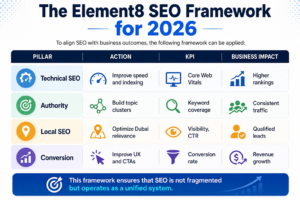
This framework ensures that SEO is not fragmented but operates as a unified system.
A 90-Day SEO Execution Plan
A structured dubai seo strategy requires clear execution phases.
Month 1: Technical Optimization
- Audit and fix technical issues
- Improve Core Web Vitals
- Optimize crawl and indexing
- Strengthen internal structure
Month 2: Authority Building
- Define content clusters
- Create or optimize pillar pages
- Publish supporting content
- Strengthen internal linking
Month 3: Conversion Optimization
- Improve landing page UX
- Add clear CTAs
- Implement tracking
- Optimize based on behavior
This approach transforms SEO into a consistent growth channel.
Common SEO Mistakes in Dubai
Many businesses fail to see results due to avoidable mistakes:
- Focusing only on rankings instead of conversions
- Ignoring local search intent
- Publishing content without structure
- Weak internal linking
- No performance tracking
Avoiding these mistakes alone can significantly improve results.
How Much Does SEO Cost in Dubai?
SEO investment in Dubai varies depending on business goals, competition, and the level of execution required. Unlike fixed services, SEO is an ongoing strategy that combines technical optimization, content development, and continuous performance improvements.
Rather than thinking in terms of fixed pricing, it is more useful to understand SEO in terms of three levels of investment, based on complexity and growth objectives.
- Foundational SEO
Suitable for smaller businesses or early-stage websites focusing on basic optimization, limited content, and low-competition keywords.
- Growth-Focused SEO
Designed for companies looking to scale visibility, build topical authority, and improve lead generation through consistent content and optimization.
- Advanced / Enterprise SEO
Required in highly competitive industries where ranking for terms like SEO company in Dubai or enterprise SEO Dubai demands deep strategy, authority building, and full-scale execution.
What Factors Influence SEO Cost?
SEO is not priced based on hours alone — it reflects the level of complexity and competitiveness involved.
Key factors include:
1. Industry Competition
Highly competitive sectors require stronger authority, deeper content, and more aggressive strategies to achieve meaningful rankings.
2. Website Condition
A technically weak website often requires significant initial work, including improvements to site speed, indexing, structure, and usability.
3. Content and Authority Requirements
Building visibility in Dubai requires structured content strategies, including topic clusters and consistent publishing aligned with search intent.
4. Local SEO Scope
Businesses targeting location-based searches must invest in local optimization, including service pages, local signals, and region-specific content.
5. Conversion Optimization
SEO success is not just about rankings. Improving user experience, calls to action, and conversion paths plays a major role in overall performance.
Why Cheap SEO Usually Fails
Low-cost SEO packages often rely on:
- generic or low-quality content
- outdated optimization techniques
- minimal strategy
- lack of performance tracking
In a competitive market like Dubai, this approach rarely delivers meaningful results. Businesses may see short-term activity, but little to no impact on qualified leads or revenue.
How to Evaluate SEO Investment (Not Just Cost)
Instead of focusing only on cost, businesses should evaluate SEO based on expected outcomes.
Ask:
- Will this strategy generate qualified leads?
- Is there a clear plan for building authority?
- How will success be measured beyond traffic?
- Does the approach align with long-term growth?
A well-executed SEO strategy should deliver:
- consistent inbound opportunities
- improved lead quality
- scalable organic growth
Choosing the Right SEO Partner
The difference between average and high-performing SEO comes down to execution and strategy.
Working with an experienced SEO company in Dubai focused on generating qualified leads ensures your investment is aligned with real business outcomes, not just rankings.
The right partner will prioritize:
- long-term growth over short-term gains
- conversion over traffic
- strategy over volume
Dubai-Specific SEO Insights
To succeed in Dubai, your strategy must reflect local behavior:
- Mobile-first usage makes speed critical
- Users prefer direct communication channels
- Competition is high in premium sectors
- Trust and credibility influence decisions
A strong local seo dubai strategy aligns with these behaviors rather than relying on generic global tactics.
What Actually Drives SEO Results in 2026
SEO success today is driven by:
- Strong technical foundations
- Deep topical authority
- Clear local relevance
- Conversion-focused execution
Businesses that align these elements consistently generate better results — not just in rankings, but in revenue.
Conclusion
SEO in Dubai has evolved into a system that rewards strategy, depth, and execution.
It is no longer about rankings alone. It is about building a structured approach that connects visibility with real business outcomes.
When technical performance, authority, local relevance, and conversion strategy work together, SEO becomes a predictable driver of qualified leads.
If you are looking to improve your current approach, working with an experienced SEO agency in Dubai can help align your strategy with measurable growth.
FAQs
What drives SEO results in Dubai in 2026?
Technical performance, topical authority, local relevance, and conversion optimization.
How is enterprise SEO different from basic SEO?
It focuses on scalability, deeper expertise, and measurable outcomes.
Why does topical authority matter?
It improves rankings across multiple related keywords and builds credibility.
Which KPIs matter more than traffic?
Conversion rate, qualified leads, and pipeline contribution.
How long does SEO take to work?
Initial results appear within 60–90 days, with stronger impact over 3–6 months.