How to Prioritize Website Features for Phase One vs Phase Two


Website feature prioritization becomes difficult when every useful idea is treated as a launch requirement. Product owners, marketing teams, sales leaders, service teams, and technical specialists can all name features that would improve the experience. The difficult decision is not whether those ideas have merit. It is deciding what must be ready for the first release, what can wait until evidence is available, and what should remain outside the roadmap.
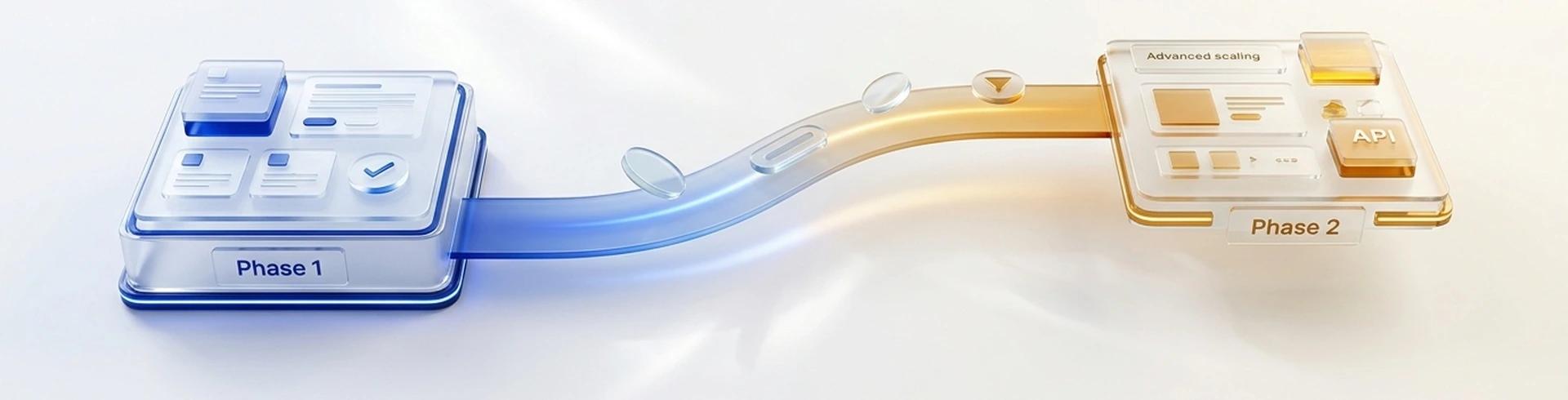
A disciplined phase-one versus phase-two decision protects the launch from scope inflation while keeping the long-term ambition visible. Phase One is the smallest credible release that enables the most important user journeys, satisfies material risk and compliance needs, and gives the organisation a reliable base for learning. Phase Two contains improvements that are valuable but dependent on usage data, operational readiness, additional integrations, or a clearer business case.
This is not an excuse to launch a thin website. It is a way to make trade-offs explicit. A feature belongs in Phase One when its absence would prevent a priority audience from completing a core task, create unacceptable risk, or make the new website impossible to operate. A feature belongs in Phase Two when it improves convenience or differentiation but the website can launch safely and credibly without it.
Business Outcomes and Launch Priorities
Before scoring individual features, define the outcomes the first release must support. Typical outcomes include generating qualified enquiries, helping existing customers find support, explaining a complex service, recruiting specialist talent, enabling a regional market, or creating a controlled publishing workflow. Each outcome should have an owner, a primary audience, and at least one observable measure.
A feature request such as “advanced filtering” is not an outcome. The underlying outcome may be that a procurement visitor can find the right capability page in under two minutes. “Personalised content” may be an attempt to improve relevance for several industries. “A new calculator” may be intended to qualify leads. Writing the outcome first prevents the roadmap from rewarding novelty instead of usefulness.
Use the organisation’s wider website design strategy as the boundary for the decision. It should clarify positioning, audiences, page roles, conversion paths, and the principles that make the site recognisable. If a proposed feature does not support a defined audience need or business outcome, it should not automatically enter Phase One simply because another stakeholder requested it.
Minimum Requirements for a Credible Launch
Phase One should pass a practical launch test. First, priority users can complete the journeys that justify the investment. Second, editors can maintain the content and approvals without unsafe workarounds. Third, the experience meets agreed standards for performance, accessibility, security, analytics, SEO, and privacy. Fourth, the team can support the release after launch. Fifth, the measurement plan can distinguish a successful journey from a broken one.
This test makes foundational work visible. A content model, search configuration, form handling, analytics events, redirect plan, and role-based access may not appear in a visual feature catalogue, yet they can be more important than a decorative interaction. The website scope of work should describe these responsibilities and acceptance criteria so that Phase One is not reduced to a collection of screens.
For every candidate, ask what fails if it is missing on launch day. If the answer is that a key enquiry cannot be submitted, a legal requirement cannot be met, an editor cannot publish safely, or search engines cannot understand the migrated site, the feature is likely foundational. If the answer is that the journey would be more delightful or the team would save some manual effort, the item may be better suited to Phase Two.
A Website Feature Prioritization Framework
Website feature prioritization works best when the score combines four lenses. Value measures the contribution to a priority outcome. Risk measures the cost of omitting the feature at launch. Effort covers design, content, engineering, integration, testing, and operational change. Readiness captures whether the requirements, data, owners, and dependencies are sufficiently clear to deliver it responsibly.
Score each lens on a simple scale and record the reasoning in plain language. A high-value feature with unknown data quality is not automatically Phase One; it may need a discovery task first. A low-effort feature with high security implications is not automatically Phase Two; the risk lens should move it forward. Record the score and its evidence so the team can revisit the decision when assumptions change. For a simple workshop, use a scale from one to five for business value, omission risk, and delivery effort, and label readiness as confirmed, partly known, or unresolved. Treat an essential security or accessibility requirement as a launch condition rather than allowing an average score to push it into a later phase.
Use confidence alongside the score. A feature supported by analytics, user research, support tickets, or validated sales requirements deserves more confidence than an idea based on preference. When confidence is low, define a small experiment or prototype rather than committing to a large build. This makes the roadmap evidence-led and gives Phase Two a clear learning agenda.
Phase One Essentials and Phase Two Enhancements
Phase One essentials usually include the information architecture, core templates, priority content, primary conversion journeys, responsive behaviour, accessibility foundations, measurement, search visibility, security controls, and editorial governance. They may also include a carefully bounded integration when the business process cannot work without it.
Enhancements may include advanced personalisation, complex comparison tools, secondary integrations, sophisticated dashboards, extensive account areas, experimental motion, or a large library of edge-case workflows. These can be strategically important, but their timing depends on the maturity of the content, data, team, and operating model. A Phase Two label is not a rejection. It is a commitment to revisit the item with better evidence.
Be careful with features that appear small but multiply across the site. A filter can require taxonomy design, data cleanup, indexing, accessible controls, analytics, and editorial maintenance. A language switcher can require translation governance, URL rules, review capacity, and search optimisation. A “simple” third-party integration can add privacy, uptime, authentication, and support obligations. Estimate the system around the feature, not just the interface element.
The Miro Tech case study illustrates how different website functions support distinct commercial journeys. Element8 developed a WordPress and WooCommerce platform supporting retail purchases alongside B2B procurement, with quote requests, sample management, inventory synchronisation, and other operational integrations. For a team planning a comparable platform, the prioritisation question is which transactions and data flows must work at launch, and which automation can follow once its dependencies are ready. The case study describes the implemented capabilities; it does not specify a Phase One or Phase Two delivery sequence.
Dependencies, User Journeys, and Launch Quality
Dependencies are a common reason a plausible Phase One feature becomes a late delivery risk. Map what must exist first: content, taxonomy, APIs, identity, approvals, legal copy, analytics events, migration rules, hosting capacity, or vendor access. Then identify the dependency owner and the date by which it must be resolved.
A feature with a high score but an unresolved dependency should be split. Put the minimum enabling work in Phase One and keep the experience expansion in Phase Two. For example, launch a reliable enquiry form and consent record first; add lead scoring and CRM enrichment after the integration has been tested with real submissions. This protects the core journey and prevents a high-uncertainty dependency from holding the entire release hostage.
Use the enterprise website cost and ROI guide to discuss total cost rather than a feature’s build estimate alone. Ongoing hosting, support, content production, monitoring, training, licences, and future changes all affect the decision. A feature that is cheap to build but costly to operate may belong later, while an expensive foundation can be sensible if it prevents rework across every future release.
User Journey and Quality Requirements
Website feature prioritization should follow the journeys that users need to complete across departments. Draw the shortest credible path for each priority audience: entry, understanding, proof, action, confirmation, and follow-up. Then test whether the proposed Phase One features support that path. If a feature does not improve a priority step or a quality gate, ask why it is needed for the first release.
Lead quality is especially important for service websites. A polished component that adds friction to qualification can reduce commercial performance. Review forms, calls to action, proof points, navigation, and response expectations as one system. The enterprise UX decision guide can help connect interface choices to lead quality rather than evaluating features in isolation.
Quality gates should be explicit. Include content approval, keyboard access, contrast, mobile behaviour, page speed, form error handling, redirect checks, metadata, structured data, analytics validation, backup and recovery, and security review. The website performance guide is useful when a visually impressive interaction competes with fast, dependable task completion.
Roadmap Ownership and Change Decisions
A good roadmap has a decision owner for every feature. Record the accountable business owner, delivery owner, dependency owner, acceptance criteria, target phase, confidence, and next review date. Avoid a single “priority” column with no explanation. Teams need to know whether an item is waiting for evidence, blocked by a supplier, deliberately deferred, or simply not valuable enough.
Set a change rule for the programme. New Phase One requests should identify the outcome they support and the item they displace, or explain the risk of not adding them. This prevents late additions from entering without a visible trade-off. A short weekly decision forum can review exceptions, while routine editorial changes remain with trained owners.
Operational governance matters after launch. The website governance guide helps frame the work required to keep the site healthy. Phase Two should not become a parking lot with no owner. Give deferred items a trigger: a traffic threshold, a content milestone, an integration readiness date, a research finding, or a quarterly review.
Security and privacy items need a different threshold. Do not defer an essential control because it is invisible to users. Review access, authentication, backups, dependencies, data collection, third-party scripts, and incident response. The web development delivery approach provides a useful baseline for deciding which controls are launch prerequisites.
Website Feature Prioritisation: A Worked Example
The following examples show how the same framework can produce different release decisions. They are illustrative; each team should validate the dependencies and risks against its own project.
| Feature | Suggested phase | Reason and acceptance evidence |
|---|---|---|
| Primary enquiry form | Phase One | A core conversion journey depends on it. Verify validation, routing, confirmation, consent, and measurement. |
| Advanced product filtering | Depends on the core task | Include at launch if visitors cannot find a suitable product without it. Otherwise validate taxonomy and demand before expanding. |
| Content personalisation | Usually Phase Two | Confirm audience segments, content coverage, consent requirements, and measurable value before implementation. |
| Migration redirects | Phase One for changed URLs | Map valuable existing URLs and test the destination, status code, and continuity of the visitor journey. |
For each feature, write one sentence for the user problem, one sentence for the business outcome, one sentence for the launch risk, and one sentence for the dependency. Then classify it as Foundation, Core Journey, Enabler, Enhancement, or Experiment. Foundation and Core Journey items normally enter Phase One. Enablers enter Phase One when they protect delivery or operations. Enhancements and Experiments normally enter Phase Two unless evidence or risk changes the decision.
A simple table can use these columns: feature; audience; outcome; phase; value score; omission risk; effort; confidence; dependencies; acceptance criteria; owner; review trigger. Keep the wording concrete. “Improve experience” is not an acceptance criterion. “A mobile visitor can find the service contact and submit a complete enquiry with a clear confirmation message” is testable.
If the first release still contains too many features, reduce scope by removing breadth before reducing quality. Launch fewer secondary templates, markets, filters, integrations, or personalisation rules while keeping the foundations sound. A smaller site that is fast, accessible, measurable, and maintainable creates better conditions for Phase Two than a larger site that nobody can confidently operate.
Element8 can help your team turn a long website feature list into a sequenced roadmap with outcomes, dependencies, acceptance criteria, and quality gates. Start with the journeys that matter most, confirm the foundations needed for a safe launch, and define the evidence that will earn each Phase Two enhancement its place. A clear roadmap gives stakeholders a fair decision process and gives delivery teams a release they can support. Speak with our team about your website roadmap.
Frequently Asked Questions
What should always be in Phase One of a website project?
Core user journeys, essential content, responsive templates, accessibility, security, analytics, SEO foundations, forms or transactions required for the business, and the editorial workflow needed to operate the site should normally be in Phase One.
How do I decide if a feature is genuinely essential?
Ask what priority audience, outcome, risk, or operating requirement depends on it. If removing it prevents a core task, creates unacceptable exposure, or forces an unsafe workaround, treat it as a Phase One candidate.
Can a complex integration be deferred to Phase Two?
Yes, if the first release has a reliable alternative and deferral does not create material risk. Split the enabling data, security, and process work from the richer automation so the core journey remains usable.
How should stakeholders agree on priorities?
Use shared scoring lenses, evidence, dependencies, acceptance criteria, and a named decision owner. Require any late Phase One addition to identify the item it displaces or the risk it addresses.
What is the best way to manage a Phase Two backlog?
Give every deferred item an owner, rationale, dependency, review date, and trigger for reconsideration. Review the backlog against real usage, support needs, commercial results, and operational capacity after launch.