
WordPress Maintenance SLA: What Businesses Should Expect From a Professional Agency


Most WordPress failures are not caused by WordPress itself.
They are caused by operational neglect.
A plugin update pushed directly to production. A multilingual workflow that silently breaks after a cache change. A WooCommerce checkout issue discovered only after sales decline. A backup system that exists but cannot restore properly during an emergency.
These are not rare incidents.
They are common operational failures inside unmanaged WordPress environments.
The reality is that many businesses still treat WordPress maintenance as a low-priority technical task instead of operational infrastructure management.
That mindset becomes dangerous as websites grow.
Modern WordPress platforms are no longer simple brochure websites. They support ecommerce operations, multilingual publishing, CRM integrations, search visibility, marketing automation, analytics, API integrations, customer portals, and enterprise workflows.
In many organizations, the website is directly connected to revenue generation.
Which means operational stability matters.
That is why serious businesses no longer view WordPress maintenance as occasional plugin updates.They treat it as governance.
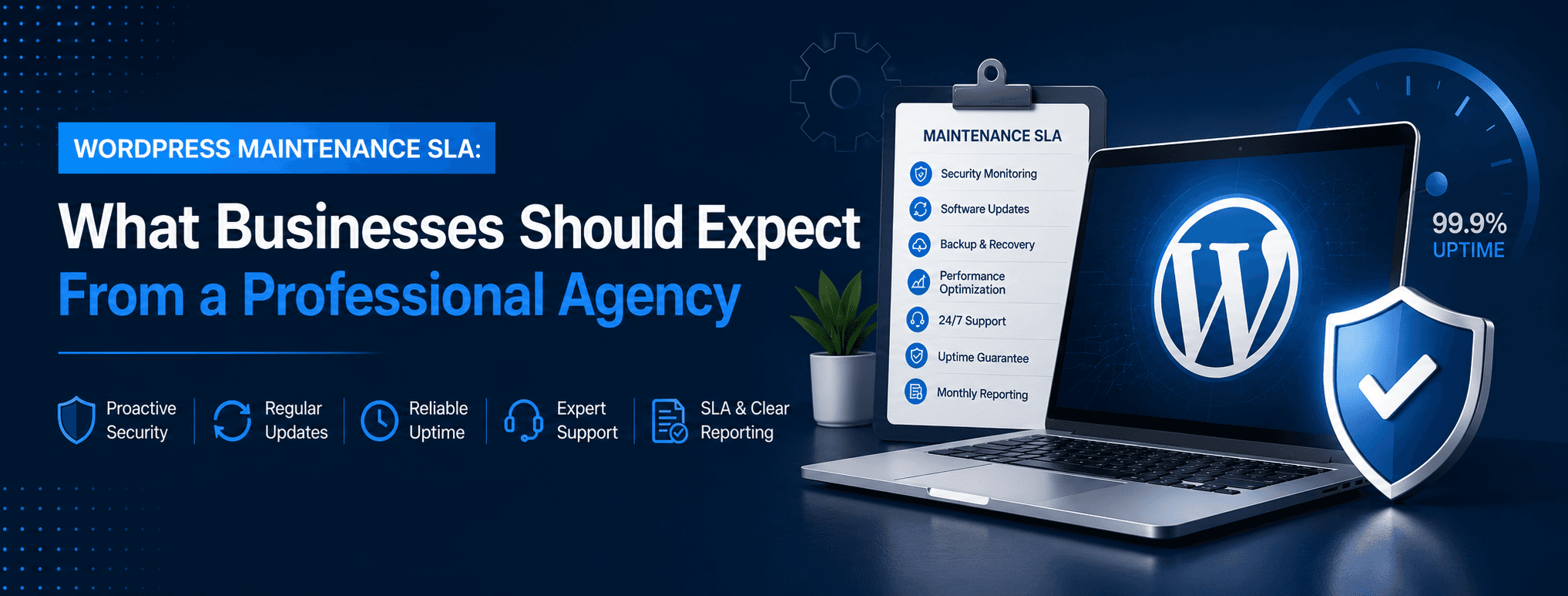
A professional WordPress Maintenance SLA (Service Level Agreement) defines how a platform is secured, monitored, maintained, optimized, tested, and governed over time.
It establishes:
- operational accountability
- deployment processes
- security oversight
- performance governance
- support expectations
- monitoring standards
- backup validation
- escalation procedures
- incident response workflows
This becomes even more important in the AI era, where structured content, search visibility, platform speed, and operational continuity directly affect discoverability across Google AI Overviews, conversational search engines, and AI-driven browsing experiences.
Businesses investing in modern WordPress in the AI era strategies increasingly understand that long-term maintainability matters just as much as launch speed.
For UAE businesses operating multilingual websites, ecommerce platforms, enterprise portals, and performance-driven marketing ecosystems, maintenance is no longer optional. It is part of sustainable digital infrastructure.
What Is a WordPress Maintenance SLA?
A WordPress maintenance SLA is a structured operational agreement that defines how a WordPress website or platform will be managed after launch.
A professional SLA typically includes:
- WordPress core updates
- plugin governance
- vulnerability monitoring
- uptime monitoring
- backup management
- rollback procedures
- performance optimization
- staging workflows
- deployment governance
- malware monitoring
- infrastructure oversight
- incident response
- multilingual QA
- technical support timelines
At the enterprise level, the objective is not simply “keeping the website online.”
The real objective is operational reliability. That distinction matters.
Basic maintenance providers usually focus on periodic updates.
Enterprise maintenance focuses on:
- governance
- risk reduction
- infrastructure continuity
- operational discipline
- long-term maintainability
- performance stability
- deployment safety
A professionally managed WordPress environment should behave like maintained infrastructure — not fragile software held together by temporary fixes.
Why Enterprise WordPress Websites Need Ongoing Governance
Modern WordPress environments are significantly more complex than many businesses realize.
A typical enterprise WordPress stack may include:
- multilingual publishing systems
- CRM integrations
- ERP connections
- analytics platforms
- ecommerce infrastructure
- AI automation tools
- CDN layers
- API integrations
- search optimization systems
- object caching
- security monitoring tools
- headless frontend frameworks
- marketing automation platforms
Every additional layer increases operational complexity. Without governance, even minor changes can create cascading failures.
For example:
- a plugin update may break multilingual publishing workflows
- a CDN rule may affect WooCommerce sessions
- a PHP version mismatch may break critical integrations
- a caching conflict may affect dynamic product pages
- a security rule may accidentally block API requests
- an untested deployment may reduce Core Web Vitals performance
These are operational governance problems.
Not CMS problems.
This distinction is important because WordPress itself is rarely the real issue. The real issue is usually the absence of structured operational management. Businesses evaluating modern CMS architectures should also understand the operational differences between headless vs traditional WordPress, especially when deployment governance, maintainability, and infrastructure complexity are involved.
WordPress Maintenance Is No Longer Just Technical Support
Many businesses still assume maintenance means:
- updating plugins
- renewing hosting
- fixing occasional issues
That mindset is outdated. Modern WordPress maintenance includes multiple operational layers.
Operational Governance
Enterprise WordPress environments require structured operational governance. Updates should never be deployed casually, approved without testing, or pushed directly to production environments.
A mature governance process defines:
- who approves deployments
- how updates are tested
- what rollback procedures exist
- how incidents are escalated
- how operational risks are controlled
Without governance, even routine updates can create instability across multilingual publishing workflows, ecommerce systems, integrations, APIs, and frontend infrastructure. One of the most common operational failures in WordPress environments is the absence of deployment discipline. Businesses often update plugins or infrastructure components directly on the live website without staging validation. This increases the risk of downtime, broken forms, checkout failures, multilingual inconsistencies, and SEO issues. Professional WordPress maintenance should operate through structured workflows that reduce deployment risk while maintaining operational continuity.
Security Governance
Security governance is not just about installing a firewall plugin or running occasional malware scans. Professional WordPress security requires continuous operational oversight.
This includes:
- vulnerability monitoring
- patch management
- access control reviews
- firewall governance
- malware detection
- admin permission audits
- hosting-level hardening
- incident response planning
Most WordPress compromises are caused by outdated plugins, weak administrative practices, poor hosting environments, or unmanaged third-party integrations — not WordPress core itself. A professionally maintained environment should continuously monitor the WordPress ecosystem for emerging vulnerabilities affecting plugins, themes, APIs, and dependencies.
Security governance is especially important for:
- ecommerce websites
- multilingual platforms
- enterprise portals
- high-traffic websites
- websites handling customer data or transactions
Performance Governance
Website speed is not a one-time optimization task. Performance changes continuously as websites evolve. New plugins, content growth, infrastructure changes, tracking scripts, third-party integrations, and frontend complexity can gradually reduce performance over time if governance is weak.
Professional WordPress maintenance should continuously monitor:
- Core Web Vitals
- page speed
- uptime
- server response times
- database performance
- cache efficiency
- CDN behavior
- frontend rendering performance
Many businesses only notice performance problems after SEO visibility declines or conversion rates begin to drop. In reality, performance degradation usually happens gradually through operational accumulation:
- oversized plugins
- inefficient queries
- excessive JavaScript
- unoptimized media
- inconsistent caching rules
- infrastructure bottlenecks
This is why long-term performance governance matters.
Infrastructure Governance
Infrastructure governance focuses on operational reliability, recoverability, and long-term platform stability.
A professionally maintained WordPress environment should include:
- backup validation
- disaster recovery planning
- uptime monitoring
- staging environments
- rollback workflows
- infrastructure monitoring
- deployment logging
- hosting oversight
One of the most overlooked operational failures in WordPress environments is assuming backups are functional without testing restoration procedures. A backup that cannot restore properly during an emergency provides very little operational value.
Professional maintenance workflows should regularly validate:
- backup integrity
- recovery timelines
- restoration accuracy
- rollback procedures
- deployment safety
Infrastructure governance becomes even more important for:
- ecommerce platforms
- multilingual publishing systems
- enterprise portals
- headless WordPress environments
- high-traffic websites
Organizations adopting headless WordPress development often require even stricter operational workflows because the frontend, CMS, API layer, CDN, deployment pipeline, and hosting infrastructure must remain synchronized across environments.
The difference between stable enterprise WordPress systems and unstable ones is rarely the CMS itself. It is governance maturity.
What Actually Breaks in Real-World WordPress Environments
This is where many maintenance discussions become disconnected from operational reality.
In practice, enterprise WordPress systems fail in predictable ways.
The operational patterns are remarkably consistent.
Plugin Conflicts & Dependency Chaos
One of the most common operational issues in WordPress environments is uncontrolled plugin growth.
Over time, businesses install plugins for:
- SEO
- analytics
- forms
- multilingual publishing
- ecommerce
- security
- automation
- marketing integrations
- page building
- performance optimization
Many of these plugins were never designed to operate together long-term. In unmanaged environments, updates are frequently deployed directly to production without compatibility testing.
This creates:
- checkout failures
- broken layouts
- PHP conflicts
- JavaScript errors
- admin instability
- failed forms
- API interruptions
- unexpected downtime
In several enterprise WordPress environments, websites operate with 40–60 active plugins and no documented governance process.
That is not maintainability.
That is accumulated technical debt.
One of the most common operational patterns we see is “plugin layering.”
A business adds one plugin to solve a small issue. Then another plugin to solve a secondary issue created by the first plugin. Over time, the environment becomes increasingly unstable and difficult to govern.
This is why plugin governance is critical.
Professional maintenance is not just about updating plugins.
It is about controlling the operational complexity plugins create over time.
Multilingual Publishing Failures
This is particularly important for UAE businesses.
Arabic and English publishing workflows introduce operational complexity that many agencies underestimate.
Common multilingual operational failures include:
- broken translated URLs
- RTL layout inconsistencies
- synchronization failures
- hreflang errors
- untranslated dynamic content
- metadata mismatches
- language-specific cache conflicts
- broken navigation states
These issues often appear after:
- plugin updates
- CDN changes
- server migrations
- caching adjustments
- theme modifications
Multilingual WordPress environments require significantly more QA discipline than single-language websites.
For example, a deployment that appears stable in English may still break Arabic rendering, RTL layouts, or translated metadata.
These failures often go unnoticed until:
- search rankings decline
- users report broken experiences
- indexed pages become inconsistent
- conversion rates drop
A professional WordPress maintenance SLA should include multilingual QA validation — especially for enterprise, government, and ecommerce websites operating across Arabic and English audiences.
WooCommerce Checkout Failures
For ecommerce businesses, maintenance failures directly affect revenue.
Common WooCommerce operational issues include:
- payment gateway failures
- checkout session conflicts
- inventory synchronization issues
- tax calculation problems
- shipping rule failures
- third-party integration instability
- caching-related cart problems
- abandoned cart workflow failures
Many ecommerce incidents happen after routine updates that were never tested properly in staging environments.
For example:
- a cache configuration may affect dynamic pricing
- a plugin update may interrupt payment processing
- a shipping integration may stop syncing correctly
- session conflicts may break cart persistence
Businesses investing in WooCommerce development or enterprise-level ecommerce website development in dubai should treat maintenance as a revenue-protection function rather than a support expense.
Ecommerce maintenance requires:
- safer deployment workflows
- stricter QA processes
- performance monitoring
- transactional validation
- operational accountability
Because every operational failure directly impacts revenue.
Performance Degradation Over Time
WordPress websites rarely become slow overnight.
Performance degradation usually happens gradually.
Examples include:
- oversized plugins
- inefficient database queries
- bloated page builders
- excessive JavaScript
- poor cache configuration
- unoptimized images
- unused scripts loading globally
- outdated infrastructure configurations
Without ongoing governance, websites slowly accumulate operational inefficiencies.
Eventually:
- Core Web Vitals decline
- search visibility weakens
- bounce rates increase
- conversion rates drop
- crawl efficiency decreases
This is why performance governance should be continuous.
Not reactive.
Modern WordPress performance maintenance often includes:
- CDN optimization
- cache governance
- image pipeline optimization
- query monitoring
- script reduction
- infrastructure tuning
- uptime monitoring
- database optimization
Professional maintenance teams also monitor performance drift over time.
This matters because websites that initially perform well often become slower months later due to:
- accumulated plugins
- operational complexity
- infrastructure neglect
- inconsistent deployments
Long-term performance governance directly impacts SEO visibility, Core Web Vitals, user experience, and AI-search discoverability.
Businesses investing in modern search visibility should align maintenance operations with broader technical SEO services to protect indexing quality, structured data integrity, and long-term performance consistency.
Backup Failures & Recovery Problems
Many businesses assume backups are working simply because backups exist.
That assumption is dangerous.
One of the most overlooked operational realities in WordPress infrastructure is failed backup integrity.
Examples include:
- incomplete backups
- corrupted archives
- inaccessible storage locations
- failed database exports
- restoration failures
- outdated recovery procedures
A backup that cannot restore properly during an emergency is operationally useless.
Professional maintenance should include:
- backup redundancy
- restoration testing
- rollback procedures
- disaster recovery workflows
- backup validation
The question is not:
“Do backups exist?”
The question is:
“Can the environment be restored safely under operational pressure?”
That distinction matters during real incidents.
Security Vulnerabilities & Infrastructure Exposure
Most WordPress compromises are not caused by WordPress core.
They are usually caused by:
- outdated plugins
- weak admin access
- unpatched vulnerabilities
- exposed environments
- poor hosting configurations
- inadequate access control
- weak operational governance
A secure WordPress environment requires continuous operational oversight.
Not occasional scanning.
Professional WordPress security governance typically includes:
- vulnerability monitoring
- malware scanning
- firewall management
- brute-force protection
- access reviews
- least-privilege permissions
- patch deployment governance
- incident response workflows
Businesses serious about long-term infrastructure protection should integrate WordPress governance into broader cybersecurity services, particularly when managing ecommerce systems, multilingual publishing environments, or enterprise business integrations.
What a Professional WordPress Maintenance SLA Should Include
Not all maintenance agreements are equal.
There is a major difference between:
- basic maintenance and
- enterprise operational governance.
A professional SLA should include multiple operational layers.
1. Security Hardening & Vulnerability Monitoring
Security should be proactive.
Not reactive.
A proper maintenance SLA should include:
- vulnerability monitoring
- malware scanning
- firewall management
- login hardening
- patch deployment governance
- access control reviews
- plugin vulnerability tracking
- incident response planning
Professional maintenance teams continuously monitor the ecosystem for emerging vulnerabilities affecting plugins, themes, hosting environments, and dependencies.
2. Plugin Governance
Plugin governance is one of the most important aspects of WordPress maintainability.
Professional governance includes:
- plugin audits
- lifecycle reviews
- compatibility testing
- dependency management
- performance impact analysis
- redundancy elimination
- deployment controls
In many enterprise environments, plugin sprawl becomes the primary source of instability.
A governance-first approach prioritizes:
- fewer plugins
- operational accountability
- long-term sustainability
- performance discipline
3. Staging & Deployment Workflows
Updates should never be deployed directly to production.
A professional maintenance workflow usually follows:
- Update testing in staging
- Functional validation
- Security review
- Performance checks
- Deployment approval
- Controlled release
- Post-deployment monitoring
This reduces:
- downtime
- broken functionality
- ecommerce disruption
- multilingual publishing failures
Enterprise WordPress environments should always maintain isolated staging workflows.
4. Performance Governance
Performance is not a one-time task.
Enterprise maintenance should include:
- Core Web Vitals tracking
- uptime monitoring
- CDN optimization
- database tuning
- cache governance
- infrastructure monitoring
- image optimization
- performance auditing
Long-term performance governance directly affects:
- search visibility
- conversion rates
- user experience
- AI-search retrieval
5. Backup Integrity & Disaster Recovery
A professional SLA should include:
- automated backups
- restoration testing
- recovery workflows
- rollback procedures
- disaster recovery documentation
- backup redundancy
Operational continuity depends on recoverability.
Not just backup existence.
6. Uptime Monitoring & Observability
Enterprise systems require visibility.
Professional maintenance teams monitor:
- uptime
- infrastructure health
- response times
- API availability
- CDN behavior
- traffic anomalies
- failed services
Monitoring allows operational issues to be identified before users experience them.
That is infrastructure maturity.
7. Multilingual QA Workflows
Multilingual websites require additional governance.
This is highly relevant for UAE businesses operating Arabic and English publishing environments.
Maintenance workflows should validate:
- translated pages
- RTL layouts
- multilingual navigation
- hreflang implementation
- localized metadata
- language-specific caching behavior
Without multilingual QA, updates can silently affect SEO visibility and user experience.
8. Incident Response Procedures
Every professional SLA should define:
- escalation procedures
- response timelines
- rollback workflows
- communication processes
- recovery expectations
When operational incidents occur, speed matters.But structured response matters even more.
Why Maintenance Matters More for UAE Businesses
The UAE market presents unique operational requirements.
Many enterprise websites in the region must support:
- multilingual publishing
- Arabic + English workflows
- enterprise governance expectations
- ecommerce scalability
- long-term operational accountability
- performance-driven SEO
- regional infrastructure requirements
This creates additional complexity compared to standard websites.
Arabic + English Publishing Complexity
Maintaining bilingual publishing environments requires:
- translation governance
- RTL testing
- multilingual SEO validation
- content synchronization workflows
- language-specific QA
Operational discipline becomes essential.
A deployment that appears stable in English may still affect Arabic rendering, mobile layouts, or translated metadata.
Without proper multilingual governance:
- search visibility can decline
- indexed pages may become inconsistent
- user experience quality may degrade
This is why multilingual maintenance requires stricter operational processes.
Enterprise Procurement Expectations
Many UAE organizations increasingly expect:
- documented governance workflows
- operational accountability
- SLA transparency
- infrastructure oversight
- security governance
- response guarantees
Cheap maintenance models rarely provide this level of operational maturity.
Enterprise buyers increasingly prioritize:
- operational continuity
- vendor accountability
- long-term maintainability
- deployment governance
This is especially true for organizations managing:
- ecommerce systems
- enterprise portals
- multilingual publishing ecosystems
- large-scale digital platforms
Long-Term Infrastructure Ownership
Businesses increasingly prioritize:
- maintainability
- scalability
- infrastructure ownership
- deployment flexibility
- operational continuity
This is one reason WordPress remains strategically valuable.
Unlike heavily restricted proprietary platforms, WordPress allows businesses to maintain control over:
- hosting
- infrastructure
- deployment architecture
- integrations
- operational workflows
That ownership matters long-term.
How Element8 Approaches WordPress Maintenance
At Element8, WordPress maintenance is approached as long-term infrastructure governance rather than reactive technical support.
That distinction shapes how systems are maintained over time.
Our operational philosophy focuses on:
- security discipline
- performance governance
- multilingual publishing stability
- long-term maintainability
- infrastructure accountability
- deployment reliability
This includes:
- structured staging workflows
- plugin governance reviews
- vulnerability management
- multilingual QA procedures
- deployment oversight
- backup validation
- performance monitoring
For organizations running modern publishing architectures such as headless WordPress with Next.js, governance becomes even more important because frontend rendering, deployment pipelines, APIs, and caching systems all introduce additional operational dependencies.
Many organizations underestimate how quickly unmanaged WordPress environments accumulate operational risk.
Over time:
- plugins expand
- integrations multiply
- governance weakens
- technical debt grows
- performance declines
Long-term sustainability requires operational discipline.Not reactive fixes after failures occur.
Signs Your WordPress Website Needs Better Maintenance Governance
Many businesses do not realize governance problems exist until operational failures become visible.
Common warning signs include:
- increasing plugin count without oversight
- slow admin performance
- inconsistent uptime
- multilingual publishing issues
- declining Core Web Vitals
- SEO volatility
- recurring security warnings
- broken integrations
- failed forms
- untested production deployments
- unexplained performance drops
These are governance indicators. Not just technical issues.
Final Thoughts
A WordPress website should not behave like fragile software held together by temporary fixes. It should operate like managed digital infrastructure. The difference between stable enterprise WordPress platforms and unstable ones is rarely the CMS itself.
It is the operational discipline behind it. Professional maintenance is not simply about updates.
It is about:
- governance
- accountability
- security
- scalability
- operational continuity
- performance
- long-term maintainability
For businesses in the UAE managing multilingual publishing, ecommerce operations, enterprise growth, and performance-driven search visibility, those operational layers are no longer optional.
They are part of sustainable digital infrastructure.
Businesses increasingly adopting structured governance frameworks and long-term operational support models are moving toward more mature enterprise website SLA and AMC maintenance strategies to improve scalability, stability, and digital continuity.
If your current WordPress environment feels increasingly difficult to manage, maintain, secure, or scale, the issue may not be WordPress itself. It may be the absence of a proper operational framework behind it.
FAQs
What is included in a WordPress maintenance SLA?
A professional WordPress maintenance SLA includes plugin updates, WordPress core updates, security monitoring, backups, uptime monitoring, staging workflows, rollback procedures, vulnerability management, performance optimization, and technical support. Enterprise-grade SLAs may also include multilingual QA, deployment governance, infrastructure monitoring, and incident response planning.
Why do businesses need ongoing WordPress maintenance?
Businesses need ongoing WordPress maintenance to protect security, performance, uptime, SEO visibility, and operational stability. Without proper maintenance, plugin conflicts, vulnerabilities, performance degradation, and integration failures can affect the website over time.
Is WordPress secure for enterprise businesses?
Yes. WordPress can be highly secure when managed properly. Most WordPress security incidents are caused by outdated plugins, weak access controls, poor hosting environments, and lack of governance rather than WordPress itself.
Why is staging important in WordPress maintenance?
Staging environments allow updates and deployments to be tested before reaching the live website. This helps prevent broken layouts, multilingual publishing issues, plugin conflicts, ecommerce failures, and operational downtime.
How does WordPress maintenance affect SEO?
WordPress maintenance directly affects Core Web Vitals, page speed, crawlability, indexing quality, uptime, schema integrity, redirects, and structured data consistency. Poor maintenance can lead to ranking drops, indexing issues, and degraded user experience.
What is plugin governance in WordPress?
Plugin governance is the process of controlling plugin selection, approvals, updates, compatibility testing, and lifecycle management to reduce security risks and operational instability. It helps improve maintainability, performance, and deployment reliability.
Can WordPress handle enterprise traffic reliably?
Yes. WordPress can reliably support enterprise traffic when backed by proper hosting, caching, CDN infrastructure, monitoring, governance workflows, and performance optimization. Operational discipline matters more than the CMS itself.
Can WordPress maintenance improve Core Web Vitals?
Yes. Ongoing WordPress maintenance can improve Core Web Vitals through performance optimization, image management, cache governance, infrastructure tuning, and plugin management. Continuous monitoring helps prevent performance degradation over time.
Why do multilingual WordPress websites require additional maintenance?
Multilingual WordPress websites require additional maintenance because translation workflows, RTL layouts, hreflang tags, localized metadata, and language-specific caching behavior must remain synchronized after updates and deployments.