

Arabic-English Website Structure: What GCC Organizations Should Decide Early
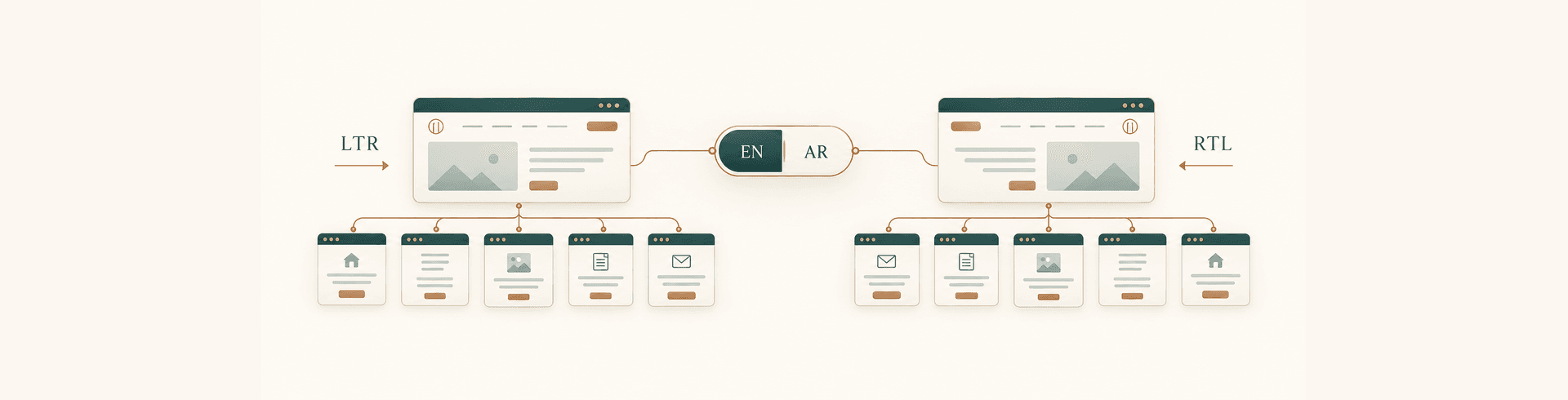


An Arabic-English website should not be treated as one English website with translated pages added later. Language affects information architecture, navigation, search behaviour, visual direction, content ownership, approvals, technology, analytics, and ongoing operations. Decisions made during discovery determine whether both audiences receive a complete, coherent experience or whether one language becomes an incomplete copy.
For GCC organisations, these choices are especially important because audiences may switch languages by task, market, role, or device. A strong bilingual structure gives Arabic and English equal strategic consideration while allowing justified differences in content and journeys. This guide covers the decisions teams should make before design and development begin.
Define the purpose of each language experience
Start with audience evidence rather than assuming every page needs a literal translation. Identify who uses Arabic, who uses English, which markets and services matter, what questions each audience asks, and where regulatory or contractual content must be equivalent. Review analytics, search demand, customer enquiries, sales feedback, and stakeholder requirements.
The result should be a documented language strategy. It may require full parity across corporate and service content, while selected campaigns or resources differ by market. Differences should be intentional and governed, not caused by a missing translation budget or unclear ownership.
Choose a URL structure early
Language URLs influence crawling, analytics, hosting, redirects, and maintenance. Common approaches include language folders on one domain, language subdomains, or separate country domains. For many GCC organisations, clear folders such as /en/ and /ar/ make ownership and reporting manageable, but the correct model depends on markets, infrastructure, and brand strategy.
Every indexable page should have one stable URL per language. Avoid changing language through cookies alone, serving multiple languages at the same URL, or relying on browser detection without accessible alternatives. Define slug conventions, including whether Arabic pages use Arabic characters or governed transliterations, and test how those URLs appear in sharing, reporting, and support workflows.
Design equivalent information architecture
Arabic and English navigation should help users reach comparable goals, but equivalent does not always mean identical labels or ordering. Build the architecture from audience tasks, not from a word-for-word menu translation. Confirm how service names, industry terms, locations, and organisational language are understood in each market.
Map every priority page to its counterpart and record justified exceptions. This mapping later supports language switching, hreflang, migration, QA, and editorial governance. The planning principles in the essential business website pages guide can be applied to each language experience.
Treat right-to-left design as structural
Arabic interfaces require more than aligning paragraphs to the right. Layout flow, navigation, breadcrumbs, carousels, icons, progress indicators, tables, forms, pagination, animation, and directional controls may need mirroring. Numbers, email addresses, codes, and mixed-language content still introduce left-to-right segments, so bidirectional text must be tested with realistic content.
Create design-system rules for direction-aware spacing, iconography, component order, and exceptions. Avoid manually duplicating every component when logical CSS properties and shared design tokens can support both directions safely. The Arabic UX, RTL, and bilingual SEO guide explains these implementation details further.
Build a content parity model
Teams need a reliable way to know whether every required Arabic and English page exists, is current, and has an owner. A parity matrix should track page type, source language, counterpart URL, translation status, reviewer, approval state, publication date, and next review date.
Parity does not require publishing weak translated content merely to fill a gap. It means defining what must match, what may differ, and why. Legal notices, product facts, service scope, pricing conditions, and critical calls to action may need strict equivalence. Thought leadership or regional campaigns may legitimately vary.
Separate translation from localisation
Translation conveys meaning between languages. Localisation adapts terminology, examples, units, dates, imagery, tone, legal references, and calls to action for the intended audience. A grammatically accurate translation can still feel unfamiliar, ambiguous, or commercially ineffective.
Use qualified Arabic writers and reviewers who understand the organisation and subject matter. Machine translation may support drafting for low-risk content, but it needs governance, terminology controls, confidentiality review, and human approval. High-risk claims, regulated information, contracts, and crisis communications require expert review.
Create a controlled terminology system
Enterprise websites often contain repeated service names, product terms, legal phrases, and brand language. Without a glossary, different translators and departments can use inconsistent Arabic terms for the same concept. This damages clarity, search relevance, and trust.
Maintain an approved bilingual terminology library with preferred terms, prohibited alternatives, context, transliteration rules, and accountable owners. Connect it to briefs, content templates, translation tools, QA, and search research. Review it whenever products, regulations, or brand positioning change.
Plan bilingual SEO as two connected strategies
Search behaviour is not a direct translation exercise. Arabic users may use Modern Standard Arabic, regional terminology, English brand names, transliterations, or mixed queries. Research intent and vocabulary independently, then align pages where their purpose matches.
Each language page needs its own title, description, heading structure, body copy, internal links, image alternatives, and structured data. Do not insert English keywords unnaturally into Arabic text. Connect genuine equivalents with reciprocal hreflang and self-referencing canonicals, and include only valid indexable URLs in sitemaps.
Make language switching predictable
A language switcher should preserve context by taking users to the equivalent page whenever one exists. Sending every switch to the homepage breaks the journey and makes missing content difficult to detect. When no counterpart exists, explain the limitation or offer the nearest useful alternative deliberately.
Label the control clearly in both languages and make it accessible by keyboard and assistive technology. Do not force a redirect based on browser language or location. Remember user preference when helpful, but keep every language directly reachable and shareable.
Select a CMS model that supports parity
The CMS should represent relationships between language versions, workflows, permissions, previews, and publication states. Decide whether translations are linked records, fields within one record, or separate sites with shared governance. The model must support the organisation’s actual teams and approval process.
Editors need to see missing, outdated, and unpublished counterparts. Preview must render RTL components accurately. Workflows should allow one language to update without silently leaving the other incorrect. The considerations in choosing the right CMS are particularly important for multilingual operations.
Define roles, approvals, and service levels
Document who writes the source, translates, localises, reviews subject matter, approves legal content, performs SEO review, publishes, and monitors each language. Define expected turnaround times and an escalation path for urgent changes. A bilingual site cannot stay aligned if Arabic approval consistently begins after English publication.
Governance should also cover agencies and vendors. Named accounts, least privilege, handover procedures, access reviews, and retained translation assets prevent dependency on one supplier. The broader enterprise website governance framework helps connect language ownership to platform ownership.
Design forms and integrations for both languages
Forms need translated labels, validation, confirmation messages, consent language, and error states. Test mixed-direction inputs such as Arabic names with English email addresses or reference numbers. Confirm how Arabic data is stored, exported, searched, and displayed in CRM, ERP, ticketing, and email systems.
Pass language and source-page context into downstream systems so teams can respond appropriately. Automated emails, PDFs, invoices, and support messages should follow the selected language. Integration owners must test encoding, field lengths, directionality, and reporting before launch.
Measure each language without fragmenting insight
Analytics should support both combined business reporting and language-specific analysis. Capture language, market, template, journey, conversion, and content identifiers consistently. Avoid creating unrelated tracking schemes that make Arabic and English performance impossible to compare.
Monitor organic visibility, engagement, form completion, errors, internal search, and conversion by language. A lower Arabic conversion rate may indicate missing content, weak localisation, an RTL defect, slower approval, or a downstream response problem. Data should lead to an accountable investigation rather than a conclusion that the audience is less valuable.
Test with realistic Arabic and English content
Placeholder text will not reveal bidirectional rendering, long labels, line breaks, mixed numerals, truncation, or font problems. QA should use real content on representative devices and browsers. Test navigation, search, forms, tables, accordions, carousels, downloads, sharing, structured data, and analytics in both languages.
Include native Arabic review and accessibility testing. Verify headings, reading order, focus order, form associations, contrast, zoom, keyboard behaviour, and screen-reader announcements. Performance should also be checked independently because font files and language-specific assets may differ.
Plan migration and launch language by language
A redesign needs separate inventories for Arabic and English URLs, content, traffic, backlinks, metadata, redirects, and counterpart relationships. Do not derive the Arabic redirect map by copying English rules. Every old URL needs the closest relevant destination in the same language where possible.
Rehearse migration, crawl both language areas, validate hreflang and canonicals, and confirm sitemaps before launch. After release, monitor status codes, indexation, traffic, forms, and language switching. The enterprise website audit checklist provides a useful foundation for this work.
Early bilingual website decisions checklist
- Define audiences, markets, goals, and required content parity for each language.
- Select stable language URLs and slug conventions.
- Map equivalent pages and documented exceptions.
- Establish RTL component rules and a shared bilingual design system.
- Create localisation standards and an approved terminology library.
- Research search intent separately and define hreflang and canonical rules.
- Choose a CMS relationship model that exposes missing or stale counterparts.
- Assign writing, translation, review, approval, publishing, and monitoring roles.
- Test forms, integrations, analytics, accessibility, and performance in both languages.
- Build separate migration evidence and post-launch monitoring for Arabic and English.
Element8 helps GCC organisations plan bilingual websites as complete operating systems rather than translated interfaces. Our Dubai web development team can support bilingual discovery, information architecture, Arabic UX, CMS workflows, technical SEO, integrations, migration, QA, and governance from early decisions through launch and ongoing improvement.
Frequently Asked Questions
Should Arabic and English websites have identical page structures?
They should support equivalent priority journeys and clearly mapped counterpart pages, but labels, ordering, examples, and selected content may differ when audience evidence justifies it. Differences should be documented and governed rather than caused by incomplete translation.
What URL structure is best for an Arabic-English GCC website?
Language folders on one domain are often practical, but the right choice depends on market strategy, infrastructure, ownership, and reporting. Every language page needs a stable unique URL, direct access, and clear relationships with genuine equivalents.
Does an Arabic website only need translated content and RTL alignment?
No. It also needs localised terminology, audience-specific search research, direction-aware components, contextual language switching, accessible forms, compatible integrations, editorial workflows, analytics, quality assurance, and accountable Arabic content ownership.
How should hreflang be implemented for Arabic and English pages?
Add reciprocal hreflang references only between genuine indexable equivalents, use the appropriate language or language-region codes, keep self-referencing canonicals, and ensure the same relationships remain consistent in rendered HTML or sitemaps.