

Choosing the Right CMS for Your Business in 2026: WordPress, Sitecore, or Headless?


Choosing the right CMS for your business in 2026 is no longer just a technical decision—it’s a strategic one that directly impacts scalability, performance, and long-term growth. Many businesses still choose a platform based on familiarity or short-term convenience, only to face limitations that force expensive rebuilds within a few years.
If you’re evaluating the best CMS for business in 2026, the real question isn’t which platform is most popular—it’s which one aligns with your growth stage, technical requirements, and digital goals.
From startups launching quickly to enterprises building complex digital ecosystems, the choice typically comes down to three paths: WordPress, Sitecore, or a headless CMS approach. Each serves a very different purpose.
This guide is designed to help you make that decision with clarity, based on real business scenarios—not just feature comparisons.
What is a Content Management System (CMS)?
A content management system (CMS) is the foundation of your website, allowing you to create, manage, and publish content without heavy technical involvement. However, in modern website development, a CMS does far more than manage content—it powers the entire digital experience.
As businesses shift toward API-first architectures and omnichannel delivery, understanding how a headless CMS works in modern website development becomes critical for building scalable digital platforms.
Why Choosing the Right CMS is Critical for Business Growth
The CMS you choose will influence how your business grows digitally over the next several years.
A misaligned CMS can create challenges such as:
- limited scalability as traffic increases
- poor SEO performance due to technical constraints
- difficulty integrating with marketing and business tools
- inefficient content workflows
For example, a fast-growing ecommerce brand may outgrow a traditional CMS if it cannot handle omnichannel delivery, while an enterprise business may struggle without advanced personalization capabilities.
More importantly, migrating to a new CMS later often involves significant redevelopment costs. That’s why understanding how to choose a CMS for website development based on long-term strategy is essential.
When WordPress is the Best CMS for Your Business
WordPress remains one of the most practical CMS options for startups and growing businesses. Its flexibility, ease of use, and cost-effectiveness make it a strong choice for companies that need to move quickly without heavy technical overhead.
If your business relies on content marketing or needs a fast, efficient website launch, WordPress is often the best CMS for a small business website.
It works particularly well for:
- startups and SMEs
- content-heavy websites
- businesses with limited development resources
However, as your business grows, WordPress may require additional customization to support complex functionality or higher traffic demands.
Is WordPress Still Relevant in the AI Era?
As digital ecosystems evolve, WordPress is adapting to modern technologies, particularly in areas like automation, performance optimization, and AI-driven content workflows. This evolution ensures that it remains a relevant choice even in 2026, especially for businesses that prioritize flexibility.
The way WordPress is adapting in the AI era highlights how it continues to evolve alongside emerging technologies.
When to Consider WordPress VIP for Enterprise Needs
For organizations that prefer WordPress but require enterprise-grade performance, WordPress VIP offers a more scalable and secure solution.
It is particularly suitable for:
- high-traffic platforms
- large content ecosystems
- enterprises needing enhanced performance and governance
Businesses exploring this path often consider wordpress development services to maintain flexibility while achieving enterprise-level reliability.
When to Choose Sitecore for Enterprise Websites
Sitecore is built for organizations that require advanced digital experience capabilities beyond traditional content management. It functions as a full digital experience platform (DXP), enabling deep personalization and integration across multiple systems.
If your business requires enterprise CMS solutions, Sitecore is typically the right fit.
It is ideal for:
- large enterprises with complex digital ecosystems
- businesses requiring advanced personalization
- organizations integrating multiple platforms and data sources
However, Sitecore involves higher costs and implementation complexity, making it more suitable for businesses with long-term digital investment plans.
Why Sitecore is Ideal for Large-Scale Digital Experiences
For enterprises managing multiple customer touchpoints, Sitecore provides a powerful framework for delivering personalized experiences at scale.
Its ability to integrate with enterprise systems and marketing tools makes it a strong choice for businesses focused on data-driven decision-making.
Organizations planning such implementations often work with a Sitecore development partner in Dubai to ensure proper architecture and execution.
What is a Headless CMS and How Does It Work?
A headless CMS separates the backend content system from the frontend presentation layer. This allows content to be delivered through APIs to multiple platforms, including websites, mobile apps, and digital interfaces.
This architecture is increasingly popular among businesses that require flexibility and scalability.
Key advantages include:
- faster performance
- omnichannel content delivery
- greater flexibility in frontend development
Businesses exploring modern CMS architecture often start by understanding how a headless CMS approach supports scalable digital experiences.
Headless CMS vs Traditional CMS: Key Differences
The key difference lies in how content is delivered and managed. Traditional CMS platforms combine backend and frontend, while headless systems separate them for greater flexibility.
This makes headless CMS ideal for businesses building custom digital experiences across multiple channels.
A deeper comparison between architectures can be seen in headless vs traditional WordPress implementations.
When to Choose Headless WordPress Development
For businesses that want the familiarity of WordPress combined with modern flexibility, headless WordPress offers a hybrid solution.
It is particularly suitable for:
- scaling digital platforms
- multi-channel content delivery
- performance-focused applications
Companies exploring this approach often consider headless WordPress development services to bridge flexibility and usability.
WordPress vs Sitecore vs Headless CMS: Which is Right for Your Business in 2026?
Each CMS serves a different business need, and the right choice depends on your priorities.
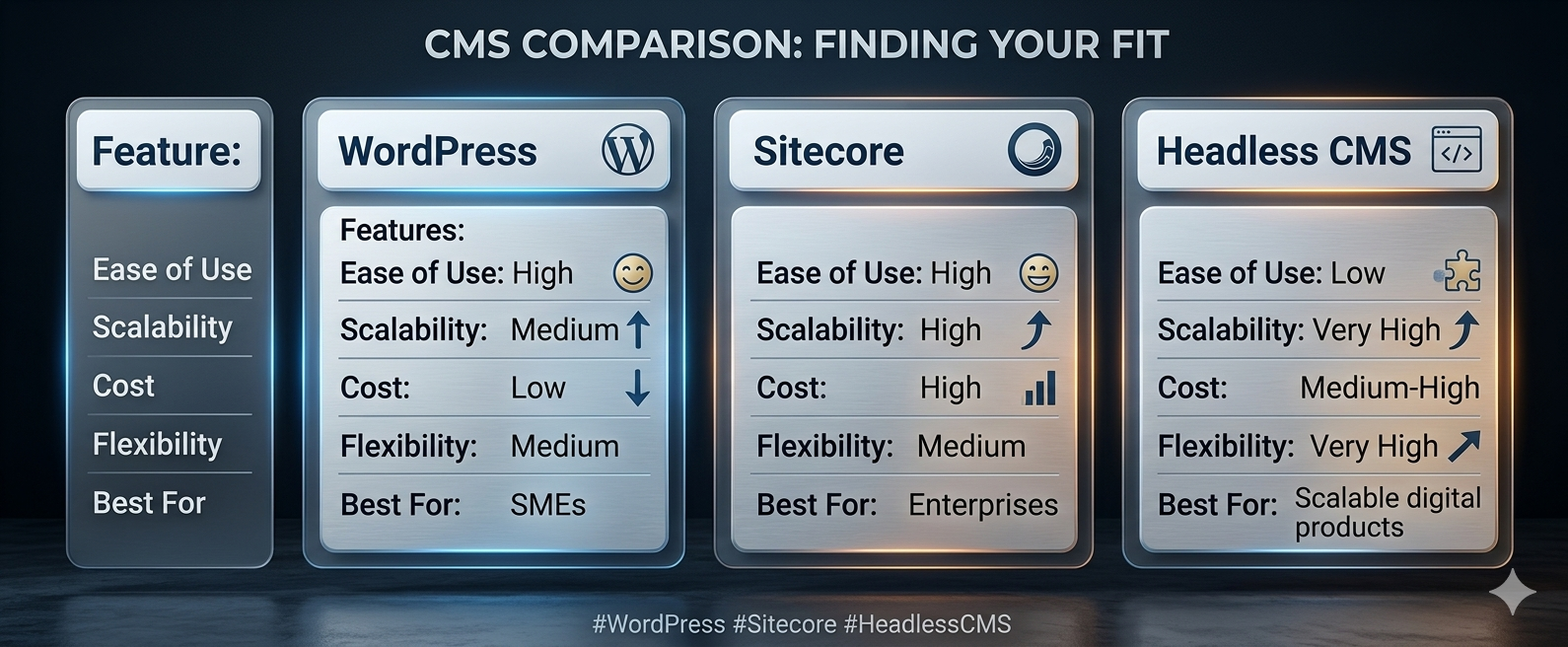
WordPress is ideal for speed and cost-efficiency, Sitecore excels in enterprise personalization, and headless CMS offers unmatched flexibility for scaling businesses.
The decision should always be based on your business model rather than feature comparisons alone.
How to Choose the Best CMS for Your Business
Choosing the right CMS depends on aligning your platform with your business goals.
Choose WordPress if:
- you are budget-conscious
- you need a content-focused website
- you want faster time to market
Choose Sitecore if:
- you require enterprise-level personalization
- you have complex integrations
- you operate at scale
Choose Headless CMS if:
- you need omnichannel delivery
- you are building scalable digital products
- you want long-term flexibility
Businesses planning larger digital ecosystems should also evaluate broader platform decisions, especially when choosing the right enterprise ecommerce platform for long-term scalability.
Best CMS for Businesses in Dubai and the UAE
For businesses operating in Dubai and the UAE, CMS selection often involves additional considerations such as multilingual content, high-performance expectations, and future regional expansion.
Organizations in this market are increasingly prioritizing:
- scalable digital platforms
- fast-loading, performance-optimized websites
- flexible architectures that support growth
Choosing the best CMS for business in Dubai requires balancing technical performance with long-term scalability, often supported by working with an experienced CMS development partner in the UAE.
CMS Trends in 2026: What They Mean for Your Platform Choice
CMS trends in 2026 are reshaping how businesses approach digital experiences. The shift toward AI-driven systems, headless architectures, and cloud-native platforms is not just technical—it directly influences CMS selection decisions.
Agentic AI and Automation in CMS Workflows
AI is evolving from content generation to execution. Modern CMS platforms are integrating automation that can manage workflows, optimize layouts, and update content dynamically.
This reduces manual effort while improving efficiency. Businesses relying heavily on content operations should prioritize CMS platforms that support these capabilities.
Headless and Hybrid CMS Dominance
Flexibility is now a core requirement. Headless and hybrid CMS architectures allow businesses to deliver content across multiple platforms without backend limitations.
This trend reinforces the importance of scalable architecture, especially for businesses expanding beyond traditional websites.
AI-Enhanced Collaboration Between Teams
CMS platforms are increasingly bridging the gap between marketing and development teams. AI-powered interfaces allow marketers to manage structured content while developers maintain control over technical architecture.
This improves workflow efficiency and reduces bottlenecks.
Predictive Analytics for Content Optimization
Advanced CMS platforms now integrate predictive analytics to track performance, analyze user behavior, and recommend optimizations.
This allows businesses to make data-driven decisions in real time, improving content effectiveness.
Immersive Web Design and Content Experience Trends
User expectations are evolving toward immersive experiences.
Key trends include:
- typography-driven layouts
- responsive and variable fonts
- dark mode standardization
These require CMS platforms that support modern frontend development.
Cloud-Native Scalability and Infrastructure Flexibility
Cloud-based CMS solutions enable businesses to scale without managing infrastructure.
Benefits include:
- improved performance during traffic spikes
- reduced operational overhead
- faster deployment cycles
What These Trends Mean for Your CMS Decision
These trends highlight a shift from traditional CMS platforms to experience-driven systems.
- WordPress is evolving to support flexibility and AI-driven workflows
- Sitecore continues to lead in personalization and enterprise integration
- Headless CMS dominates in scalability and omnichannel delivery
Your CMS decision should align with these trends to ensure long-term growth.
Need Help Choosing the Right CMS for Your Business?
There is no one-size-fits-all CMS. The right choice depends on your business stage, technical requirements, and long-term growth strategy.
If you are exploring scalable digital architectures, investing in headless WordPress development can provide the flexibility needed for omnichannel experiences. For enterprise-level personalization and complex integrations, working with a Sitecore development partner in Dubai ensures your platform is built for scale. Businesses that prefer a content-first approach with enterprise reliability often consider WordPress development services to balance performance and usability.
For organizations planning large-scale digital platforms, aligning your CMS with a robust enterprise website development strategy is equally critical to avoid future limitations.
Making the right decision early can prevent costly rebuilds and performance challenges later.
A well-planned CMS strategy today will define how effectively your business grows tomorrow.
FAQs
What is the best CMS for business in 2026?
The best CMS for business in 2026 depends on your specific needs. WordPress is ideal for content-driven websites and small to medium businesses, Sitecore is better suited for enterprises requiring advanced personalization, while headless CMS is the preferred choice for scalable, omnichannel digital platforms.
How do I choose the right CMS for my business?
Choosing the right CMS depends on your business size, budget, scalability requirements, and digital goals. If you need a simple and cost-effective solution, WordPress works well. For enterprise-level capabilities, Sitecore is a strong option. For flexibility and future scalability, headless CMS is often the best choice.
Is WordPress still a good choice for enterprise websites?
Yes, WordPress can be a good choice for enterprise websites when implemented correctly. Solutions like WordPress VIP provide enhanced performance, security, and scalability, making them suitable for large organizations with high traffic and content demands.
What is the difference between headless CMS and traditional CMS?
A traditional CMS combines content management and frontend presentation, while a headless CMS separates them. This allows content to be delivered via APIs across multiple platforms, providing greater flexibility, scalability, and performance.
When should a business choose Sitecore CMS?
Sitecore is best suited for large enterprises that require advanced personalization, integration with multiple systems, and the ability to manage complex digital experiences across multiple channels.
Is a headless CMS better than WordPress?
A headless CMS is not necessarily better than WordPress—it depends on the use case. Headless CMS is ideal for businesses that need flexibility, scalability, and omnichannel delivery, while WordPress is better for simpler, content-focused websites with faster implementation needs.
What are the benefits of headless WordPress?
Headless WordPress combines the ease of content management in WordPress with the flexibility of headless architecture. This allows businesses to build fast, scalable, and highly customized digital experiences while still using a familiar backend.