
Ecommerce Website Design UAE: Cost, Features & Process Guide


Ecommerce website design in the UAE typically costs anywhere from AED 5,000 for a basic template store to AED 200,000+ for an enterprise platform — and the difference comes down to platform choice, design depth, integrations, and how the site is engineered to scale. This guide breaks down exactly what drives that cost, the features a UAE online store genuinely needs, the design and development process from brief to launch, and how to choose the right platform and partner.
The UAE has become one of the Middle East’s fastest-growing ecommerce markets, driven by digitally connected consumers, high mobile commerce adoption, and ambitious business transformation initiatives. As competition intensifies, launching an online store is no longer enough. Businesses must invest in ecommerce website design that delivers exceptional customer experiences while supporting long-term scalability, operational efficiency, and growth.
For growing businesses and enterprise retailers alike, the challenge extends far beyond choosing an attractive layout. Selecting the right ecommerce platform, technology architecture, integrations, and digital commerce strategy directly influences customer acquisition, operational performance, and long-term return on investment. Decisions made during the planning stage determine how effectively a platform can scale with evolving customer expectations and business requirements — whether you’re launching a new store or modernizing an existing one.
How Much Does an Ecommerce Website Cost in the UAE?
The headline cost of an ecommerce website is only one part of the investment. For growing businesses and enterprise organizations, the real consideration is the Total Cost of Ownership (TCO) — the combined cost of building, operating, maintaining, and scaling a digital commerce platform over its lifecycle.
While a basic online store may require a relatively modest investment, larger ecommerce platforms involve additional considerations such as platform licensing, cloud infrastructure, system integrations, security, ongoing optimization, and long-term support. Evaluating these factors helps you choose a solution that aligns with both immediate objectives and future growth.
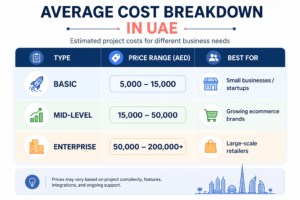
As a practical benchmark, ecommerce website design costs in the UAE generally fall into three tiers:
| Project tier | Typical UAE cost (AED) | What you get |
|---|---|---|
| Basic store (Shopify / WooCommerce) | 5,000 – 15,000 | Template-based design, standard checkout, essential payment gateway setup — suited to startups and small businesses |
| Mid-level custom store | 15,000 – 50,000 | Custom UX/UI design, bilingual (Arabic/English) support, local payment and shipping integrations, SEO foundation |
| Enterprise ecommerce platform | 100,000 – 200,000+ | Custom architecture, ERP/CRM integrations, large catalogues, advanced personalization, performance engineering |
If you’re comparing regional pricing benchmarks, our guide to Enterprise Website Development Costs in Dubai provides additional insight into how project scope, complexity, and business requirements influence overall investment.
Factors That Influence Ecommerce Website Design Cost in the UAE
Understanding what drives ecommerce website pricing is important before you invest. The prices Dubai businesses pay often depend on complexity, integrations, and scalability requirements. In the UAE market, costs vary not just by design but by how the website is built to perform, scale, and convert.
Below are the key factors that directly influence your total investment:
1. Platform Architecture & Technology Selection
Choosing the right platform is essential for successful online store development in the UAE. The platform you choose plays a major role in both upfront cost and long-term scalability.
- Shopify: Ideal for businesses seeking a fast, reliable launch with minimal technical complexity. It offers built-in hosting, security, and easy management, making it a popular choice for SMEs in Dubai and across the UAE.
- WooCommerce: A flexible option built on WordPress. It’s suitable for businesses that want more control over content and customization, but it requires ongoing maintenance and technical support.
- Custom Ecommerce Development: Best suited for enterprises or brands with unique requirements. While the initial cost is higher, it provides full control, advanced integrations, and long-term scalability.
If you’re unsure which direction to take, it’s worth reviewing different approaches through our Shopify development services in the UAE, where we outline platform suitability based on business size and goals.
Beyond initial implementation costs, evaluate each platform’s ability to support future expansion, third-party integrations, multi-region commerce, and evolving customer expectations. Selecting the right platform early reduces the likelihood of expensive migrations as the business grows.
2. Customer Experience Strategy
Ecommerce success depends on delivering intuitive, frictionless customer experiences that strengthen brand perception and increase conversions. User experience strategy should be driven by customer behaviour, business objectives, and long-term scalability rather than visual aesthetics alone.
In a competitive market like Dubai, where users are exposed to high-end digital experiences every day, investing in a professionally crafted interface can significantly improve trust and engagement. Many businesses underestimate how much strong design contributes to actual revenue growth — which is why experienced UI/UX design input early in the project consistently pays for itself.
3. Catalogue Scale & Operational Complexity
The size of your product catalogue affects both development effort and performance optimization.
- A store with 50 products is relatively simple to structure and manage
- A store with 5,000+ products requires:
- Advanced filtering systems
- Optimized database structure
- Scalable hosting and performance tuning
Larger catalogues also require better UX planning to ensure users can quickly find what they need, which adds to design and development time.
Enterprise retailers managing thousands of SKUs often require advanced product information management (PIM), intelligent search, filtering, and inventory synchronization across multiple sales channels.
4. Business System Integrations
As organizations grow, integrations become central to operational efficiency. Connecting ecommerce platforms with ERP, CRM, marketing automation, warehouse management, and analytics systems reduces manual processes and creates a unified customer experience.
Modern ecommerce websites are not standalone systems; they connect with multiple third-party tools to run efficiently. Common integrations include:
- Payment Gateways: Such as Telr, Stripe, and PayTabs, which are widely used in the UAE market
- Shipping & Logistics: Integration with providers like Aramex, DHL, or local courier services for real-time tracking and pricing
- ERP & CRM Systems: For inventory management, customer data, and business automation
The more integrations your business requires, the more development time is needed to ensure everything works seamlessly. A lean integration set keeps costs down for an ecommerce website design for a small business in the UAE, while businesses planning long-term growth should invest in scalable integrations early — professional ecommerce development can prevent costly rebuilds later.
5. Digital Growth Foundation
Ecommerce platforms should be designed to support sustainable digital growth. Integrating technical SEO, performance optimization, structured data, and conversion-focused UX during development reduces future optimization costs and creates stronger long-term ROI.
Perhaps the most underestimated yet fundamentally critical cost factor is the integration of performance marketing. A high-end aesthetic is insufficient if the platform fails to generate consistent traffic or convert users.
To ensure your investment functions as a revenue-generating asset rather than a static expense, prioritize the following during the development phase:
- Technical SEO Foundation: Engineering the site structure for optimal crawlability, maximizing page load speeds, and ensuring precise indexing.
- Strategic Content Optimization: Developing keyword-optimized product and category architectures that align with regional search intent.
- Conversion Rate Optimization (CRO): Designing layouts and call-to-action (CTA) placements specifically engineered to reduce friction and guide the user journey.
- Data Intelligence: Implementing robust performance tracking and advanced analytics to monitor ROI in real time.
For businesses aiming to secure organic market share and maximize long-term ROI, embedding these strategies from the initial build is essential. Our specialized SEO services in the UAE are designed to bridge this gap by driving qualified traffic that converts into loyal customers.
Rather than evaluating ecommerce website design solely by its initial cost, consider the long-term value it delivers. A scalable platform with the right architecture, integrations, and optimization strategy often generates significantly greater returns than a lower-cost solution that requires frequent redevelopment. Understanding Total Cost of Ownership enables businesses to make technology investments that support sustainable growth rather than short-term savings.
Essential Features of a High-Converting Ecommerce Website in the UAE
In the competitive UAE landscape, particularly within Dubai’s sophisticated digital economy, simply having an online presence is insufficient. To capture a tech-savvy audience, your platform must transcend aesthetics and function as a high-performance sales engine.
A high-converting ecommerce website prioritizes a mobile-first approach, low-latency performance, and frictionless checkout experiences. Below is a complete ecommerce website features checklist that UAE businesses should follow:
Core Technical Foundations
The underlying architecture of your site determines whether a user stays or bounces within the first three seconds.
- Mobile-First, Responsive Design: With over 70% of UAE consumers shopping via smartphones, your interface must be “thumb-friendly” and flawlessly responsive across all devices.
- Lightning-Fast Loading Speeds: High-resolution imagery must be balanced with clean code and CDN (Content Delivery Network) usage. Even a one-second delay can significantly erode conversion rates.
- Scalable Infrastructure: Leveraging robust platforms like Magento (Adobe Commerce) or high-tier Shopify setups ensures your site can handle traffic surges and complex functional growth.
UAE-Specific Localization
Operating in the Emirates requires adherence to local consumer habits and regulatory standards.
- Bilingual Functionality (Arabic + English): To achieve maximum market penetration, offering a seamless dual-language experience is a non-negotiable standard.
- Regional Payment Ecosystems: Integration with trusted gateways such as Telr, PayTabs, or Stripe UAE is vital. Furthermore, offering Cash on Delivery (COD) and Buy Now, Pay Later (BNPL) options remains a critical trust-builder for new brands.
- VAT Compliance: Systems must be engineered to display VAT clearly and automatically generate tax-compliant invoices.
Conversion-Driven UX & Trust Signals
Once a user is on the site, the goal shifts to reducing friction and building authority.
- Secure & Simplified Checkout: Implementing SSL encryption and minimizing checkout steps is essential. Frictionless transitions between the cart and payment confirmation reduce abandonment.
- Social Proof & Robust Validation: High-quality visuals (including 360-degree views) paired with customer reviews, ratings, and trust badges act as powerful psychological triggers for conversion.
- Direct Communication (WhatsApp Integration): In the UAE market, real-time assistance via WhatsApp is a high-impact feature that bridges the gap between browsing and buying.
- Smart Navigation & Search: Intuitive menus and advanced category-based filters help users locate products instantly, facilitating a faster path to purchase.
Optimize Your Digital Storefront for Growth
Building a platform that incorporates these sophisticated features is the difference between a static expense and a scalable revenue asset.
Are you looking to audit your current site’s performance, or are you ready to develop a new, high-performing platform from the ground up? Explore our E-commerce Solutions in the UAE to see how we build stores that dominate the UAE market.
The Ecommerce Website Design Process: From Brief to Launch
Whatever platform you choose, a disciplined process is what separates a store that converts from one that merely exists. A typical ecommerce website design project in the UAE follows these stages:
- Discovery & Strategy: Defining your business model, target customers, product catalogue structure, integration requirements, and success metrics. This stage sets the scope that determines cost and timeline.
- UX Architecture & Wireframing: Mapping customer journeys, navigation, category structures, and checkout flows before any visual design begins — including Arabic/English content planning where relevant.
- UI Design: Crafting the visual identity of the store — layouts, product page templates, typography, and imagery direction — aligned to your brand and conversion goals.
- Development & Integrations: Building the storefront, configuring or customizing the platform, and connecting payment gateways, shipping providers, ERP/CRM, and analytics.
- Content & Catalogue Setup: Loading products, descriptions, pricing, VAT configuration, and SEO metadata — often the hidden critical path for large catalogues.
- Quality Assurance & Testing: Cross-device testing, checkout and payment testing, performance and load validation, and security checks.
- Launch & Optimization: Go-live, analytics verification, and a post-launch optimization cycle informed by real user behaviour.
In terms of timeline: a basic ecommerce website can take 2 to 4 weeks, a mid-level build with custom design and integrations usually takes 4 to 8 weeks, and advanced platforms with ERP integrations and large catalogues may take 8 to 16 weeks or longer, depending on content readiness and approval cycles.
Choosing the Right Ecommerce Platform for Long-Term Growth
Choosing the right e-commerce platform is one of the most important technology decisions a business will make. Beyond launching an online store, the platform must support future growth, customer experience, operational efficiency, and evolving business requirements.
For organizations in the UAE, platform selection should consider scalability, integration capabilities, security, localization, total cost of ownership, and the ability to support multi-channel commerce. Rather than asking which platform is “best,” evaluate which solution aligns with your long-term digital commerce strategy.
Shopify
Shopify is one of the most popular ecommerce platforms in the UAE, especially for small- to mid-sized businesses looking for a fast, reliable launch.
- Easy to use with minimal technical knowledge
- Fast deployment with pre-built themes and apps
- Secure hosting and automatic updates
- Supports UAE payment gateways like Stripe, PayTabs, and Telr
Shopify Plus has also become a strong option for growing and mid-market businesses seeking enterprise-grade reliability without the operational complexity of managing infrastructure. For organizations prioritizing rapid deployment, omnichannel selling, and predictable maintenance, Shopify Plus offers an excellent balance between flexibility and scalability.
WooCommerce
WooCommerce is a flexible ecommerce solution built on WordPress, making it a strong choice for businesses that need content and ecommerce on a single platform.
- Highly customizable and open-source
- Great for SEO-driven ecommerce websites
- Ideal for businesses that rely on content marketing
- Large ecosystem of plugins and extensions
WooCommerce is particularly effective for organizations where content marketing, SEO, and editorial publishing play a central role in customer acquisition. However, businesses anticipating rapid growth should carefully evaluate hosting, security, and performance requirements to ensure the platform continues to scale alongside increasing traffic and operational demands.
To maximize flexibility and platform control, forward-thinking businesses use specialized WooCommerce development services in Dubai, ensuring their digital storefront is engineered for high performance and long-term scalability.
Magento (Adobe Commerce)
Adobe Commerce (formerly Magento) is designed for organizations with complex ecommerce operations, multiple customer segments, extensive product catalogues, and sophisticated integration requirements. It provides the flexibility required by enterprise retailers that need complete control over customer experiences, pricing models, workflows, and backend operations.
- Built for large product catalogues and high traffic
- Advanced customization and integrations
- Strong performance for complex ecommerce operations
This platform is best suited for established brands with technical resources and larger budgets. While it requires significant investment, it offers unmatched flexibility for large-scale operations. For enterprise businesses in the UAE, Magento is often part of a broader ecommerce development strategy that includes integrations, automation, and advanced UX design.
Custom Ecommerce Development
Custom ecommerce development is the most flexible option, allowing you to build a platform tailored entirely to your business model.
- Fully customized design and functionality
- Scalable architecture for long-term growth
- Seamless integration with ERP, CRM, and third-party systems
- Ideal for unique or complex business requirements
While the upfront cost is higher, custom development provides long-term value by eliminating platform limitations and enabling full control over performance and user experience. It is best suited for organizations with unique operational requirements, complex business logic, or ambitious digital transformation initiatives — providing complete ownership of the digital commerce experience.
How to Select the Right Ecommerce Platform?
There is no universal “best” ecommerce platform. The right choice depends on your organization’s business model, operational complexity, growth ambitions, and long-term technology strategy.
When evaluating platforms, decision-makers should consider:
- Expected business growth over the next 3–5 years
- Product catalogue size and complexity
- Integration requirements with ERP, CRM, POS, and marketing platforms
- Multi-language and multi-region expansion plans
- Internal technical capabilities
- Security and compliance requirements
- Total Cost of Ownership (TCO)
Selecting a platform should not be viewed as a short-term website decision but as a long-term investment in digital commerce infrastructure. The right platform enables businesses to scale efficiently while supporting evolving customer expectations and operational goals.
When Should Businesses Upgrade Their Ecommerce Platform?
Many organizations begin with a platform that meets their immediate needs but eventually outgrow its capabilities as operations become more complex.
Signs that it may be time to modernize your ecommerce platform include:
- Increasing performance issues during high traffic periods
- Growing product catalogues that are difficult to manage
- Manual processes caused by disconnected business systems
- Expansion into multiple countries or languages
- Limited customization restricting customer experience improvements
- Difficulty integrating ERP, CRM, warehouse, or marketing automation platforms
- Rising maintenance costs that outweigh platform benefits
Rather than waiting for technology limitations to affect revenue, organizations should regularly assess whether their ecommerce platform continues to support their business objectives and future growth plans.
Ecommerce Design Best Practices That Drive Revenue
A visually appealing ecommerce website is only the starting point. In a competitive market like the UAE, your website must be strategically designed to convert visitors into paying customers. This means combining strong design principles with insights into performance, SEO, and user behaviour.
Below are the key best practices every UAE ecommerce business should follow in 2026.
Customer Experience That Drives Revenue
Ecommerce success depends on delivering intuitive, frictionless customer experiences across every stage of the buying journey. Design decisions should reduce complexity, build trust, and support faster purchasing decisions while maintaining brand consistency across channels.
User experience (UX) and user interface (UI) design play a critical role in how customers interact with your website. Strong ecommerce UX design practice in the UAE directly impacts engagement and conversion rates.
- Clean, modern layout: A clutter-free design helps users focus on your products. In markets like Dubai, where users are exposed to premium brands, design quality directly impacts perception.
- Clear navigation: Your menu structure should be intuitive, allowing users to find products within 2–3 clicks. Poor navigation is one of the main reasons users abandon ecommerce websites.
- Strong product visuals: High-quality images, zoom functionality, and lifestyle shots significantly improve engagement and conversions. Investing in professional product visuals is just as important as the website itself.
- Minimal distractions: Avoid unnecessary pop-ups, excessive animations, or confusing layouts. Every element on the page should guide the user toward conversion.
A professionally designed interface ensures your website aligns with both user expectations and business goals. If you’re planning a redesign, our web design services in Dubai focus heavily on UX-driven ecommerce experiences.
Search Visibility as a Growth Strategy
An ecommerce website that isn’t optimized for search engines will struggle to generate consistent traffic. SEO should be built into the foundation of your website — not added later.
- Optimized URLs: Clean, keyword-rich URLs improve both user experience and search rankings (e.g., /mens-shoes instead of /product?id=123).
- Product schema markup: Structured data helps search engines understand your products and display rich results, such as ratings and prices, directly in search listings.
- Fast loading speed: Google prioritizes fast websites. Speed optimization not only improves rankings but also reduces bounce rates and increases conversions.
- Keyword-optimized content: Each product and category page should target relevant keywords with optimized titles, descriptions, and metadata.
SEO is a long-term growth driver for ecommerce businesses in the UAE, helping brands rank higher and attract qualified traffic month after month.
Conversion Optimization Throughout the Customer Journey
Driving traffic to your website is only half the battle. Conversion Rate Optimization (CRO) ensures that visitors actually take action — whether it’s making a purchase, adding to cart, or contacting your business.
Smart CTAs
Your calls to action (CTAs) should be clear, visible, and persuasive. Avoid generic wording and focus on action-driven language:
- “Buy Now”
- “Add to Cart”
- “Get Offer”
Placement is equally important. CTAs should appear above the fold, on product pages, and throughout the checkout process.
Simplified Checkout
A complicated checkout process is one of the biggest conversion killers in ecommerce.
- Offer guest checkout to reduce friction
- Minimize the number of steps required
- Enable autofill for faster form completion
- Display trust signals (secure payment icons, guarantees)
For UAE businesses, integrating local payment methods and ensuring a seamless checkout experience is essential. This is where working with an experienced ecommerce web design agency in the UAE makes a significant difference.
Personalization
Modern ecommerce websites are expected to deliver personalized experiences.
- Product recommendations based on browsing behaviour
- “Recently viewed” sections
- Dynamic offers or discounts
Personalization increases engagement and encourages repeat purchases, especially in competitive sectors like fashion, electronics, and beauty.
Final Insight
The most successful ecommerce websites in the UAE don’t rely on design alone — they combine UX, SEO, and CRO into a unified strategy. If your current website isn’t delivering results, it may not be a traffic problem — it could be a design and conversion problem.
Choosing the Right Ecommerce Design & Development Partner in the UAE
Selecting an ecommerce development partner is about more than technical capability. The right partner should understand digital commerce strategy, platform architecture, systems integration, customer experience, and long-term operational growth. A strategic technology partner helps businesses build scalable ecommerce ecosystems rather than simply delivering a website.
A Proven Portfolio of Scalable Solutions
A reputable agency should demonstrate a track record of delivering high-performance ecommerce platforms.
- Industry Relevance: Look for experience in your specific sector (B2B, B2C, or D2C). A well-optimized B2C ecommerce website in the UAE must prioritize speed, personalization, and mobile-first design.
- Regional Credibility: Verify their track record with UAE-based clients to ensure they understand local logistics and regulatory frameworks.
- Performance Metrics: Seek case studies that highlight measurable results, such as improvements in page load speeds or conversion rates.
Deep Local Market Intelligence
The UAE’s digital economy is unique. An agency must possess an intimate understanding of the region’s cultural and commercial nuances, including:
- Consumer Behaviour: Tailoring the UX to the preferences of a diverse, multinational demographic.
- Payment & Logistics: Expertise in integrating local payment gateways and last-mile delivery solutions essential for the Middle East.
- Bilingual Excellence: The ability to execute flawless English-Arabic localization that resonates with the local audience.
Technical Mastery and Integration Capabilities
Your agency should offer deep technical expertise across industry-leading platforms, including Magento (Adobe Commerce), Shopify, and custom headless architectures. Beyond the front-end, they must be capable of:
- Complex Integrations: Seamlessly connecting your ecommerce storefront with ERP, CRM, and inventory management systems — the core discipline of an established web development company in Dubai.
- Search Engine Authority: Ensuring that SEO best practices are baked into the site’s architecture from day one.
Commitment to Post-Launch Excellence
An ecommerce platform is a living asset that requires continuous refinement. A professional agency provides a roadmap for long-term success through:
- Proactive Maintenance: Regular security patches and version updates.
- Performance Optimization: Ongoing monitoring to ensure the site remains fast and functional as your traffic scales.
- Data-Driven Iteration: Using analytics to suggest UX improvements that drive higher ROI over time.
The right ecommerce partner contributes far beyond implementation. By combining strategic consulting, enterprise architecture, platform expertise, and ongoing optimization, organizations can build digital commerce ecosystems that support sustainable growth, operational efficiency, and measurable business outcomes.
Strategic Consulting & Digital Transformation
Ecommerce projects extend beyond development. Technology partners should help organizations evaluate platform suitability, define digital commerce roadmaps, identify operational efficiencies, and recommend scalable architectures that support future business growth. Strategic consulting reduces implementation risks while ensuring technology investments align with long-term business objectives.
Why Professional Ecommerce Website Design Delivers Greater Long-Term Value
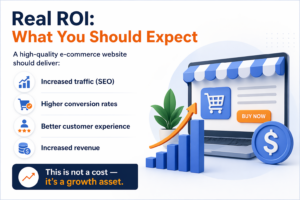
For ambitious organizations, an ecommerce platform is far more than an online storefront — it is a core business asset that supports revenue generation, customer experience, operational efficiency, and long-term digital growth. While low-cost solutions may reduce initial investment, they often introduce scalability limitations, integration challenges, and higher operational costs as the business expands.
Investing in professional ecommerce website design should therefore be evaluated on long-term business value rather than upfront cost alone. A scalable architecture, strong customer experience, seamless integrations, and continuous optimization contribute significantly to return on investment over the platform’s lifecycle.
Customer Experience That Increases Revenue
High-performing ecommerce platforms guide customers through intuitive purchasing journeys that reduce friction, increase conversion rates, and encourage repeat purchases. Every design decision should support measurable business outcomes rather than purely visual appeal.
- Frictionless Path to Purchase: A clean, intuitive checkout process drastically reduces cart abandonment by eliminating unnecessary hurdles.
- Strategic Visual Hierarchy: Professional design uses clear calls to action (CTAs) and logical navigation to guide users toward conversion, ensuring the user journey is effortless.
- High-Impact Visuals: Utilizing high-resolution imagery and 360-degree views minimizes purchase hesitation and builds consumer confidence.
Building Customer Trust & Brand Credibility
In Dubai’s luxury-oriented, high-standard market, your digital aesthetic directly reflects your brand’s legitimacy. Strong brands build trust through consistent customer experiences, transparent policies, secure payment environments, and professional digital interactions across every touchpoint.
- First Impressions: Research indicates that users make a judgment on brand trustworthiness within milliseconds. A professional, bespoke design signals authority and reliability.
- Perceived Security: A polished layout, combined with clearly integrated, secure payment gateways, reduces “transaction anxiety,” making customers more comfortable sharing sensitive financial data.
Performance, Search Visibility & Operational Efficiency
A premium design is as much about what is “under the hood” as what is on the surface.
- Mobile-First Responsiveness: With the majority of UAE commerce occurring on mobile devices, a responsive design ensures a flawless experience across all screen sizes.
- SEO from the Ground Up: Quality ecommerce design integrates technical SEO, including optimized image sizes, clean code, and structured URLs, to ensure your products rank higher in Google search results.
- Reduced Bounce Rates: Fast-loading pages and intuitive UX keep users engaged longer, sending positive signals to search algorithms and improving your organic visibility.
Performance improvements benefit more than search rankings. Faster websites improve customer satisfaction, reduce operational bottlenecks, support higher traffic volumes, and contribute directly to increased revenue.
Scalability & Sustainable Growth
Ecommerce platforms should evolve alongside the business. Scalable technology foundations reduce the need for costly redevelopment projects while enabling organizations to expand product catalogues, enter new markets, integrate additional business systems, and support increasing customer demand.
- Future-Proofing: Scalable platforms grow with your business, requiring fewer expensive overhauls than DIY or low-end templates.
- Brand Differentiation: Custom design distinguishes your brand in a crowded marketplace, preventing you from blending in with competitors who rely on generic layouts.
Secure Your Market Position
A well-designed ecommerce platform is an appreciating asset that increases your average order value and builds sustained brand loyalty.
Are you ready to transform your online presence into a high-performance sales engine? Explore our professional web design services in the UAE to see how we bridge the gap between creative excellence and commercial results.
Building Your UAE Ecommerce Website for Long-Term Growth
Ecommerce success in the UAE is no longer defined by simply launching an online store. As customer expectations continue to evolve, businesses need digital commerce platforms that combine exceptional customer experiences with scalable technology, operational efficiency, and long-term adaptability.
Choosing the right approach to ecommerce website design involves much more than comparing development costs or feature lists. Platform architecture, business integrations, performance, security, localization, and future scalability all play a critical role in determining how effectively your store supports business growth over time.
For organizations operating in the UAE and across the GCC, investing in a scalable ecommerce ecosystem enables teams to streamline operations, deliver consistent customer experiences, and respond more effectively to changing market demands. Whether expanding into new regions, integrating enterprise systems, or modernizing an existing platform, every technology decision should support long-term commercial objectives rather than short-term implementation goals.
At Element8, we partner with businesses to design and develop ecommerce platforms that combine strategy, technology, and customer experience into a single digital commerce ecosystem. From Shopify Plus and Adobe Commerce implementations to custom ecommerce development and platform modernization, our solutions are built to support measurable business outcomes and sustainable growth.
Planning your next ecommerce transformation? Speak with the Element8 team to build a scalable digital commerce platform designed for long-term success.
FAQs
How much does an ecommerce website cost in the UAE?
The cost of building an ecommerce website in the UAE typically ranges from AED 5,000 to AED 200,000, depending on the website’s complexity, platform, and required features. A basic Shopify or WooCommerce store for small businesses may cost between AED 5,000 and 15,000, while mid-level custom websites range from AED 15,000 to 50,000. Enterprise ecommerce platforms with advanced integrations, custom UX, and scalability can exceed AED 100,000. Factors like payment gateway integration, SEO setup, and mobile optimization also influence the final cost.
Which platform is best for ecommerce in the UAE?
The best ecommerce platform in the UAE depends on your business size and goals. Shopify is ideal for small to medium businesses due to its ease of use, fast setup, and support for UAE payment gateways. WooCommerce suits flexibility and content-driven websites. For large-scale operations, Magento (Adobe Commerce) or custom ecommerce solutions offer advanced scalability and customization. Many UAE businesses start with Shopify and upgrade as they grow.
Do I need VAT compliance for ecommerce in the UAE?
Yes, VAT compliance is mandatory for ecommerce businesses operating in the UAE. Your website must correctly apply 5% VAT, display pricing transparently, and generate tax-compliant invoices. Your ecommerce system should also integrate with accounting or ERP tools for accurate VAT reporting. Non-compliance can lead to penalties, so work with a web development agency that understands UAE tax regulations and can implement VAT-ready functionality from the start.
How long does it take to build an ecommerce website?
The timeline depends on the project’s complexity. A basic ecommerce website can take 2 to 4 weeks, while a mid-level website with custom design and integrations usually takes 4 to 8 weeks. More advanced platforms with custom features, ERP integrations, and large product catalogues may take 8 to 16 weeks or longer. Timelines also depend on content readiness, approval cycles, and the level of customization required.
Can I integrate local payment gateways?
Yes, ecommerce websites in the UAE can integrate a wide range of local and international payment gateways. Popular options include Telr, PayTabs, Stripe, and Checkout.com, all of which support UAE-based businesses. These gateways allow you to accept credit cards, Apple Pay, and local payment methods, ensuring secure transactions and faster checkouts. Many UAE businesses also combine online payments with Cash on Delivery (COD) to maximize conversions.
Is Shopify good for UAE businesses?
Yes, Shopify is one of the best ecommerce platforms for UAE businesses, especially startups and SMEs. It offers a user-friendly interface, fast deployment, and seamless integration with UAE payment gateways like Stripe and PayTabs, plus mobile optimization, secure checkout, and a wide range of apps for marketing and logistics. For highly customized or enterprise-level requirements, consider Magento or custom-built ecommerce solutions for greater flexibility.
If you’re weighing up ecommerce website design in the UAE, Element8’s Dubai team can review your requirements, recommend the right platform, and give you a realistic cost and timeline — get in touch for a consultation.