
Website Development Cost in Dubai: Complete 2026 Guide


Website development cost in Dubai typically ranges from AED 3,500 for a basic business website to AED 275,000+ for custom enterprise platforms in 2026. Where your project lands in that range depends on scope, platform choice, integrations, security requirements, and how much the site must scale.
As businesses across the UAE continue accelerating digital transformation initiatives, website development has evolved far beyond creating simple online platforms. Modern organizations require scalable digital ecosystems that support customer engagement, multilingual experiences, operational efficiency, integrations, and long-term business growth.
In 2026, business and enterprise websites are no longer treated as standalone marketing assets. They function as integrated digital platforms that connect with CRMs, ERP systems, ecommerce operations, customer portals, analytics ecosystems, and internal workflows.
This guide breaks down website development cost in Dubai by project type, explains the factors that move pricing up or down, covers the hidden costs of ownership, and shows how organizations can plan digital investments that align with long-term business objectives.
Looking for design-stage budgets specifically — UI/UX, wireframes, and visual design pricing? See our companion guide to website design cost in Dubai. This article focuses on the full development build: platforms, engineering, integrations, and total cost of ownership.
Website Development Cost in Dubai: Quick Answer (2026)
As a practical planning benchmark, these are the typical Dubai market ranges by project type in 2026:
- Basic business website: AED 3,500 – AED 8,000
- Corporate/SME website: AED 12,000 – AED 55,000
- Ecommerce website: AED 15,000 – AED 110,000+
- Custom web application / enterprise platform: AED 50,000 – AED 275,000+
- Large-scale enterprise ecosystems: AED 25,000 – AED 500,000+ depending on integrations and infrastructure
These are planning estimates, not fixed rates — each tier is unpacked in detail below.
Why Website Development Costs in Dubai Vary Significantly
One of the most common misconceptions about website pricing is that all websites follow the same development model. In reality, enterprise website development projects differ substantially from standard business websites in terms of architecture, governance, integrations, and scalability.
A small informational website may require limited functionality, while enterprise platforms often involve:
- Complex UX strategy
- Multilingual infrastructure
- Third-party integrations
- Custom workflows
- Enterprise CMS implementation
- Security and compliance frameworks
- Advanced hosting environments
- Performance optimization
- Accessibility requirements
- Ongoing scalability planning
Organizations investing in long-term digital infrastructure typically prioritize stability, scalability, and operational efficiency over short-term development costs.
For enterprises in sectors such as government, healthcare, finance, education, retail, and logistics, website development becomes a strategic business investment rather than a simple design project.
Businesses planning scalable digital ecosystems should evaluate long-term operational requirements before selecting an enterprise web development company in Dubai.
Website Development Cost by Type: A Deeper Look
Basic Business Website
Ideal for service-based businesses that need to establish trust. These usually include 3–5 pages: Home, About, Services, and Contact.
- What’s included: Mobile-responsive design, basic SEO setup, contact forms, and social media integration.
- Cost range: AED 3,500 – AED 8,000.
Corporate/SME Website
For established firms, a corporate site requires a more robust Content Management System (CMS), such as WordPress, enabling the marketing team to update content frequently.
- What’s included: 10–20 pages, blog section, advanced UI/UX, career portals, and multilingual support (English/Arabic).
- Cost range: AED 12,000 – AED 55,000.
E-commerce Website
In 2026, e-commerce development in Dubai requires more than just a “buy” button. It needs integration with regional payment gateways (Telr, PayTabs) and logistics providers.
- What’s included: Inventory management, payment gateway integration, Tabby/Tamara “Buy Now Pay Later” setups, and high-level security.
- Cost range: AED 15,000 – AED 110,000+.
Custom Web Application & Enterprise Solutions
These are built from scratch using frameworks like Laravel, ReactJS, or Python/Django. They are designed for businesses with unique workflows that a standard CMS cannot handle.
- What’s included: Bespoke UI/UX, API integrations (ERP/CRM), high-load performance optimization, and custom user roles.
- Cost range: The custom website development cost UAE companies invest in can exceed AED 50,000 – AED 275,000+.
Key Factors That Influence Enterprise Website Development Cost
1. Website Scope and Platform Complexity
The overall scope of the project is one of the largest pricing factors.
Basic corporate websites generally require fewer development resources compared to enterprise platforms that support advanced business operations.
Enterprise-level projects may include:
- Multi-site architecture
- Customer portals
- Ecommerce systems
- User dashboards
- Advanced search functionality
- CRM integrations
- API-based infrastructure
- Role-based permissions
- Workflow management systems
Organizations requiring advanced business logic often invest in custom web application development to support operational workflows and enterprise integrations.
The more interconnected the platform becomes, the greater the development complexity and implementation effort.
2. CMS Selection and Content Governance
The content management system (CMS) significantly impacts website development costs.
Organizations with large content operations, multiple stakeholders, and multilingual publishing requirements often require enterprise-grade CMS solutions that support governance, scalability, and workflow automation.
Common enterprise CMS options include:
- WordPress (custom enterprise implementation)
- Sitecore
- Drupal
- Headless CMS platforms
- Adobe Experience Manager
While WordPress remains highly flexible for many enterprise implementations, large organizations may require additional customizations for:
- Content governance
- Role permissions
- Multi-site management
- Enterprise security
- Workflow approvals
- Performance optimization
Businesses evaluating scalable content ecosystems often compare multiple CMS development services before selecting the right enterprise platform.
Organizations with advanced personalization and enterprise content requirements may also evaluate Sitecore development services for large-scale digital experience management.
3. UX/UI Strategy and Customer Experience Design
Modern enterprise websites prioritize user experience as a core business function.
UX/UI planning impacts:
- Customer engagement
- Conversion rates
- Accessibility
- Operational efficiency
- User retention
- Digital adoption
Enterprise UX design often includes:
- Customer journey mapping
- Information architecture
- Accessibility compliance
- Mobile-first design systems
- User behavior analysis
- Multi-device optimization
- Enterprise dashboard design
Organizations investing in enterprise customer experiences frequently partner with specialized UX/UI design agencies in Dubai to improve usability, accessibility, and long-term engagement.
4. Third-Party Integrations and Enterprise Systems
One of the biggest cost drivers in enterprise website development is integration complexity.
Modern organizations rely on interconnected digital ecosystems involving:
- CRM platforms
- ERP systems
- Marketing automation tools
- Payment gateways
- Inventory systems
- HR platforms
- Analytics systems
- Customer support software
These integrations require:
- API development
- Middleware configuration
- Security testing
- Workflow mapping
- Data synchronization
- Performance optimization
Integration-heavy projects typically require advanced backend architecture and significantly more development resources compared to standalone websites.
For enterprise ecommerce ecosystems, organizations often require scalable ecommerce website development services capable of supporting omnichannel operations and complex integrations.
Security, Compliance, and Infrastructure
Enterprise organizations operating in regulated industries often require advanced security and compliance frameworks.
Security implementation may include:
- SSL infrastructure
- Role-based access control
- Secure authentication systems
- Penetration testing
- Firewall configurations
- Data encryption
- Backup systems
- Monitoring systems
Additionally, organizations may require compliance considerations related to:
- UAE data protection regulations (PDPL)
- GDPR for international audiences
- Accessibility standards
- Government digital requirements
- Internal governance policies
Enterprise infrastructure planning also includes hosting environments, cloud scalability, redundancy systems, and disaster recovery planning.
These requirements directly impact development timelines and implementation costs.
Organizations undergoing modernization initiatives often integrate website infrastructure into broader digital transformation strategies to improve scalability and operational efficiency.
Typical Enterprise Website Cost Ranges in Dubai
Website development costs in Dubai vary based on project scope, integrations, and infrastructure requirements.
Below is a general enterprise-focused pricing framework for 2026.
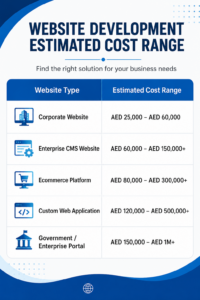
These figures vary depending on:
- System integrations
- UX requirements
- Security complexity
- Content architecture
- Performance requirements
- Multi-language implementation
- Workflow systems
- Hosting infrastructure
Organizations should avoid evaluating projects solely based on upfront pricing and instead assess long-term scalability and operational efficiency.
Why Enterprise Websites Require Higher Investment
Enterprise websites involve significantly more complexity compared to standard business websites.
Unlike smaller projects, enterprise platforms often support:
- Multiple departments
- High traffic environments
- Content governance workflows
- Regional operations
- Enterprise analytics
- Omnichannel experiences
- Internal operational systems
Development teams must plan for:
- Scalability
- Performance under load
- Long-term maintenance
- Security resilience
- Technical debt reduction
- Future platform expansion
The goal is not simply to launch a website, but to create sustainable digital infrastructure that supports long-term organizational growth.
Key Factors Influencing Website Development Costs in Dubai
Understanding why one quote is AED 5,000 and another is AED 50,000 is critical for decision-makers.
- Design complexity: A template-based site is cost-effective but lacks brand uniqueness. Tailored UI/UX design, which involves wireframing and prototyping, increases the investment but significantly boosts conversion rates.
- Bilingual functionality: In Dubai, Arabic/English support is standard. However, implementing Right-to-Left (RTL) coding correctly requires specialized technical expertise.
- Features & integrations: Adding AI chatbots, booking engines, or real-time user behavior tracking will drive up the price due to the development hours required.
- SEO readiness: A “pretty” site that doesn’t rank is a liability. Integrated SEO, including schema markup and site speed optimization, is a prerequisite for the Dubai market.
The Hidden Costs Organizations Should Consider
Many businesses underestimate the long-term operational costs associated with enterprise digital platforms. The true budget question is not just “how much does the build cost?” but “what is the total cost of ownership over three to five years?”
In addition to development costs, organizations should account for:
Ongoing Maintenance
- Security updates
- CMS updates
- Plugin management
- Bug fixes
Organizations managing large digital ecosystems often require ongoing website maintenance services to ensure security, stability, and long-term platform performance.
Hosting and Infrastructure
- Cloud hosting
- CDN implementation
- Scalability environments
- Backup systems
SEO and Performance Optimization
- Technical SEO
- Core Web Vitals optimization
- Content optimization
- Analytics management
Many enterprise organizations also invest in advanced technical SEO services to improve search visibility, site performance, and long-term digital growth.
Content Operations
- Multilingual content management
- Workflow approvals
- Governance systems
Future Scalability
- Feature expansion
- Additional integrations
- New user requirements
Planning for long-term digital operations helps reduce technical debt and operational inefficiencies over time.
Choosing the Right Website Development Partner in Dubai
Selecting the right development partner is often more important than choosing the lowest-cost option.
Enterprise organizations should evaluate a web development company in Dubai based on:
- Technical expertise
- Enterprise project experience
- UX capabilities
- CMS specialization
- Scalability planning
- Security implementation
- Integration experience
- Long-term support capabilities
A strategic technology partner should understand both technical architecture and business objectives.
Organizations should also assess whether the agency can support future digital transformation initiatives beyond the initial website launch.
Enterprise Website Development Trends in 2026
Several trends are influencing enterprise website development strategies across the UAE.
Headless Architecture
Organizations increasingly adopt headless CMS platforms for flexibility and omnichannel delivery.
AI-Powered Experiences
AI-driven personalization, automation, and intelligent search capabilities continue growing.
Accessibility Compliance
Accessibility standards are becoming increasingly important for enterprise and government organizations.
Performance Optimization
Core Web Vitals and user experience performance remain critical ranking and engagement factors.
Security-First Development
Cybersecurity and data protection are becoming central components of enterprise architecture planning.
Businesses planning future-ready digital ecosystems should align website investments with evolving technology expectations.
How Organizations Can Plan Website Budgets More Effectively
To build scalable digital infrastructure, organizations should approach website development strategically rather than transactionally.
Effective planning includes:
- Defining long-term business goals
- Mapping operational workflows
- Identifying integration requirements
- Evaluating scalability expectations
- Prioritizing customer experience
- Planning governance structures
- Allocating ongoing maintenance budgets
A well-planned website reduces future redevelopment costs and supports sustainable digital growth. And if your immediate question is about the design phase alone — interface design, UX planning, and design-stage pricing — our dedicated guide to website design cost in Dubai covers those budgets in depth.
Conclusion
Website development costs in Dubai continue evolving as organizations invest in scalable digital ecosystems that support long-term growth, operational efficiency, and customer engagement.
For enterprise organizations, website development is no longer limited to design and development alone. It involves strategic planning, integration architecture, user experience optimization, governance systems, scalability planning, and digital transformation readiness.
Businesses evaluating website investments should focus on long-term value creation rather than short-term pricing alone.
A scalable digital platform built with the right architecture, infrastructure, and strategic planning can become a critical driver of operational efficiency and business growth in 2026 and beyond.
Planning a Website Development Project in Dubai?
Element8 helps organizations across the UAE build scalable digital platforms tailored for enterprise growth, operational efficiency, and long-term digital transformation initiatives.
Speak with our enterprise web development team to discuss your project requirements, infrastructure goals, and a realistic budget for your build.
FAQs
How much does a website cost in Dubai?
In 2026, a website in Dubai typically costs AED 3,500 – AED 8,000 for a basic business site, AED 12,000 – AED 55,000 for a corporate website, AED 15,000 – AED 110,000+ for ecommerce, and AED 50,000 – AED 275,000+ for custom enterprise platforms.
How much does enterprise website development cost in Dubai?
Enterprise website development costs in Dubai typically range from AED 25,000 to AED 500,000+ depending on project scope, integrations, infrastructure requirements, and scalability expectations. Multi-site, multilingual, and integration-heavy platforms sit at the higher end of that range.
What is the website development cost in the UAE outside Dubai?
Website development cost in the UAE follows similar ranges across Abu Dhabi, Sharjah, and the other emirates, since most agencies serve the whole country. Pricing is driven by scope, platform, and integrations rather than location, though enterprise and government projects may carry additional compliance requirements.
How much does an ecommerce website cost in Dubai?
Ecommerce website costs in Dubai typically start around AED 15,000 and can exceed AED 110,000 for large catalogs, multilingual stores, and custom integrations with regional payment gateways (Telr, PayTabs), BNPL providers like Tabby and Tamara, and logistics platforms.
Why are enterprise websites more expensive?
Enterprise websites involve advanced UX strategy, integrations, governance systems, security implementation, scalability planning, and long-term infrastructure management, making them significantly more complex than standard websites. They must support multiple departments, high traffic, and interconnected business systems.
Is WordPress suitable for enterprise websites?
Yes. WordPress can support enterprise implementations when properly customized with scalable architecture, governance systems, security optimization, and performance enhancements. Many large UAE organizations run enterprise-grade WordPress alongside platforms like Sitecore and headless CMS options.
What affects website development pricing the most?
The biggest pricing factors include integrations, platform complexity, CMS requirements, UX strategy, multilingual (English/Arabic) support, security implementation, and scalability planning. Integration-heavy builds with custom workflows consistently cost more than standalone brochure websites.
How long does enterprise website development take?
Most enterprise website projects take between 3 to 9 months depending on scope, integrations, approval workflows, and infrastructure complexity. Simpler corporate websites can launch in 6–12 weeks with a well-defined scope.