

Healthcare Website Design in Dubai: Cost, Features & Best Practices



When a patient in Dubai needs a specialist, their first move is rarely to ask a friend. They Google it. They check your website, scroll through your doctor profiles, look for a booking button, and make a judgement call in under ten seconds. If your site looks outdated, loads slowly, or doesn’t answer their questions clearly, they move on to the next result.
This is the reality of healthcare in the UAE today. With the digital health market across the region growing rapidly and patients increasingly expecting the same seamless experience from a clinic website as they do from a banking app, having a professionally designed medical website is no longer optional — it is a core part of your practice’s credibility.
Whether you run a private clinic in JLT, a multi-specialty hospital in Abu Dhabi, or a specialist practice under DHA licensing, this guide walks you through everything you need to know about healthcare website design in Dubai: what features you need, what it typically costs, and how to make smart decisions when choosing a design partner.
What Makes Healthcare Website Design Different from Other Industries
Not every website serves the same purpose. A restaurant website needs to look appetising. A law firm’s site needs to feel authoritative. But a medical website needs to do something much harder — it needs to build trust with someone who may be about to make a decision about their health.
That changes nearly every design decision.
Trust signals are non-negotiable
Patients need to know your clinic is legitimate before they book. This means your website must clearly display DHA (Dubai Health Authority) or MOH (Ministry of Health) licensing credentials, doctor qualifications and specialisations, and any relevant accreditations. These aren’t just nice additions — they are the first things a cautious patient looks for, and their absence creates doubt.
Compliance and privacy matter
While UAE healthcare regulations differ from HIPAA in the US, any website collecting patient data through appointment forms, chat tools, or portals must handle that data responsibly. Your web design agency should understand data privacy best practices, SSL security, and how to structure forms and patient communication tools in a way that protects both the patient and the practice.
Accessibility and multilingual design are essential
Dubai is one of the most diverse cities in the world. Your patients may be Emirati nationals, South Asian expats, European professionals, or Arab nationals from across the region. A healthcare website that only serves one language is leaving a significant portion of its audience underserved. Arabic and English bilingual design — with proper right-to-left (RTL) layout support for Arabic — is a baseline requirement, not an upgrade.
Must-Have Features for a Medical Website in Dubai
A well-designed medical website is more than a digital brochure. It should actively serve patients throughout their journey — from the moment they search online to the moment they walk into your clinic. Here are the features that matter most.
Online appointment booking and patient portal
The single biggest conversion driver on any medical website is an easy-to-use appointment booking system. Patients expect to be able to book a slot without making a phone call. A good booking integration should show doctor availability in real time, send automated confirmation and reminder messages, and ideally integrate with your clinic management software.
For larger practices, a patient portal — where patients can view past visit notes, download reports, or message their doctor — adds significant value and builds long-term loyalty.
WhatsApp integration
This is uniquely important in the UAE market. WhatsApp is not just a messaging app here — it is how patients communicate with businesses. Adding a WhatsApp chat button to your medical website gives patients an immediate, familiar way to ask questions, confirm appointments, or follow up after a visit. In terms of conversion impact, it is one of the highest-return additions you can make.
Doctor and specialist profiles
Patients choose doctors, not just clinics. Each specialist on your team should have a dedicated profile page that includes their photo, qualifications, areas of expertise, languages spoken, and a direct booking link. These pages also serve an SEO purpose — they can rank for searches like “cardiologist in Dubai” or “paediatric specialist JBR.”
Department and service pages
Every specialty or service your clinic offers should have its own page. This is important for two reasons. First, it helps patients find exactly what they’re looking for quickly. Second, individual service pages can rank in search results for specific medical queries, bringing in highly targeted organic traffic. A clinic offering physiotherapy, dermatology, and general practice should not be describing all three on a single page.
Arabic and English bilingual design (RTL layout)
As mentioned above, a bilingual website is essential in Dubai. But bilingual design is not simply a matter of translating text — it requires a full layout adjustment for Arabic, since Arabic reads right to left. Navigation, buttons, form fields, and imagery all need to adapt correctly for the Arabic version of the site. This is a technical requirement that many generic web design agencies get wrong, which is worth keeping in mind when you evaluate partners.
Trust and compliance elements
Beyond DHA and MOH licensing badges, your website should include patient testimonials, Google review integration, and media mentions if applicable. For medical tourism-facing practices, international accreditations such as JCI (Joint Commission International) are worth prominently displaying. These elements reduce hesitation and give new patients the confidence to make an appointment.
Mobile-first design
More than 70% of web traffic in the UAE comes from mobile devices. A medical website that is not fully optimised for mobile — with fast load times, tap-friendly buttons, readable fonts, and a streamlined booking flow — will lose a significant portion of its potential patients before they even read a word of your content.
Healthcare Website Design Cost in Dubai
One of the most common questions clinic owners ask is: how much does a medical website cost in Dubai? The honest answer is that it depends on the complexity of what you need. Here is a general guide to help you set expectations.
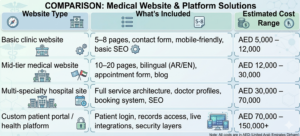
These ranges reflect typical project costs with an experienced Dubai-based web design agency. Cheaper options do exist, but they often come with trade-offs — generic templates, no Arabic support, limited SEO, or no ongoing maintenance. For a healthcare brand where patient trust is at stake, the cost of a poorly designed website is much higher than the savings.
It is also worth budgeting for ongoing costs: hosting, SSL renewal, content updates, and SEO maintenance. A good agency will offer a care plan or retainer option that keeps your site secure, fast, and up to date.
Best Practices for Medical Website UX in the UAE
Design is not just about how a website looks — it is about how it works for the person using it. Here are the UX principles that matter most for healthcare websites in the Dubai market.
Make the path to booking obvious: Your primary call-to-action — whether that is “Book an Appointment,” “Call Us,” or “Chat on WhatsApp” — should be visible without scrolling on every page. Do not make patients hunt for it.
Prioritise page speed: Google research shows that a one-second delay in page load time can reduce conversions by up to 20%. In the UAE, patients on mobile networks expect instant load times. Compress images, use a fast hosting provider, and test your site regularly with tools like Google PageSpeed Insights.
Structure content around patient questions: Your homepage should answer three things immediately: what you offer, who you serve, and how to get in touch. Department and service pages should answer the questions patients actually search for — symptoms, treatments, recovery time, cost — rather than being filled with clinical jargon.
Use local SEO to your advantage: Register your clinic on Google Business Profile with accurate location, hours, and service categories. Encourage patients to leave Google reviews. Use location-specific terms naturally throughout your content — phrases like “dermatologist in Dubai Marina” or “physiotherapy clinic near DIFC” help your site appear in local searches.
Ensure WCAG accessibility compliance: Accessible design — clear contrast ratios, alt text on images, keyboard-navigable pages — is both good practice and increasingly expected. It also helps with SEO.
How to Choose the Right Healthcare Web Design Agency in Dubai?
Not every agency that offers web design services in Dubai has experience with the specific requirements of the healthcare sector. Here is what to look for when evaluating your options.
Sector experience: Ask whether the agency has designed websites for clinics, hospitals, or medical practices before. Ask to see examples. A portfolio with healthcare clients tells you the agency understands the trust dynamics, compliance considerations, and UX patterns that matter in this space.
Bilingual design capability: Confirm that the agency can build fully functional Arabic RTL layouts, not just translate text. Ask how they handle bilingual content management — ideally, you should be able to update content in both languages through one CMS.
SEO integration: A beautiful website that no one finds is a missed opportunity. Your agency should build SEO best practices into the site from the ground up — clean URL structures, fast load times, proper heading hierarchy, schema markup for medical content, and on-page optimisation for your target keywords.
Appointment system and third-party integrations: Clarify whether the agency can integrate your preferred booking tool, EMR system, or CRM. Custom integrations require technical capability that not all agencies have.
Post-launch support: Your website is not a one-time project. Ask what happens after launch — who handles security updates, content changes, and technical issues. A clinic that loses its website due to a missed update or security breach loses patient trust with it.
Transparent pricing: A reliable agency will give you a clear scope of work and a fixed price or a clearly defined hourly rate before work begins. Be cautious of agencies that are vague about cost or scope.
At Element8, we work with healthcare businesses across Dubai and the wider UAE, building websites that balance strong visual design with real clinical credibility. If you want to see how we approach web design for businesses in Dubai across different sectors, our main services page is a good starting point.
Final Thoughts
A healthcare website in Dubai is one of the most consequential marketing investments a clinic or hospital can make. Done well, it builds trust before a patient ever walks through your door, converts searchers into booked appointments, and serves as the digital hub around which all your other marketing efforts connect.
Done poorly, it does the opposite — it raises doubts, creates friction, and hands patients to your competitors.
The difference comes down to understanding what patients actually need, building a site that is technically sound and visually credible, and working with a team that knows the specific requirements of the UAE healthcare market.
If you are planning a new website for your clinic or hospital — or if your current site is not performing the way it should — we would be glad to talk through your options. Get in touch with the Element8 team for a no-obligation consultation and a clear project quote.
FAQs
How much does a healthcare website design cost in Dubai?
The cost of a medical website in Dubai depends on the size and complexity of the project. A basic clinic website with 5–8 pages, a contact form, and mobile-friendly design typically costs between AED 5,000 and AED 12,000. A mid-tier site with bilingual (Arabic/English) support, appointment booking, and a blog falls in the AED 12,000–30,000 range. A full multi-specialty hospital website with doctor profiles, department pages, and SEO integration can cost AED 30,000–70,000. Custom patient portals with live integrations and secure login systems start from AED 70,000 and above. Budget separately for hosting, ongoing maintenance, and content updates.
How long does it take to build a medical website in Dubai?
A basic clinic website can typically be designed, developed, and launched within 4–6 weeks, provided content and approvals are delivered on time. A mid-tier bilingual site with appointment booking features usually takes 8–12 weeks. A large multi-specialty hospital site or a custom patient portal can take anywhere from 3 to 5 months. The biggest factor that affects timelines on the client side is the speed of content delivery — doctor bios, service descriptions, images, and legal copy. Having these ready before development begins can cut the timeline significantly.
Do I need a separate Arabic website or can I have one bilingual site?
You do not need two separate websites. A single bilingual site — with a language toggle that switches between English and Arabic — is both the standard approach and the more practical one. The key requirement is that the Arabic version must use a proper right-to-left (RTL) layout, not simply translated text dropped into a left-to-right template. This means navigation, buttons, form fields, and visual hierarchy all need to be mirrored for Arabic. Many agencies offer translation without true RTL design, which results in a broken Arabic experience. When evaluating a web design agency in Dubai, always ask to see a live example of their Arabic RTL work.
Should I use WordPress or a custom CMS for a medical website?
For the majority of clinics and small-to-mid-sized hospital websites in Dubai, WordPress is a strong and practical choice. It is flexible, widely supported, has a large ecosystem of healthcare-compatible plugins for booking and forms, and is straightforward for non-technical staff to manage and update. It also integrates well with most third-party booking tools and CRMs. A custom-built CMS or web application makes more sense when you need a patient portal with secure login, integration with an EMR or hospital information system, or complex multi-location functionality that WordPress plugins cannot reliably handle.
What is the most important page on a healthcare website?
For most clinics, the homepage and the individual doctor or specialist pages drive the most decisions. Patients want to know quickly that they are in the right place, and they want to feel confident in the person they are about to trust with their health.