
Custom Website Design vs Template Website: Which Delivers Better ROI for Dubai Businesses?


When building a website, many businesses in Dubai choose template-based solutions to save time and reduce upfront costs. While this approach may seem practical in the beginning, it often leads to limitations in performance, scalability, and long-term growth.
A website today is not just a digital presence—it’s a core business asset that directly influences conversions, search rankings, and customer experience. That’s why choosing between a template and a custom website should be based on ROI, not just initial investment.
What is a Template Website?
A template website is built using pre-designed themes available on platforms like WordPress or Shopify. These templates allow businesses to launch quickly without extensive development.
Pros of Template Websites
- Lower upfront cost
- Faster deployment
- Easy setup
Cons of Template Websites
- Limited customization
- Generic design that lacks brand uniqueness
- SEO limitations due to bloated code
- Slower performance impacting user experience
While templates can work as a starting point, they often become restrictive as business needs grow.
What is a Custom Website?
A custom website is built from the ground up, tailored specifically to your business goals, audience, and functionality requirements.
Key Benefits of Custom Websites
- Unique, brand-focused design
- SEO-optimized structure
- Faster loading speeds
- Scalable architecture
Working with an experienced web design agency in Dubai ensures your website is strategically built to deliver performance, scalability, and long-term ROI. Businesses that invest in professional custom web design services often see better engagement, stronger branding, and higher conversions.
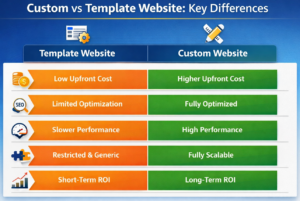
Custom vs Template Website: Key Differences
Cost Comparison: Short-Term vs Long-Term
At first glance, template websites appear to be the more affordable option. With low upfront costs and quick deployment, they are often the go-to choice for startups and small businesses looking to establish an online presence quickly. However, this initial cost advantage can be misleading when viewed from a long-term business perspective.
Template websites often come with a range of hidden and recurring costs. As businesses grow, they typically require additional features such as advanced forms, integrations, SEO tools, and performance enhancements. These are usually added through third-party plugins—many of which are paid and require ongoing subscriptions. Over time, the cost of maintaining these plugins, along with regular updates and compatibility fixes, can significantly increase the total investment.
Another major cost factor is performance optimization and redesign. Template websites are not built with specific business goals in mind, which often leads to poor user experience and lower conversion rates. As a result, businesses frequently find themselves redesigning or rebuilding their websites within a short period. This not only increases costs but also leads to lost time and potential revenue during transitions.
In contrast, custom websites require a higher initial investment but are designed with long-term efficiency and scalability in mind. They are built specifically for your business needs, eliminating unnecessary features and reducing reliance on third-party plugins. This results in lower maintenance costs, better performance, and fewer technical issues over time.
Custom websites also provide a stronger foundation for SEO and conversion optimization, which directly impacts revenue generation. A well-built custom website can attract more organic traffic, engage users effectively, and convert visitors into leads or customers—delivering measurable returns on investment.
Additionally, as your business evolves, a custom website can be easily scaled and enhanced without requiring a complete rebuild. This flexibility helps businesses avoid repeated development costs and ensures that the website continues to support growth.
That’s why evaluating the true custom web design cost is essential—not just in terms of budget, but in terms of long-term business value and ROI.
ROI Breakdown: Why Custom Websites Perform Better
1. Higher Conversion Rates
Custom websites are designed around user behavior, ensuring that every element—from layout to call-to-action—is optimized for conversions.
A well-structured user experience can increase conversion rates significantly, turning your website into a consistent lead generation tool rather than just an informational platform.
2. Better SEO Performance
Custom websites are built with clean code and optimized architecture, making them more search engine friendly.
They support:
- Faster indexing
- Better Core Web Vitals performance
- Improved ranking potential
In contrast, template websites often include unnecessary code that slows down performance and limits SEO growth.
3. Faster Page Speed
Website speed plays a crucial role in both user experience and rankings. Research shows that users are likely to leave a website if it takes more than a few seconds to load.
Template websites often rely on multiple plugins and heavy scripts, while custom-built websites are optimized for speed, resulting in better engagement and lower bounce rates.
4. Scalability & Flexibility
As your business grows, your website needs to evolve. Template websites often struggle with advanced integrations, increased traffic, and new feature requirements.
Custom websites are designed to scale, allowing seamless upgrades and integrations without compromising performance.
5. Stronger Brand Differentiation
In a competitive market like Dubai, standing out is critical. Template websites often look similar, making it difficult to establish a strong brand identity.
Custom websites, however, are built to reflect your brand’s uniqueness, helping you build trust and credibility with your audience.
Dubai Market Perspective
Dubai’s digital landscape is one of the most competitive in the region, with businesses across industries heavily investing in their online presence. From real estate and ecommerce to finance and hospitality, companies are constantly competing for visibility, user attention, and conversions.
In such an environment, a basic or generic website is no longer enough. Users in Dubai have high expectations—they expect websites to load instantly, look premium, and function seamlessly across all devices. A delay of even a few seconds can significantly increase bounce rates and result in lost business opportunities.
Another critical factor is the mobile-first audience. A large percentage of users in Dubai access websites through mobile devices, making responsive design and performance optimization essential. Template websites often struggle to deliver consistent performance across devices, whereas custom websites are specifically optimized for mobile usability and speed.
Additionally, Dubai’s diverse population brings the need for multilingual capabilities, particularly in English and Arabic. Custom websites allow for better localization, right-to-left (RTL) support, and culturally relevant user experiences, which are difficult to achieve with standard templates.
Hosting and latency also play a key role. Websites targeting users in the UAE must be optimized for regional hosting and faster server response times to ensure smooth performance. Custom-built websites can be tailored for these technical requirements, improving both user experience and search engine rankings.
In a market where first impressions directly impact credibility, investing in a high-performance, custom-designed website is often the difference between capturing leads and losing them to competitors.
Common Mistakes to Avoid
Choosing the wrong approach when building a website can lead to long-term performance issues and missed growth opportunities. Many businesses make decisions based on short-term convenience rather than long-term strategy.
One of the most common mistakes is choosing a website purely based on upfront cost. While template websites may seem affordable initially, they often result in higher costs over time due to redesigns, plugin dependencies, and performance limitations.
Another major issue is ignoring scalability. Businesses grow, and their digital needs evolve—but template websites are often not designed to handle increasing traffic, integrations, or advanced functionalities. This leads to frequent rebuilds, which can disrupt operations and increase expenses.
Many businesses also fall into the trap of overloading their websites with plugins to compensate for missing features in templates. This not only slows down the website but also creates security vulnerabilities and maintenance challenges.
Perhaps the most critical mistake is not considering SEO during development. Without proper technical optimization, even a visually appealing website may struggle to rank on search engines, limiting its ability to generate organic traffic and leads.
Lastly, some businesses underestimate the importance of user experience (UX). A website that is difficult to navigate or poorly structured can lead to high bounce rates and low conversion rates, regardless of how good it looks.
Avoiding these mistakes requires a strategic approach—one that focuses on long-term performance, scalability, and user-centric design.
Who Should NOT Choose Custom Websites
While custom websites offer significant advantages, they are not always the right choice for every stage of a business.
If you are in the early stages of launching a business and need to validate your idea quickly, investing heavily in a custom website may not be necessary. In such cases, a simple template-based website can help you establish an initial online presence without a large financial commitment.
Businesses working with tight budget constraints may also find template solutions more practical in the short term. Custom websites require a higher upfront investment, which may not be feasible for startups or small businesses with limited resources.
Additionally, if your requirements are minimal—such as a basic informational website with no advanced functionality—a template website can serve the purpose effectively without the need for customization.
However, it’s important to understand that template websites should be viewed as a temporary solution rather than a long-term strategy. As your business grows, you may face limitations in performance, scalability, and branding, making it necessary to transition to a custom-built website.
Planning for this transition early can help businesses avoid unnecessary costs and ensure a smoother upgrade when the time comes.
When to Choose What
Template Websites
- Startups with limited budgets
- MVP launches
- Short-term projects
Custom Websites
- Growing businesses
- Ecommerce brands
- Real estate companies
- Enterprises
For businesses focused on long-term growth, partnering with a reliable custom web design company ensures your website supports scalability, performance, and conversion goals.
Why Businesses Choose Element8
Businesses across Dubai choose Element8 because of its proven track record of delivering over 900+ successful projects across industries such as real estate, healthcare, ecommerce, and corporate sectors. This experience enables the team to understand diverse business challenges and create tailored digital solutions that drive measurable results.
Element8 focuses on building websites that are not only visually appealing but also conversion-driven. Every design decision is made with the goal of improving user engagement and maximizing lead generation.
Additionally, the company follows an SEO-first development approach, ensuring that every website is optimized for performance, speed, and search visibility from the start. This combination of strategy, design, and technical expertise makes Element8 a trusted partner for long-term digital growth.
Conclusion
Choosing the right website approach isn’t just a design decision—it directly impacts your business growth, lead generation, and long-term ROI. While template websites may work as a starting point, businesses serious about scaling in Dubai need a solution built for performance, flexibility, and results.
If you’re planning to upgrade or build a high-performing website, now is the time to make the right investment.
Request a consultation with our experts and discover how a custom-built website can drive real business growth
FAQs
Is a custom website better than a template?
Yes, a custom website is generally better for long-term ROI because it offers improved SEO, faster performance, and a tailored user experience that drives higher conversions and better engagement.
Are template websites bad for SEO?
Template websites are not inherently bad, but they often come with limitations such as slower loading speeds and restricted customization, which can affect their ability to compete in highly competitive markets.
How much does a custom website cost in Dubai?
The cost depends on the complexity and features required. While the initial investment is higher, evaluating the actual custom web design cost helps businesses understand the long-term value and ROI it delivers.
Can I upgrade from a template website later?
Yes, you can upgrade at any time, but it usually requires a complete rebuild. This makes it more efficient to invest in a scalable solution early if long-term growth is your goal.
Which website type is better for ecommerce?
Custom websites are ideal for ecommerce because they offer better scalability, faster performance, and a more personalized user experience, all of which contribute to higher sales and conversions.