

Headless CMS SEO: Challenges for Enterprise Websites
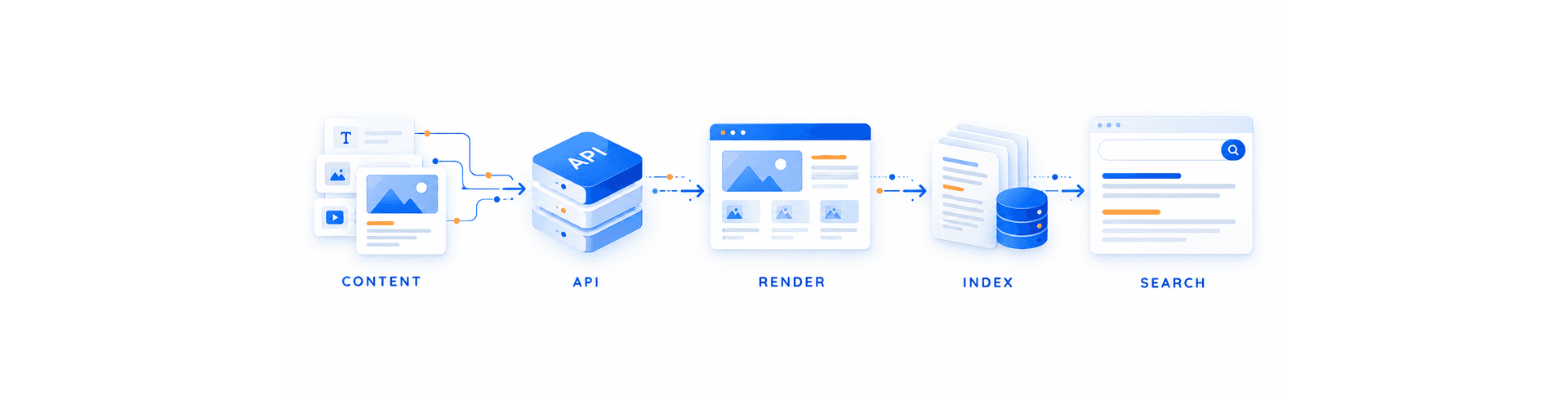


A headless CMS can give enterprise teams more control over channels, front-end technology, and content reuse. It can also remove many of the SEO defaults that a traditional content management system provides automatically. When the presentation layer is separated from content management, teams must deliberately engineer rendering, metadata, internal links, structured data, canonicals, sitemaps, redirects, performance, and editorial previews.
This does not make headless architecture inherently bad for search. It makes SEO outcomes more dependent on implementation quality and operating discipline. An enterprise website can perform strongly with a headless CMS when search requirements are treated as product capabilities, tested in every release, and owned across content, engineering, and SEO teams.
Why headless CMS SEO is different
In a traditional CMS, content storage, templates, routing, metadata, and page delivery are usually part of one platform. A headless CMS stores structured content and exposes it through APIs, while a separate application renders the website. That separation creates flexibility, but it also distributes responsibility across more systems.
A page may depend on the content model, API response, front-end route, rendering mode, cache, CDN, deployment platform, and third-party services. A change in any layer can affect what search engines crawl and understand. The architecture therefore needs explicit contracts for URLs, indexability, HTML output, metadata, links, and error handling.
Headless is most useful when the organisation has a real need for multichannel content, advanced experiences, independent front-end teams, or a composable technology strategy. Teams still deciding between approaches should compare the operational trade-offs in headless versus traditional WordPress before treating decoupling as a default choice.
Rendering is the first SEO architecture decision
Search engines need dependable HTML, links, status codes, and metadata. Client-side rendering can produce an interactive experience, but relying on JavaScript execution for essential content and links adds crawl, rendering, and diagnostic complexity. Critical page content should normally be available in the initial or reliably rendered HTML.
Server-side rendering
Server-side rendering creates HTML for each request. It can support dynamic, personalised, or frequently changing pages while delivering crawlable output. The trade-offs include infrastructure complexity, server response time, cache design, dependency failures, and the need to monitor rendering at scale.
Static generation
Static generation builds pages before requests arrive. It can provide fast, stable output and strong cacheability, but large enterprise websites may face long build times, stale content, failed builds, or delayed publishing. Incremental generation and targeted revalidation can reduce those problems, provided the invalidation rules are accurate.
Hybrid rendering
Many enterprise websites need a hybrid approach. Stable editorial pages may be generated statically, while frequently changing or authenticated experiences use server rendering or client-side features. The correct decision should be made by template and user need, not by one platform-wide preference.
Whichever approach is selected, QA should inspect the HTML response, rendered DOM, status code, canonical, headings, links, structured data, and content after deployment. Rendering strategy is not complete until teams can monitor it.
URL governance can become fragmented
A headless CMS may store content without owning the final public URL. The front-end application often creates routes from content type, slug, locale, hierarchy, and market rules. If ownership is unclear, teams can create duplicate paths, orphaned pages, broken previews, inconsistent trailing slashes, or URLs that change when content is reorganised.
Define a central URL contract. It should cover content types, hierarchy, slug rules, locales, pagination, filters, campaigns, redirects, reserved routes, and legacy URLs. Editors should see the intended public URL before publication, and route validation should prevent collisions.
Every route must return the correct HTTP status. A polished error component served with HTTP 200 creates a soft-404 problem. Deleted content should return 404 or 410 where appropriate, moved content should redirect once to the best replacement, and server errors should not be disguised as empty successful pages.
Metadata needs a shared content contract
SEO titles, meta descriptions, canonical URLs, robots directives, social metadata, language annotations, and structured data are often assembled from several sources. Some values belong in the CMS, some are derived by the application, and some depend on market or template rules.
Define which system owns each field, the fallback logic, validation limits, and preview behaviour. Editors should be able to control meaningful fields without entering code. Developers should not hardcode metadata that business teams need to change, while editors should not be asked to construct technical URLs or JSON-LD manually.
Fallbacks should be safe but visible. Automatically using a heading as the title can prevent an empty tag, but it should not hide incomplete optimisation. Publishing checks and reports should identify missing or duplicated metadata by template and market.
Canonical tags and duplicate content require care
Headless applications can expose the same content through preview routes, API-driven variants, campaign paths, query parameters, multiple domains, or regional versions. Canonical rules must reflect the indexable public page, not the CMS endpoint or an internal front-end hostname.
Generate absolute canonicals from a trusted public-domain configuration and the validated route. Test them after deployment. Do not assume a canonical tag will correct an uncontrolled URL system; internal links, redirects, sitemaps, hreflang, and canonicals should reinforce the same preferred URL.
For migrations, preserve a mapping from every valuable legacy URL to its new destination. The planning controls in enterprise SEO recovery after a failed migration also show why redirects, canonicals, internal links, and sitemaps must be validated together.
Internal linking is not automatic
Content APIs can return text without a dependable understanding of site relationships. Navigation, breadcrumbs, related content, contextual links, pagination, and hub structures must be modelled and rendered deliberately. If the front end only exposes links after interaction or through client-side events, crawlers and users may not discover important pages efficiently.
Use real HTML anchor elements with crawlable destinations for primary navigation and contextual links. Model content relationships in the CMS where editors need control, and derive links programmatically only from clear rules. Prevent links to drafts, expired pages, incorrect locales, or routes that return errors.
Enterprise information architecture should show how content supports topics, audiences, products, services, and customer journeys. Related-content systems should prioritise relevance and usefulness rather than simply showing the newest items.
Structured data must match rendered content
A headless system can generate structured data at the application layer, but the data still needs editorial inputs and template logic. Entities, names, images, dates, authors, breadcrumbs, products, FAQs, and organisational information must match what users can see and what the page actually represents.
Centralise schema generation by template rather than allowing each component to emit unrelated blocks. Validate JSON syntax, entity types, required relationships, URLs, and visible-content consistency. Include schema tests in deployment pipelines and monitor live pages because caching or front-end releases can create differences from the CMS record.
Structured data is not a substitute for clear content and architecture. It helps machines interpret well-implemented pages; it does not make hidden, duplicated, or inaccessible content useful.
XML sitemaps need reliable orchestration
Traditional CMS platforms commonly generate sitemaps from published records. In a headless architecture, the front end may need to combine content from multiple sources, markets, and applications. Sitemap generation must account for publication status, canonical route, indexability, language, update date, and deployment state.
Only include canonical, indexable URLs that return HTTP 200. Split large sitemaps by meaningful type or market, keep the index current, and avoid updating every last-modified value when nothing on the page changed. Image or video extensions should be used only when the platform can populate them accurately.
Compare sitemap URLs with crawled URLs and indexed pages. Differences can reveal orphaned content, failed builds, stale routes, incorrect noindex rules, or deployment delays.
International SEO adds another layer
Enterprise headless websites often serve multiple countries and languages. Content models, URLs, publishing workflows, and front-end routing must agree on locale and market relationships. Hreflang should connect equivalent canonical pages, including a suitable fallback when relevant.
Do not generate language annotations merely because records share an identifier. Confirm that each destination exists, is indexable, returns HTTP 200, and represents an equivalent page. Missing translations need a documented fallback policy rather than silent duplication.
Arabic and English experiences also require layout, component, metadata, and workflow support beyond translation. The practical issues are covered in the guide to Arabic UX, RTL, and bilingual SEO.
Performance gains are possible but not guaranteed
Headless architecture is often associated with speed, but a modern framework does not automatically produce a fast website. Large JavaScript bundles, hydration, third-party tags, unoptimised media, repeated API calls, slow server rendering, and poor cache invalidation can create serious performance problems.
Set performance budgets for representative templates and journeys. Measure server response, loading, responsiveness, layout stability, JavaScript execution, API dependencies, image delivery, and cache behaviour. Test realistic content volumes and lower-powered mobile devices, not only a fast developer laptop.
Optimisation should happen throughout delivery. The practices in website speed optimisation during development help teams control assets, code, third parties, testing, and monitoring before performance debt reaches production.
Editorial preview and publishing can affect SEO quality
Editors need to see how structured content will appear in its final context. Weak preview systems make it harder to detect heading errors, missing links, layout problems, metadata gaps, language issues, and component misuse. Preview should use the relevant front-end version while protecting unpublished content from public access and indexation.
Publishing workflows should coordinate content state with build and cache state. An editor may click publish while the public page remains stale, partially rebuilt, or unavailable. Provide clear deployment feedback, targeted revalidation, failure alerts, and a recovery path.
Content governance should define required fields, approval roles, scheduled publication, expiry, localisation, and ownership. A technically flexible platform without editorial controls can create inconsistent and thin content at scale.
Monitoring must span CMS, API, and front end
Monitoring only the CMS does not prove the public website is healthy. A content record can be published while the API, build, route, cache, or rendering layer fails. Monitor the complete path from source content to public HTML.
Useful checks include API errors, build failures, route status, rendering output, cache freshness, sitemap changes, robots directives, canonicals, structured data, internal links, Core Web Vitals, crawl anomalies, and search performance. Alert ownership should be explicit so issues are investigated rather than merely recorded.
Release QA should sample live pages after every deployment. For complex rebuilds, the governance framework in planning an enterprise website rebuild without breaking SEO, UX, or governance provides a useful model for cross-functional ownership.
Build SEO requirements into the delivery system
The most reliable headless SEO programme converts expectations into reusable components, contracts, and automated tests. Each indexable template should define its URL, rendering mode, metadata, canonical, headings, internal links, structured data, sitemap inclusion, locale rules, status behaviour, and performance budget.
Automated tests can detect missing canonicals, invalid metadata, blocked pages, broken links, schema errors, incorrect status codes, and unexpected HTML changes. Automated checks cannot judge content usefulness or every search-intent issue, so expert crawling and manual review remain necessary.
Create a shared definition of done across product, content, engineering, QA, analytics, and SEO. Search requirements should be part of acceptance criteria before a feature enters production, not a ticket raised after traffic declines.
A practical headless CMS SEO checklist
- Every indexable route returns meaningful HTML and the correct HTTP status.
- Public URL ownership, slug rules, locales, redirects, and error routes are documented.
- Titles, descriptions, canonicals, robots directives, and social metadata have clear owners and fallbacks.
- Navigation, breadcrumbs, contextual links, pagination, and related content use crawlable anchors.
- Structured data is generated centrally and matches visible page content.
- Sitemaps contain only canonical, indexable, deployed HTTP-200 pages.
- Hreflang connects equivalent canonical pages and handles missing translations safely.
- Performance budgets cover server response, JavaScript, media, APIs, and third parties.
- Editors can preview final layouts and understand publication or build status.
- Monitoring validates the live front end, not only the CMS record.
Element8 helps enterprise teams plan and implement headless platforms where technical flexibility does not come at the expense of crawlability, content governance, performance, or search visibility. If you are evaluating architecture or correcting a difficult implementation, our enterprise SEO team in Dubai can audit the complete path from content model and API to rendered public page.
Frequently Asked Questions
Is a headless CMS bad for SEO?
No. A headless CMS can support strong SEO, but the front-end application must deliberately implement rendering, routes, metadata, canonicals, internal links, structured data, sitemaps, status codes, performance, and monitoring that a traditional CMS may provide by default.
Which rendering method is best for headless CMS SEO?
There is no single best method. Static generation suits stable pages, server-side rendering suits dynamic content, and hybrid approaches often work best across enterprise templates. Critical content, links, metadata, and status codes must be reliably available to users and search engines.
How should headless CMS canonicals be generated?
Generate absolute canonical URLs from a trusted public-domain configuration and the validated front-end route. They should reference the preferred indexable page, not a CMS endpoint, preview URL, deployment hostname, or an uncontrolled request parameter.
What should enterprises monitor on a headless website?
Monitor API and build failures, route status, rendered HTML, cache freshness, robots directives, canonicals, sitemaps, internal links, structured data, performance, crawl anomalies, indexation, search traffic, and conversion outcomes across important templates and markets.