
Headless WordPress vs Sitecore vs AEM: A CIO Decision Framework for GCC Enterprises


To choose an enterprise Content Management System (CMS) or a Digital Experience Platform (DXP) in the GCC is no longer a simple matter of evaluating user interfaces and licensing costs. For Chief Information Officers (CIOs), Chief Technology Officers (CTOs), and IT Directors across the UAE, Saudi Arabia, etc, the platform decision sits at the intersection of strict national data compliance, complex multi-region localization, and aggressive digital transformation mandates.
As regional initiatives like the UAE Digital Government Strategy 2025 and Saudi Vision 2030 accelerate, enterprises should transition away from legacy, monolithic systems. The modern customer journey can stretch from smart screens, consumer applications, IoT-powered retail kiosks, and conversational AI interfaces. These can capture the touchpoints demanding a flexible architecture.
When architecting a high-performance digital ecosystem, enterprise IT leadership should fundamentally decide between three distinct paths: Headless WordPress development (Enterprise VIP), Sitecore CMS development company (XM Cloud), and Adobe Experience Manager (AEM). This comprehensive architectural evaluation framework can provide the technical granularity and compliance insights necessary to align your enterprise tech stack with regional business realities.
The Modern GCC Digital Landscape: A Paradigm Shift
Historically, GCC enterprises have depended on monolithic, all-in-one architectures. While these traditional platforms are consolidating content storage and frontend rendering within a single database and server infrastructure, they have introduced considerable technical debt. Heavy plugin stacks, bloated database queries, and server-side rendering bottlenecks consistently compromise page speed, directly degrading Core Web Vitals and reducing organic search visibility.
For modern GCC organizations, content distribution should extend far beyond a standard web browser. Omnichannel delivery is now a prerequisite. Regional enterprises operate complex, multi-division platforms in which a single piece of corporate data or promotional media should propagate instantly across localized corporate web portals, native iOS and Android applications, customer self-service systems, and smart city integrations.
To achieve this level of operational agility, the enterprise market has undergone a structural shift toward decoupled and composable architectures. By completely isolating the backend content repository from the presentation layer through structured APIs, IT leaders can eliminate direct backend vulnerabilities, optimize edge-caching mechanisms across regional Content Delivery Networks (CDNs), and give development teams full design freedom.
Core Platform Identities
Before getting started on the localized infrastructure compliance, it is important to outline the core technical identities of the three primary contenders:
- Headless WordPress (Enterprise/VIP): An API-first, composable content repository. By leveraging WordPress solely as an administrative backend and decoupled frontend frameworks, organizations retain a globally recognized, highly intuitive editorial interface while avoiding the performance and security bottlenecks of traditional monolithic installations.
- Sitecore (XM Cloud / XP): A highly sophisticated, data-driven .NET enterprise ecosystem. Moving rapidly from its legacy on-premises roots to a cloud-native, composable DXP model, Sitecore is engineered primarily for organizations that demand real-time content personalization, multivariate testing, and deeply integrated Customer Data Platform (CDP) capabilities natively.
- Adobe Experience Manager (AEM as a Cloud Service): A marketing-led omnichannel heavyweight. Designed for large-scale conglomerates deeply embedded in the Adobe Experience Cloud ecosystem, AEM serves as a centralized digital asset hub and an enterprise-grade multi-site deployment engine.
GCC-Specific Architectural Deep Dive
Data Sovereignty and Regional Cloud Compliance
Data localization is an absolute regulatory mandate within the Middle East. IT leadership cannot deploy a platform without verifying its compliance with national security and privacy frameworks.
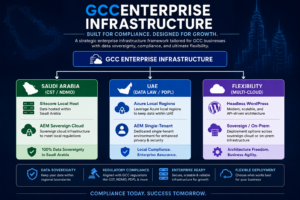
In the Kingdom of Saudi Arabia (KSA), any platform that processes citizen data should align closely with the regulations of the Communications, Space, and Technology Commission (CST) and the governance framework of the National Data Management Office (NDMO).
- Sitecore addresses these mandates effectively via its composable deployment paths. Organizations can provision and host dedicated infrastructure within secure, sovereign cloud data centers located directly inside Saudi borders, utilizing local Microsoft Azure availability zones.
- Adobe Experience Manager offers high-tier compliance through its Managed Services and Cloud Service models, incorporating specific Digital Sovereignty add-ons. These environments use advanced single-tenant isolation strategies and dedicated network topologies to keep transactional logs and sensitive PII within local parameters.
- Headless WordPress provides unparalleled infrastructural autonomy. Because the backend content layer functions independently of the presentation frontend, enterprise environments can be self-hosted behind local government firewalls, inside an enterprise private cloud, or through managed secure-cloud providers like AWS UAE or local telecom clouds (such as e& or du), guaranteeing absolute compliance with the UAE Data Protection Law (Federal Decree-Law No. 45 of 2021).
Localization and Arabic Right-to-Left (RTL) Workflows
Deploying multi-region platforms across the GCC will need careful attention to language governance. Arabic localization introduces unique typography mechanics, variable layout directions, and a rigorous translation-approval workflow. Delivering premium multilingual experiences across the GCC requires more than translation alone; it demands seamless RTL rendering, responsive localization logic, and high-end digital presentation layers. Through projects such as Amali, Element8 has developed sophisticated multilingual digital experiences tailored for luxury and regional audiences.
- Adobe Experience Manager (AEM) provides an exceptionally strong out-of-the-box multilingual workflow engine. Its native Multi-Site Manager (MSM) allows enterprises to create a centralized content blueprint and inherit updates seamlessly across distinct country sub-sites (e.g., .ae, .sa, .qa), while maintaining independent language layers. It integrates natively with enterprise translation management systems (TMS), automating the conversion of complex Right-to-Left (RTL) content strings without breaking parent layout components.
- Sitecore approaches localization through highly granular, field-level language versions. Within Sitecore XM Cloud, multi-region governance natively handles simultaneous language variations, preventing asset duplication. However, achieving flawless RTL rendering across decoupled frontends requires a well-structured component design methodology inside the presentation layer (such as Next.js or Tailwind CSS configurations).
- Headless WordPress shifts the localization responsibility into a modular strategy. While the WordPress administrative backend provides intuitive multilingual plugins, a headless implementation handles localized routing, hreflang synchronization, and RTL CSS injection directly within the frontend framework. This requires strict API data contract mapping to prevent localized layout anomalies or hydration failures when the client browser renders Arabic characters.
Total Cost of Ownership (TCO) vs. Regional Talent Availability
A major pitfall for GCC enterprise IT projects is selecting a platform architecture without considering the local engineering talent pipeline required to maintain it.
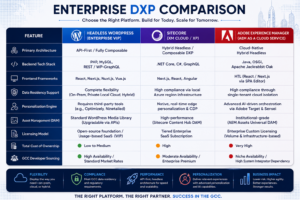
- Headless WordPress features exceptional developer availability across the Middle East. By separating the core engine from the frontend, your internal teams or external agency partners do not need niche CMS certifications. They simply need standard, widely available engineering proficiencies: PHP and REST/GraphQL familiarity for the backend, and modern JavaScript (React, Next.js, Node.js) expertise for the presentation layer. This drastically lowers recruitment overhead and keeps the long-term TCO highly optimized.
- Sitecore requires a specialized, mid-to-high premium software engineering base. Because its core foundation is deeply rooted in the Microsoft enterprise ecosystem ( .NET/C#), implementing custom rendering pipelines, advanced search personalization modules (via Sitecore Discover), or complex API orchestration requires certified Sitecore developers. Sourcing this talent locally within the Dubai or Riyadh markets carries a financial premium.
- Adobe Experience Manager sits at the highest end of the cost spectrum. Its monolithic-to-hybrid cloud architecture demands specialized talent in enterprise Java and OSGi frameworks. Because these specialized development skills are scarce in the local GCC market, regional enterprises often rely on tier-one global systems integrators, resulting in higher project implementation fees, longer delivery lifecycles, and substantially higher TCO.
The CIO Decision Matrix
The following structured semantic matrix provides a direct, technical breakdown designed for enterprise architectural evaluation:
Architectural Performance & Enterprise Use Cases
Headless WordPress (WordPress VIP / Enterprise)
For organizations looking to maximize operational speed, minimize unnecessary software licensing footprints, and scale content more quickly across distributed consumer touchpoints, Headless WordPress development provides a powerful enterprise acceleration framework for modern GCC enterprises.
Modern enterprises increasingly favor composable architectures that combine scalability with operational flexibility. Element8 has implemented high-performance digital solutions for organizations such as Bushrana Global Trading, leveraging agile web technologies and scalable frontend ecosystems to support evolving business operations.
- Headless SEO and Engineering Mechanics
In a headless WordPress configuration engineered by a professional enterprise web development company, the standard monolithic compilation layer is entirely bypassed, and content can act as structured, clear JSON payloads.
To prevent common headless SEO pitfalls, developers must implement Server-Side Rendering (SSR) or Static Site Generation (SSG) within frameworks such as Next.js. Long-term enterprise performance also depends heavily on structured maintenance governance, proactive uptime monitoring, and security patch management, all of which should be defined within a comprehensive website maintenance SLA guide. This architecture ensures that when search engine web crawlers evaluate your domain, they receive fully rendered, semantic HTML directly from the server edge, bypassing execution queues for client-side JavaScript rendering.
Furthermore, decoupled environments require intentional engineering of schema markup pipelines, cross-domain canonical tag synchronization, and API-driven dynamic sitemap generation to accurately reflect frontend routing paths.
Sitecore (Experience Platform & XM Cloud)
When an enterprise operates in a heavily regulated sector such as banking or insurance, or is a listed entity subject to scrutiny by the Dubai Financial Market (DFM) or the Saudi Capital Market Authority (CMA), it needs data-driven, real-time customer personalization. Sitecore provides an ideal enterprise solution. Organizations evaluating enterprise personalization ecosystems can also explore this in-depth Sitecore enterprise guide for a deeper understanding of Sitecore’s composable architecture and GCC deployment considerations.
- Composable Personalization Mechanics
Moving beyond legacy, resource-heavy monolithic installations, modern deployments leverage Sitecore XM Cloud. This architecture relies on cloud-native headless services to push pre-rendered static layouts to the edge, while dynamically injecting personalized content blocks in real time via API interactions with the Sitecore Customer Data Platform (CDP).
Adobe Experience Manager (AEM as a Cloud Service)
For government ministries, semi-government authorities, and massive sovereign wealth funds that operate sprawling global digital presence networks, AEM serves as an authoritative industry standard.
- The Ecosystem Multiplier
AEM’s primary competitive advantage is its native, multi-layered integration with the broader Adobe ecosystem. When a corporate marketing department relies heavily on Adobe Analytics for compliance-vetted user tracking and Adobe Target for algorithmic multivariate testing, AEM functions as a natural operational extension.
Using its advanced Universal Editor and AI-driven asset categorization systems, corporate authoring teams can coordinate asset transformations and rapidly distribute approved global media formats across thousands of digital touchpoints.
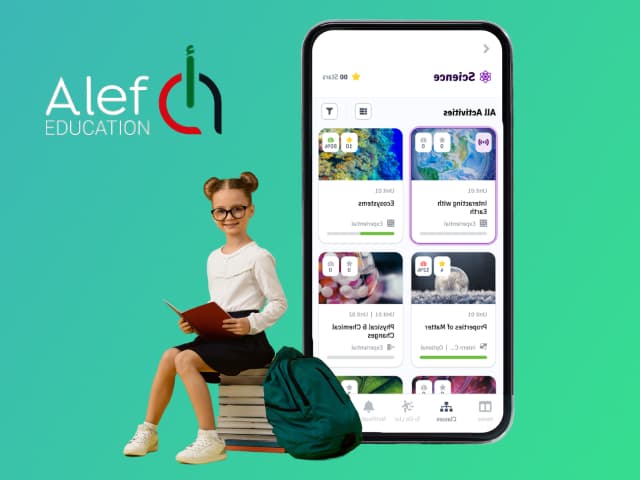
Enterprise-scale educational ecosystems in the GCC increasingly require centralized content governance, multilingual scalability, and secure digital infrastructure. Element8 has contributed to large-scale digital transformation initiatives such as Alef Education, where scalable digital experiences and enterprise-grade architecture played a critical role in supporting high-volume educational engagement across the region.
Next Steps for GCC IT Leadership: The Pragmatic Audit
To systematically remove execution risks before committing significant capital to an enterprise CMS transformation, your technology leadership team will need to perform an objective internal readiness assessment:
- Perform a Technical Talent Audit: Do not buy an enterprise Java- or .NET-driven platform if your current internal engineering pool consists solely of JavaScript and open-source web developers. Match your architectural choices to sustainable hiring realities.
- Classify Your Data Residency Tiers: Clear out your customer PII data flows. If your organization can handle sensitive government workloads or financial transactions within KSA or the UAE, explicitly define whether your platform should live inside an on-premises sovereign cloud data center or if it can legally use a compliance-vetted enterprise SaaS endpoints.
- Execute an Integration Dependency Mapping Session: Document all the needed internal and external data integrations, including CRMs, ERP solutions, regional payment processors, and localized SMS alert gateways. Determine whether a lightweight, API-first headless CMS or a comprehensive, all-encompassing Enterprise DXP provides the most cost-effective integration blueprint for your digital roadmap.
Partner with Element8 for Your Digital Transformation
Navigating the complexities of enterprise-grade CMS migrations requires a balance of deep architectural expertise and local regulatory compliance. As a premier digital agency in Dubai, Element8 specializes in building high-performance, compliant web ecosystems tailored for the GCC market. Whether your organization demands the lean agility of Headless WordPress development or the enterprise personalization power of a Sitecore CMS development company, our certified engineering and SEO teams are equipped to architect, deploy, and scale your omnichannel strategy.
Contact Element8 today to schedule an architectural consultation and map out a bulletproof digital framework for your enterprise.