

Building IPO-Ready Websites in the GCC: Lessons from Listed Companies


An Initial Public Offering (IPO) marks a milestone for any enterprise, but in the Gulf Cooperation Council (GCC), transitioning from a private entity to a publicly traded powerhouse requires more than just financial auditing. It demands an absolute cultural and digital shift towards radical transparency.
As capital markets across the region experience monumental growth, driven by a surge in retail investor participation and massive institutional capital inflows, the corporate website is no longer a simple digital brochure. It is a highly scrutinized, high-stakes corporate asset. At Element8, we help GCC enterprises build scalable, investor-ready digital ecosystems aligned with modern regulatory and institutional expectations.
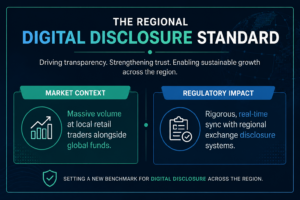
Companies eyeing a debut on the Dubai Financial Market (DFM), the Abu Dhabi Securities Exchange (ADX), or Saudi Arabia’s Tadawul: market trust begins at the URL. Successful listed companies understand that their digital infrastructure dictates how regulatory bodies, underwriters, and global asset managers evaluate their corporate governance and operational maturity.
To secure institutional credibility and retail confidence, pre-IPO enterprises must implement highly strategic IPO website development frameworks. Let’s explore the non-negotiable digital lessons from the listed giants across the GCC and break down what it takes to build fully compliant, investor-ready infrastructure.
Building secure and enterprise-grade investor platforms requires collaboration with an experienced web engineering partner capable of handling multilingual architecture, compliance-ready infrastructure, and scalable digital ecosystems. As a leading web development company in Dubai, Element8 specializes in building high-performance corporate platforms tailored for GCC enterprises and regulated industries.
What Is an IPO-Ready Website?
An IPO-ready website is a corporate digital platform designed to support investor communication, regulatory compliance, financial disclosures, and governance transparency before and after a company becomes publicly listed. Unlike a standard corporate website focused primarily on marketing and lead generation, an IPO-ready website functions as a critical investor relations (IR) hub that enables shareholders, analysts, regulators, and institutional investors to access accurate, timely, and compliant information.
For GCC businesses preparing to list on exchanges such as the Dubai Financial Market (DFM), Abu Dhabi Securities Exchange (ADX), or Saudi Exchange (Tadawul), an IPO-ready website must support bilingual Arabic and English content, secure document distribution, corporate governance disclosures, financial reporting archives, and real-time regulatory announcements. It should also provide enterprise-grade security, mobile accessibility, and scalable infrastructure capable of supporting increased public scrutiny and investor engagement.
In today’s capital markets, a well-structured IPO-ready website is not simply a communications tool—it is a strategic asset that strengthens investor confidence, demonstrates operational maturity, and supports long-term market credibility.
Bilingual Compliance and Absolute Accessibility
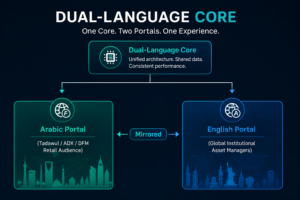
The foundational layer of any GCC investor relations (IR) portal is language. The regional regulator mandates that all price-sensitive communications, financial disclosures, and corporate updates be issued simultaneously in both Arabic and English.
The Regional Standard: Listed firms must maintain perfectly mirrored versions of their IR hubs in both languages. Every single PDF download, financial chart, and board biography must match identically across both linguistic versions, leaving no room for asymmetric data distribution.
The Lesson from Listed Giants
Do not rely on automated machine translation plugins or quick-fix widgets. Although an automated tool is sufficient for basic e-commerce, it can be disastrous when dealing with financial regulators. Translating technical accounting language incorrectly, or even misinterpreting legal terms associated with business governance, can cause significant trouble for a corporation. Mistranslating specialized accounting terminology or corporate governance legalese can expose a company to severe compliance violations, regulatory fines, and reputational damage.
Professional localization executed by native-speaking financial experts ensures that an institutional portfolio manager in London or New York and a retail day-trader in Riyadh or Abu Dhabi receive the same degree of clarity.
Furthermore, your backend digital architecture must support seamless Right-to-Left (RTL) rendering. This means design layouts, interactive charts, and navigation flows must flip natively without breaking UI elements or distorting financial graphs when users toggle between English and Arabic.
Centralizing the “Corporate Story” and Equity Value
Long before the opening bell rings, your website serves as the primary tool for your equity storytelling. Merely uploading historical balance sheets is insufficient. Institutional investors seek a cohesive narrative that demonstrates long-term growth prospects, operational resilience, and strong internal governance.
Building this level of investor confidence requires more than a visually polished website. It requires an enterprise-level architecture that enables secure disclosure, scalable content, multilingual capabilities, and real-time regulatory integration. Explore how Element8’s enterprise website development services help GCC businesses build robust digital ecosystems tailored for institutional trust.
Crucial IR Portal Features
To structure an enterprise-grade IR web architecture that commands institutional respect, pre-IPO firms should build dedicated, easily discoverable sub-sections targeting specific components of the equity story:
- The Investment Case: A clear presentation of market differentiators, competitive moats, macroeconomic tailwinds, and addressable market projections.
- Board & Management Profiles: Highly detailed professional biographies of the executive leadership team and board members, emphasizing independent oversight and regional operational expertise.
- Corporate Governance Frameworks: Clear public disclosures detailing committee structures (e.g., Audit, Nomination, Remuneration), internal risk controls, and regulatory compliance charters.
- Dividend Distribution History: A historical map and forward-looking policy statement outlining capital allocation strategies, payout ratios, and shareholder value delivery.
Asset Architecture Optimization
Enterprise web design requires a secure, high-performance repository model. Documents such as prospectuses, white papers, analyst briefs, and Environmental, Social, and Governance (ESG) reports must be organized within a centralized, searchable document center.
Choosing the right CMS and ownership framework is equally critical for long-term scalability, compliance, and content governance. Businesses evaluating modern enterprise platforms can explore the differences between WordPress, Webflow, Wix, and Shopify in this detailed comparison by Element8.
All assets should feature optimized file sizes for rapid download over mobile networks, and financial data tables must be exportable to raw formats (such as Excel/CSV), so buy-side analysts can instantly ingest the data into their financial valuation models.
Regulatory Integration and The Interactive IR Calendar
Exchanges across the GCC, specifically the DFM, ADX, and Tadawul, enforce zero-tolerance policies regarding the late or unequal distribution of material information. To satisfy these regulatory mandates, your web presence must shift from a static collection of pages to a real-time communications engine.
Technical Execution: Automated Disclosure Syndication
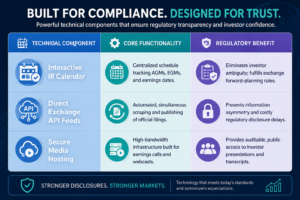
Successful listed companies remove human error by integrating direct Application Programming Interfaces (APIs) between their website content management systems (CMS) and the official dissemination platforms of their respective stock exchange, such as the DFM’s electronic disclosure systems or Tadawul’s Wessal platform.
The moment the exchange approves price-sensitive data or regulatory filings, the API instantly pulls and renders the disclosure directly onto your corporate website’s IR feed. This completely bypasses manual web content updates, ensuring the broader public domain is notified simultaneously and protecting your company from insider information leak vulnerabilities.
Technical Readiness, Responsiveness, and Real-Time Alerts
The GCC capital market landscape is characterized by an exceptionally high volume of tech-savvy retail investors. Mobile apps and smartphone-driven trading dominate the local ecosystem. Consequently, an IR portal that is difficult to navigate on a smartphone will instantly alienate a massive portion of your domestic investor base.
Enterprise investor portals require far more than visual design. They demand scalable backend engineering, secure API integrations, responsive frameworks, and real-time disclosure architecture capable of supporting high traffic volumes and institutional scrutiny.
Embracing a Responsive Framework
Your investor relations portal must utilize a highly refined responsive design framework. Financial performance tables, stock price tickers, and dynamic SVG or HTML5 financial charts must adapt smoothly across a vast matrix of devices, from standard desktop viewports to tablets and smartphones.
Touch targets must be distinct, and complex data layouts must be re-engineered into accordion menus or scrollable panels on mobile viewports to prevent layout breakages.
Automated Investor Retention Systems
To maintain long-term market interest and liquidity for compliance, the digital platform must include built-in, secure subscription management systems. Investors, analysts, and media personnel should be able to opt into automated notification loops.
The moment a regulatory filing, press release, or dividend payout announcement is processed, the system should trigger real-time, multi-channel alerts via email, SMS, or direct WhatsApp Business API integrations. This proactive communication architecture ensures continuous engagement with your investor community long after the initial IPO hype subsides.
Common Website Mistakes Pre-IPO Companies Should Avoid
As organizations prepare for a public listing, regulatory scrutiny extends beyond financial reporting to the digital infrastructure used to communicate with investors, analysts, and regulators. Many otherwise well-prepared companies undermine investor confidence by overlooking critical website and investor relations requirements.
Relying on Automated Translation for Financial Disclosures
Machine translation tools may be suitable for general content, but they are unsuitable for investor relations communications. Financial statements, governance disclosures, and regulatory announcements require precise interpretation and localization. Even minor translation inaccuracies can create inconsistencies between Arabic and English disclosures, exposing organizations to compliance and reputational risks.
Treating Investor Relations as a Secondary Navigation Item
Many pre-IPO companies bury investor information several clicks deep within the website. Listed companies, however, are expected to provide direct and highly visible access to investor relations resources, including governance information, financial reports, stock exchange announcements, and leadership disclosures. Difficulty accessing this information can negatively impact investor perception and transparency.
Publishing Unstructured Financial Documents
Uploading PDFs without proper categorization, search functionality, or document governance creates friction for analysts and institutional investors. An IPO-ready website should provide a centralized document center with clear categorization, version control, filtering capabilities, and support for downloadable formats such as PDF, Excel, and CSV.
Failing to Separate Public and Confidential Information
Pre-IPO organizations frequently manage sensitive financial information during the listing process. Weak content governance workflows, inadequate permissions, or poorly configured staging environments can create the risk of premature disclosure. Enterprise-grade role-based access controls, approval workflows, and secure publishing environments are essential.
Neglecting Mobile Investor Experience
Retail investor participation across GCC capital markets continues to grow, and many investors access disclosures, announcements, and corporate updates through mobile devices. Financial charts, governance documents, and investor resources must remain fully accessible and usable across smartphones and tablets without compromising functionality.
Relying on Manual Disclosure Publishing Processes
Manual publication workflows increase the likelihood of delays, inconsistencies, and human error. Leading listed companies integrate their investor relations platforms with stock exchange disclosure systems and internal workflows to ensure accurate and timely distribution of material information.
Overlooking Arabic RTL Testing
Supporting Arabic content extends beyond translation. Investor portals must be tested extensively for native Right-to-Left (RTL) functionality to ensure charts, navigation structures, document repositories, and interactive components display correctly across all devices and browsers.
Launching Without Security and Penetration Testing
Investor relations platforms contain highly sensitive information and often become targets for cyber threats. Prior to listing, organizations should conduct comprehensive security assessments, vulnerability scans, penetration testing, and infrastructure reviews to ensure the platform can withstand both operational and reputational risks.
Final Thought
For GCC enterprises preparing for an IPO, website readiness is no longer a branding exercise—it is a governance, compliance, and investor confidence initiative. Avoiding these common mistakes can significantly reduce operational risk while helping establish the transparency and credibility expected of a publicly listed company.
Strategic Timeline and Next Steps
Building a digitally secure, legally compliant investor relations portal cannot be crammed into a rushed two-week sprint right before listing day. To ensure rigorous quality control, comprehensive vulnerability penetration testing, and thorough compliance auditing, pre-IPO enterprises must integrate web development directly into their broader corporate transition roadmap.
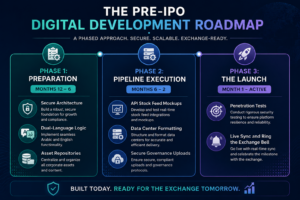
The optimal approach is to begin building your specialized digital architecture 6 to 12 months before your targeted public debut. This runway gives your corporate communications and marketing teams ample time to benchmark their digital strategies against frameworks such as the Dubai Financial Market IPO Communications Guide or specialized advisory toolkits, such as the Uniqus IPO Readiness Checklist for KSA. By combining secure infrastructure, multilingual compliance architecture, and enterprise-grade UX engineering, Element8 helps pre-IPO businesses across the GCC launch digital platforms designed for long-term investor confidence and market credibility.
By approaching your corporate website with the same discipline you applied to your financial restructuring, you ensure your business goes to market with a digital footprint that commands a premium valuation.
FAQs
How does an IPO-ready website differ from a standard corporate website?
A standard corporate website is designed primarily for marketing, customer acquisition, and brand positioning. An IPO-ready website, however, acts as a regulated financial portal. It features a dedicated Investor Relations (IR) architecture, real-time stock price widgets, automated regulatory feed integrations with regional exchanges, strict dual-language English/Arabic synchronization, corporate governance disclosure centers, and high-security file distribution repositories for the safe publication of price-sensitive company data.
What are the explicit bilingual web requirements for DFM and Tadawul listings?
Both the Dubai Financial Market (DFM) and Saudi Arabia’s Tadawul require all listed enterprises to make their material disclosures, financial reports, and regulatory filings accessible to the public in both Arabic and English simultaneously. From a web development perspective, this means your IR portal must be completely mirrored. Automated translation widgets are non-compliant; you must use professional, human financial localization alongside a native Right-to-Left (RTL) development layout to guarantee complete data accuracy.
Why are automated translation tools like Google Translate forbidden for IR portals?
Automated or algorithmic translation services cannot understand the highly nuanced context of specialized Middle Eastern financial regulations and accounting terminology. Reliance on automated translations carries the risk of presenting false information, misinterpreting information from the balance sheet, or confusing language used in corporate governance. Such errors can result in regulatory non-compliance, severe financial penalties, and a rapid breakdown of investor trust.
How can a pre-IPO company ensure its website data is secure against leaks?
Before an IPO, financial performance information is highly confidential and subject to strict insider trading regulations. To prevent data leaks, your web development infrastructure must enforce Enterprise-grade Access Controls (RBAC), multi-factor authentication (MFA) for content administrators, advanced file encryption protocols, and staging environments completely separated from the live public web server. Additionally, comprehensive third-party vulnerability assessments and penetration testing must be performed before the system goes live.
At what stage of the IPO planning process should web development begin?
Web architecture preparation should start 6 to 12 months before your targeted public listing date. This long runway allows your executive teams to design the user experience, integrate automated stock exchange API pipelines, perform rigorous localization audits, populate historical financial libraries, and ensure the entire platform undergoes thorough stress testing before institutional roadshows commence.