
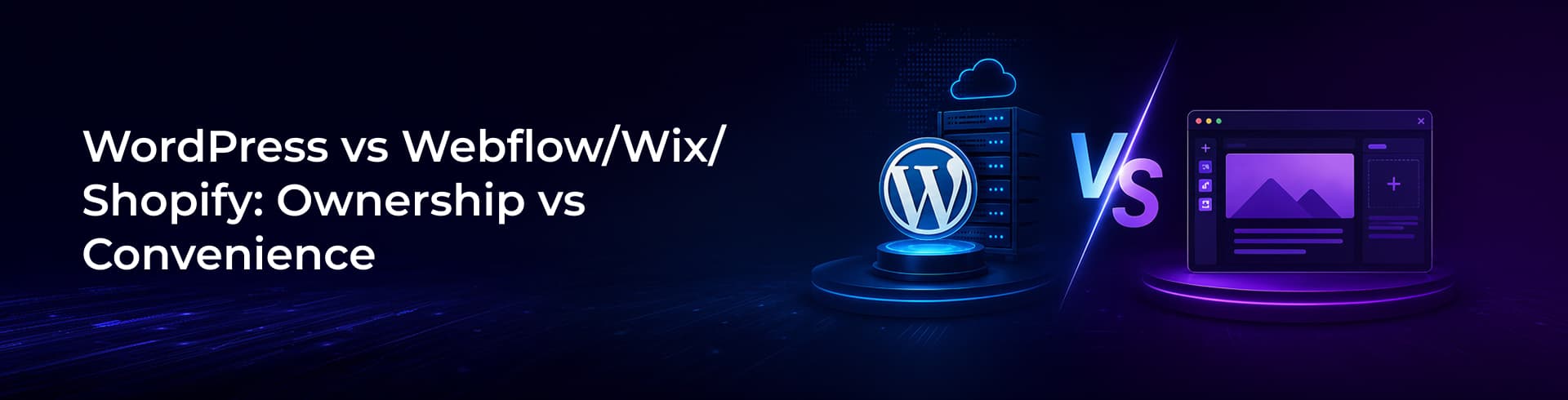
WordPress vs Webflow/Wix/Shopify: Ownership vs Convenience (2026 Decision Guide)


Choosing a website platform used to be a marketing decision. In 2026, it is a business infrastructure decision.
The platform you choose controls how quickly your team can publish, how much you can customize, how expensive change becomes over time, and how much risk you carry when traffic, complexity, and integration demands grow. That is why this comparison matters for founders, marketing leaders, and enterprise teams evaluating long-term digital strategy.
If you have already read our pillar on WordPress in the AI era, this article goes one level deeper. We are focusing on the real trade-off that decision-makers face: ownership vs convenience.
Webflow, Wix, and Shopify are excellent in many situations. WordPress is also excellent in many situations. The wrong move is not choosing one specific platform. The wrong move is choosing a platform for a 3-month launch while ignoring the next 3 years of operations, SEO, security, and commercial growth.
Why This Comparison Matters More in the AI Era
AI has increased content velocity, design experimentation, and campaign speed. Teams can prototype pages faster than ever. But AI has also increased pressure on quality controls:
- Better structured content
- Better SEO governance
- Faster technical iteration
- Better data portability
- More consistent analytics and attribution
- Tighter brand and security controls
In short, AI made execution faster, but it did not remove operational complexity. If anything, it exposed weak foundations faster.
That is why platform selection today is less about which interface feels easiest on day one, and more about which operating model remains sustainable when:
- You add multiple teams
- You localize content
- You scale paid and organic channels
- You introduce product, CRM, and marketing automation integrations
- You need reliable reporting and governance
For businesses investing in web development services, this platform decision is now directly tied to growth reliability.
The Core Trade-off: Ownership vs Managed Convenience
Let’s simplify the debate.
Managed convenience platforms (Webflow, Wix, Shopify in different ways) optimize for speed and ease.
Ownership-oriented platforms (WordPress, especially self-hosted architectures) optimize for control and extensibility.
Neither is universally better. The right question is: Which constraints can your business tolerate over time?
Convenience usually gives you:
- Fast launch
- Lower technical onboarding
- Fewer infrastructure decisions
- Centralized platform updates
Ownership usually gives you:
- Greater customization control
- Better portability options
- More flexible integration architecture
- Stronger long-term governance and stack control
The deeper your workflows become, the more ownership tends to matter.
The simpler your goals remain, the more convenience may be enough.
Quick Snapshot: Which Platform Fits Which Situation
Here is the practical summary before we go deeper:
- WordPress fits businesses that need long-term flexibility, editorial depth, integration control, and scalable architecture choices.
- Webflow fits design-led teams that want fast launches with clean visual control and moderate complexity.
- Wix fits small teams that need simple brochure-style sites with minimal technical overhead.
- Shopify fits commerce-first teams prioritizing fast retail operations with managed storefront infrastructure.
Where teams get stuck is when they choose a platform that fits the current team size but not the future operating model.
WordPress vs Webflow: Flexibility, SEO, and Long-Term Control
Webflow is strong for visual speed. It helps teams move from design to launch quickly, especially when page requirements are predictable and development bandwidth is limited.
WordPress is stronger when architecture complexity increases over time.
Design velocity vs extensibility
Webflow advantages:
- Fast visual build workflows
- Good control for structured design systems
- Reduced setup friction for non-engineering teams
WordPress advantages:
- Deep backend extensibility
- Larger ecosystem for advanced workflows
- Better long-term adaptability for mixed use cases (content, integrations, dynamic features)
If your website is mainly a marketing surface with straightforward conversion paths, Webflow can be a very efficient choice.
If your website evolves into a content + product + integration platform, WordPress typically offers more operational headroom.
SEO and content operations in this comparison
Both platforms can produce strong SEO outcomes. The differentiator is not only metadata control. It is how far you can operationalize SEO at scale.
When content volume, internal link strategy, schema patterns, multilingual strategy, and custom templates become heavier, teams often prefer WordPress because it can support more custom process design over time. This becomes especially relevant if your team follows cluster models like:
For decision-makers, the question is simple: Are you solving for launch convenience or long-term SEO operations?
WordPress vs Wix: Simplicity vs Scalability
Wix has a clear value proposition: minimal friction for getting online quickly. For very small teams and basic business websites, this can be useful.
WordPress becomes more compelling when long-term adaptability matters.
Ease of launch vs future architecture limits
Wix strengths:
- Beginner-friendly setup
- Fast basic site creation
- Simple day-to-day updates for small sites
WordPress strengths:
- Broader extensibility for complex workflows
- Greater flexibility for custom business logic
- Better strategic room for growth and integration depth
Wix is often enough for organizations that:
- Need a simple web presence
- Do not expect heavy integration needs
- Do not need advanced content governance
- Do not anticipate complex replatforming or regional expansion requirements
WordPress is often better for organizations that expect:
- Evolving content structures
- Multiple stakeholders and role-based workflows
- Integration with CRM, ERP, analytics, and automation stacks
- Enterprise governance and performance engineering expectations
Migration and lock-in considerations
All platforms create some operational lock-in through workflows, content structures, and team habits. The risk increases when customization depends heavily on platform-specific constraints without a portable architecture plan.
This is where ownership becomes strategic. Businesses that prioritize long-term flexibility usually evaluate WordPress earlier, especially when they expect future headless options like headless WordPress with Next.js architecture.
WordPress vs Shopify: Content-Led vs Commerce-Led Strategy
Shopify is one of the strongest managed commerce platforms globally. It is optimized for store operations, fast checkout journeys, and ecosystem-led commerce workflows.
WordPress (with WooCommerce) can be stronger when content depth and custom commerce logic need to coexist at scale.
When Shopify should win
Shopify is often the right choice when:
- Commerce is the primary website function
- You want fast deployment of standard storefront features
- Your team prefers managed infrastructure
- You can work within platform conventions for most core flows
For many D2C brands, Shopify is a practical and powerful first choice.
When WordPress + WooCommerce can be stronger
WordPress + WooCommerce can be stronger when:
- Content strategy and commerce are equally critical
- You need deeper ownership over architecture and deployment decisions
- You need broader customization latitude
- You want tighter control of how commerce and editorial ecosystems integrate
If your team requires a custom content-commerce engine rather than a storefront-first model, WordPress is often strategically better. This is especially true when growth depends on SEO authority, educational content, and region-specific landing architecture alongside eCommerce.
For teams planning that direction, it is helpful to align platform work with ecommerce web development and headless WordPress development considerations early.
Decision Framework: 10 Questions to Choose the Right Platform
Use this framework with leadership and delivery teams before committing.
- What is the primary business role of the site in 24 months: brochure, content engine, commerce engine, or hybrid?
- How many stakeholders need governed publishing workflows?
- How many integrations are required now, and what is likely in the next 12 to 24 months?
- How much customization do your conversion journeys need?
- How dependent is growth on organic search authority?
- Do you need architecture portability and infrastructure control?
- How strict are your security, compliance, and governance expectations?
- How often will your page templates and content models evolve?
- Can your team sustain technical operations, or do you need maximum managed convenience?
- What is your expected cost of change if requirements shift significantly?
If most answers point to scale, control, and integration depth, ownership models become more attractive.
If most answers point to speed, standardization, and low operational overhead, convenience models may be better.
Enterprise Considerations: Governance, Security, Compliance, and Data Control
Enterprise decisions are rarely made on editor experience alone. Governance and risk posture matter as much as publishing speed.
Governance maturity
Larger organizations require:
- Role-based workflows
- Change approval processes
- Auditability
- Clear ownership boundaries
- Consistent release controls
WordPress can be configured to support this maturity well when implemented properly. Shopify can also support strong governance in commerce-first contexts. Webflow and Wix can be effective in narrower operating patterns, but enterprise governance needs often require careful capability mapping.
Security and operational resilience
Security outcomes depend more on operational discipline than platform labels. The key is whether your chosen platform and team model can enforce:
- Access control rigor
- Update/patch processes
- Monitoring and incident workflows
- Backup and recovery testing
- Vendor risk visibility
If you need deeper perspective on this side, review our WordPress security hardening guide and align it with your platform choice process.
Compliance and data residency sensitivity
Regional business requirements may involve constraints around:
- Data handling location
- Access governance
- Audit controls
- Contractual obligations with enterprise clients
When these constraints become strict, ownership-oriented architectures are often easier to align long term because you can design around governance requirements directly rather than adapting only to platform defaults.
SEO Reality Check Across Platforms
A common myth is that one platform “wins SEO by default.” In reality, SEO success depends on strategy + implementation + operational discipline.
What all platforms can do
Most modern platforms can handle baseline SEO:
- Titles and meta descriptions
- Basic structured content
- Responsive rendering
- Indexable page structures
What separates performance at scale
The bigger SEO differences appear when you need:
- Advanced template logic across many page types
- Large-scale internal linking operations
- High editorial throughput with governance
- Technical controls integrated with dev workflows
- Performance engineering tied to content and conversion outcomes
This is where teams often compare WordPress not just against Webflow/Wix/Shopify, but also against headless and API-first choices. If you are evaluating architecture depth, this companion comparison is useful: WordPress vs Strapi CMS architecture.
For competitive regions like Dubai, the platform itself is only part of SEO performance. Execution quality across content, technical SEO, internal linking, and performance is what compounds. Teams looking for that support often combine platform strategy with dedicated SEO services.
Total Cost of Ownership: 12-Month vs 36-Month View
Short-term cost comparisons are often misleading. Platform decisions should include cost of change, not just setup cost.
12-month view (what teams usually compare)
Common evaluation factors:
- Initial design and development effort
- Subscription and app/plugin costs
- Launch timeline
- Basic maintenance requirements
In this window, convenience platforms may appear cheaper and faster for many scenarios.
36-month view (what leadership should compare)
The long-term view should include:
- Cost of major redesigns
- Cost of integration complexity
- Cost of workflow limitations
- Cost of migration constraints
- Cost of performance/security remediation
- Cost of SEO operations at scale
- Cost of cross-team coordination friction
Many organizations discover that early convenience can convert into high change cost later if platform constraints and business requirements drift apart.
This does not automatically mean WordPress is always lower TCO. It means WordPress often provides better control over long-term economics when complexity rises. The most accurate answer comes from modeling your specific roadmap and operating model.
Common Replatforming Mistakes
Teams migrating between platforms often repeat similar mistakes.
- Choosing based on homepage aesthetics only
- Ignoring content model and taxonomy design
- Underestimating redirect and URL governance
- Treating integrations as post-launch tasks
- Skipping technical SEO migration planning
- Not mapping ownership of ongoing platform operations
- Failing to define future-state governance before build
If your team is planning a migration now, include cross-functional stakeholders from marketing, SEO, engineering, security, and leadership in the decision cycle. Platform choice is not a single-department decision.
Recommended Platform Paths by Business Type
Here is a practical mapping to speed up decision-making.
Early-stage service business with simple goals
Best fit is often convenience-first, provided future migration path is considered.
If growth plans include content scale and integration depth, starting with WordPress may prevent replatforming later.
Design-centric brand with moderate complexity
Webflow can be a strong option when visual iteration speed is the top priority and content model complexity is moderate.
If customization and integration needs are likely to increase significantly, WordPress may offer stronger long-term flexibility.
Small local business with minimal technical support
Wix can work well for speed and simplicity.
If the business later needs richer SEO operations, complex landing structures, or advanced integrations, reevaluating toward WordPress becomes common.
Commerce-first brand with fast retail priorities
Shopify is often the fastest operational path for standard eCommerce growth.
If your strategy becomes heavily content-driven or highly customized beyond conventional storefront patterns, WordPress + WooCommerce may become strategically stronger.
Enterprise content + integration ecosystem
WordPress is frequently preferred when content governance, extensibility, integration variety, and infrastructure control are core requirements.
Hybrid setups combining WordPress backend and modern frontend stacks can also be strong, as covered in headless vs traditional WordPress.
Ownership, Convenience, and the AI Workflow Layer
AI has changed how teams produce and test content, but platform fundamentals still matter.
Convenience platforms can accelerate campaign execution quickly.
Ownership-oriented platforms can better support custom AI workflows at scale when you need:
- Controlled content pipelines
- Structured editorial governance
- Multi-channel distribution logic
- Internal tooling integration
- Risk-managed automation
If your strategy includes long-term AI-assisted publishing operations, evaluate whether your platform can support process-level customization and governance, not just content creation speed.
This is one reason many teams revisit architecture models discussed in headless CMS strategy once growth complexity increases.
Practical Scoring Matrix You Can Use Internally
To make an objective platform decision, score each platform from 1 to 5 across these criteria:
- Launch speed
- Editorial ease
- Customization depth
- Integration flexibility
- SEO scalability
- Performance control
- Security/governance fit
- Data portability comfort
- Long-term cost predictability
Then weight each criterion by business priority. For example, a content-led B2B brand may weight SEO scalability and integration flexibility higher than launch speed. A D2C brand may weight storefront operations and conversion tooling higher.
This converts platform selection from opinion-driven debate into decision transparency.
Final Verdict: Choose for 3 Years, Not 3 Weeks
If your objective is fast launch with low complexity, managed convenience can be the right decision.
If your objective is durable growth infrastructure with deeper control, ownership-oriented architecture usually wins over time.
So the real answer to “WordPress vs Webflow/Wix/Shopify” is not a universal winner.
It is a strategy match:
- Convenience is excellent when your business model is simple and speed is the main constraint.
- Ownership is excellent when your roadmap includes complexity, scale, governance, and integration depth.
The most expensive mistake is choosing convenience for a business that is already outgrowing convenience.
The second most expensive mistake is choosing ownership without operational discipline to manage it well.
When platform decisions are aligned to actual business trajectory, both risk and cost improve.
Conclusion and Next Step
Platform selection is not about trends. It is about fit.
If your team is currently deciding between WordPress, Webflow, Wix, and Shopify, run the decision framework above with real growth assumptions, not only current-state needs. If you want a practical recommendation mapped to your exact roadmap, integrations, SEO goals, and governance level, talk to our team.
FAQs
Which platform is best for businesses in UAE: WordPress, Webflow, Wix, or Shopify?
It depends on growth model and complexity. For long-term control, integrations, and scalability, WordPress is often preferred. For quick launches with simpler needs, Webflow or Wix may be enough. For commerce-first execution, Shopify is often strongest out of the box.
Is Shopify better than WordPress for long-term eCommerce growth?
Shopify is usually better for fast standardized commerce operations. WordPress + WooCommerce can be better when you need deeper content-commerce integration, broader customization, and more architecture control over time.
How risky is vendor lock-in with Webflow/Wix/Shopify compared to WordPress?
Every platform has some lock-in. Managed platforms can increase dependency on platform-specific workflows and constraints. WordPress generally offers more architectural ownership and portability options when implemented with good governance.
Which platform gives better SEO control in competitive markets like Dubai?
All platforms can support basic SEO. For high-competition environments, results usually depend on technical execution depth, content operations, performance governance, and internal linking at scale. WordPress often provides wider long-term control for these operations.
When should a company migrate from Wix/Webflow/Shopify to WordPress?
Consider migration when business needs outgrow platform constraints, such as complex integrations, advanced content architecture, governance requirements, multilingual expansion, or high customization demands that are becoming costly to maintain.