
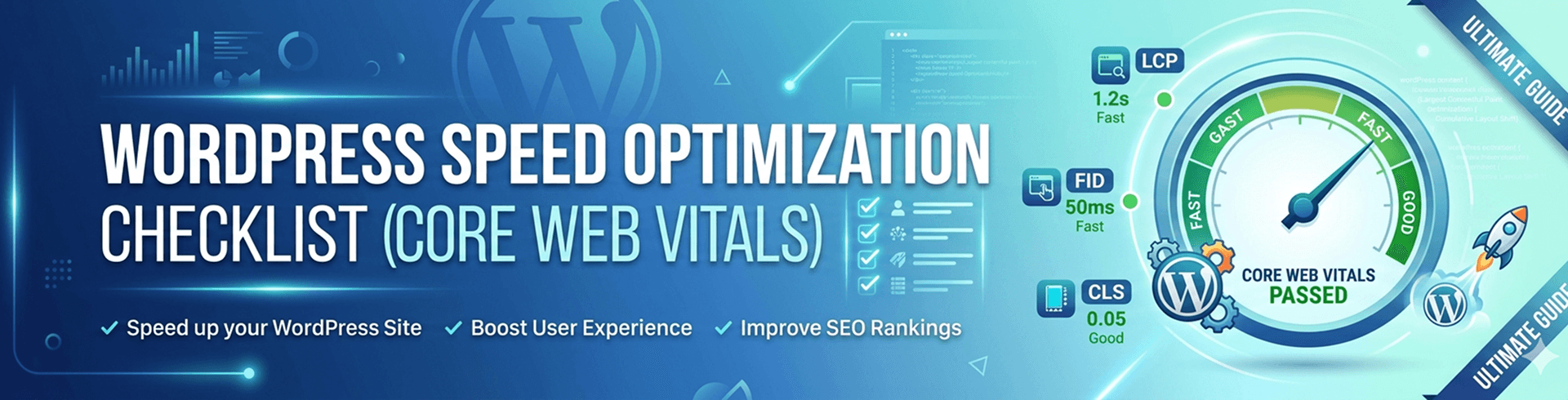
WordPress Speed Optimization Checklist 2026 (Core Web Vitals)


Website speed is no longer just a technical metric.
It directly affects:
- search visibility
- conversion rates
- mobile usability
- customer experience
- operational scalability
- AI-search discoverability
For enterprise WordPress environments, performance is not something that can be solved with a single caching plugin or occasional optimization work.
It requires operational governance.
Modern WordPress ecosystems are increasingly complex. A typical enterprise environment may include multilingual publishing workflows, ecommerce systems, marketing automation, analytics platforms, third-party APIs, personalization tools, CDN infrastructure, and headless frontend frameworks.
Every additional layer affects performance.
Without governance, websites gradually become slower over time.
Plugins accumulate. JavaScript expands. Media libraries become bloated. Database queries increase. Third-party scripts multiply. Core Web Vitals decline.
This is one reason businesses are increasingly prioritizing long-term operational governance rather than reactive optimization work. As discussed in our guide on WordPress maintenance SLA and enterprise governance, sustainable WordPress performance depends heavily on deployment discipline, infrastructure oversight, monitoring workflows, and operational accountability.
This becomes even more important in the AI era.
Search engines and AI-driven discovery systems increasingly evaluate:
- rendering quality
- mobile performance
- structured content delivery
- crawl efficiency
- loading speed
- interaction responsiveness
Businesses investing in modern WordPress in the AI era strategies are increasingly prioritizing performance governance alongside security, maintainability, and scalability.
For UAE businesses managing multilingual publishing environments, enterprise ecommerce operations, and performance-driven search visibility, WordPress optimization is no longer just about achieving better PageSpeed scores.
It is about maintaining sustainable digital infrastructure.
Why Core Web Vitals Matter for Modern WordPress Websites
Core Web Vitals are performance metrics Google uses to measure loading speed, visual stability, and interaction responsiveness.
The three primary metrics are:
- Largest Contentful Paint (LCP)
- Cumulative Layout Shift (CLS)
- Interaction to Next Paint (INP)
Together, these metrics help evaluate real-world user experience.
For WordPress websites, Core Web Vitals influence:
- mobile usability
- search visibility
- user retention
- conversion performance
- engagement quality
- crawl efficiency
Google increasingly prioritizes websites that provide stable, fast, and responsive experiences.
However, Core Web Vitals are not simply SEO metrics.
They are operational indicators.
Poor Core Web Vitals often reveal deeper infrastructure problems such as:
- inefficient frontend rendering
- oversized JavaScript bundles
- weak caching governance
- unoptimized media delivery
- plugin overload
- poor hosting environments
- inconsistent deployment practices
Many businesses focus only on Lighthouse scores while ignoring the operational causes behind poor performance.
That approach rarely creates long-term stability.
For example:
A website may temporarily achieve good performance scores after optimization work, but gradually decline again due to:
- uncontrolled plugin growth
- unoptimized media uploads
- excessive third-party tracking scripts
- infrastructure neglect
- frontend bloat
This is why enterprise WordPress performance should be governed continuously.
Not optimized once and forgotten.
Core Web Vitals also influence AI-search discoverability.
AI systems increasingly prioritize:
- fast rendering
- clean content structure
- stable layouts
- crawlable architecture
- mobile usability
Slow websites create friction not only for users, but also for search engines and AI-driven content retrieval systems.
For multilingual and ecommerce websites in the UAE market, this becomes even more important because:
- mobile traffic is dominant
- multilingual rendering increases complexity
- ecommerce interactions require responsiveness
- search competition is increasingly performance-driven
Performance governance is now part of long-term digital competitiveness.
The Biggest Causes of Slow WordPress Websites
Most WordPress websites do not become slow because of WordPress itself.
They become slow because operational complexity accumulates over time without governance.
The performance problems are usually predictable.
Plugin Overload
One of the most common causes of poor WordPress performance is uncontrolled plugin accumulation.
Businesses often install plugins for:
- SEO
- forms
- analytics
- multilingual publishing
- marketing automation
- ecommerce
- security
- popups
- image optimization
- page building
Over time, these plugins introduce:
- excessive scripts
- inefficient database queries
- render-blocking resources
- frontend bloat
- API overhead
Many enterprise WordPress environments operate with dozens of active plugins and no governance framework.
This creates performance instability.
The problem is not necessarily the number of plugins.
The problem is operational quality.
A poorly optimized plugin can create more performance damage than multiple lightweight plugins combined.
Professional performance governance should continuously evaluate:
- plugin necessity
- frontend impact
- database impact
- query behavior
- script loading patterns
- compatibility overhead
Without plugin governance, websites gradually accumulate technical debt.
Oversized Themes & Page Builders
Many WordPress themes prioritize visual flexibility over performance efficiency.
Large page builders often introduce:
- excessive DOM elements
- oversized CSS files
- render-blocking JavaScript
- frontend rendering delays
- layout instability
This becomes particularly problematic on multilingual and ecommerce websites where page complexity is already high.
Large themes also increase maintenance complexity because:
- updates become harder to govern
- frontend consistency becomes fragile
- optimization workflows become more difficult
Performance-focused WordPress environments usually prioritize cleaner frontend architecture and controlled component usage.
Unoptimized Images & Media Delivery
Media delivery remains one of the largest contributors to slow websites.
Common issues include:
- oversized images
- missing next-gen formats
- uncompressed media
- improper lazy loading
- excessive background videos
- inconsistent responsive image handling
Many businesses upload large assets directly from design tools without optimization workflows.
This creates unnecessary bandwidth overhead.
Professional optimization strategies typically include:
- WebP or AVIF delivery
- responsive image sizing
- image compression pipelines
- lazy loading governance
- CDN-based media delivery
For multilingual websites, image management also becomes more operationally complex because content duplication across languages increases asset volume significantly.
Poor Hosting Infrastructure
Hosting quality directly affects WordPress performance.
Shared hosting environments often struggle with:
- inconsistent CPU allocation
- memory limitations
- poor database performance
- inadequate caching layers
- slow response times
Enterprise WordPress performance usually requires:
- scalable infrastructure
- isolated environments
- optimized PHP workers
- object caching
- CDN integration
- database optimization
Without strong infrastructure foundations, frontend optimization alone cannot solve performance bottlenecks.
Excessive Third-Party Scripts
Modern websites frequently depend on:
- analytics tools
- advertising platforms
- chat systems
- tracking scripts
- personalization engines
- tag managers
- social embeds
These tools often introduce:
- render-blocking requests
- JavaScript overhead
- layout shifts
- interaction delays
One of the most common operational mistakes is adding third-party tools without evaluating performance impact.
Over time, websites become overloaded with scripts that significantly affect Core Web Vitals.
Professional governance should continuously audit:
- third-party script necessity
- loading behavior
- execution impact
- interaction overhead
WooCommerce Complexity
WooCommerce introduces additional operational complexity because ecommerce websites generate dynamic content continuously.
Common WooCommerce performance challenges include:
- cart fragments
- dynamic pricing
- session handling
- inventory queries
- payment gateway overhead
- personalized content rendering
Without proper optimization governance, WooCommerce websites often experience:
- slower checkout flows
- degraded mobile performance
- increased server load
- unstable caching behavior
Businesses investing in WooCommerce development should treat performance optimization as part of ecommerce infrastructure governance rather than standalone technical work.
Multilingual Performance Overhead
Multilingual WordPress websites introduce additional performance complexity.
This is highly relevant for UAE businesses operating Arabic and English publishing environments.
Performance challenges often include:
- translation plugin overhead
- duplicated content structures
- multilingual cache fragmentation
- hreflang processing
- RTL rendering complexity
- duplicated media libraries
Many multilingual websites appear stable initially but gradually slow down as operational complexity grows.
Without governance, multilingual environments become increasingly difficult to optimize consistently.
Enterprise WordPress Speed Optimization Checklist
WordPress speed optimization should not rely on isolated fixes.
It should operate through structured performance governance.
The following checklist reflects how enterprise WordPress performance should be managed over time.
Hosting & Infrastructure Optimization
Use Scalable Hosting Infrastructure
Shared hosting environments often create performance bottlenecks under traffic load.
Enterprise WordPress environments typically require:
- VPS infrastructure
- cloud hosting
- scalable compute resources
- optimized PHP workers
- isolated server environments
Infrastructure quality directly affects:
- response times
- rendering speed
- WooCommerce performance
- concurrency handling
- API responsiveness
Implement CDN Governance
A Content Delivery Network (CDN) reduces latency by distributing assets across edge locations.
CDN governance should include:
- cache policies
- image delivery optimization
- static asset management
- cache invalidation workflows
- regional traffic optimization
For UAE businesses serving multilingual audiences across regions, CDN governance becomes especially important.
Use Object Caching
Object caching reduces repeated database queries.
Technologies such as:
- Redis
- Memcached
- Varnish
can significantly improve backend performance.
Object caching is especially valuable for:
- WooCommerce websites
- multilingual publishing systems
- enterprise content platforms
- high-traffic websites
Optimize Database Performance
Database inefficiencies gradually affect WordPress performance over time.
Optimization workflows should include:
- query analysis
- transient cleanup
- revision management
- table optimization
- indexing improvements
- WooCommerce database tuning
Large WordPress environments often suffer from database bloat caused by years of unmanaged operational growth.
Frontend Performance Optimization
Reduce Render-Blocking Resources
Render-blocking CSS and JavaScript significantly affect Largest Contentful Paint.
Optimization strategies include:
- critical CSS extraction
- deferred JavaScript loading
- unused CSS removal
- script splitting
- asynchronous loading
Frontend optimization should focus on reducing unnecessary rendering overhead rather than simply compressing assets.
Optimize Image Delivery
Image delivery optimization should include:
- WebP or AVIF formats
- responsive image sizing
- lazy loading
- CDN-based image delivery
- compression workflows
Oversized images remain one of the most common causes of poor Core Web Vitals.
Optimize Font Loading
Poor font-loading behavior often affects:
- CLS
- rendering stability
- perceived performance
Optimization strategies include:
- preloading fonts
- reducing font variants
- using modern font formats
- minimizing layout shifts
Reduce JavaScript Complexity
Excessive JavaScript affects:
- INP
- interaction responsiveness
- mobile rendering
Many WordPress websites suffer from frontend bloat caused by:
- tracking scripts
- unnecessary plugins
- oversized frameworks
- excessive animations
Performance governance should continuously audit JavaScript impact over time.
WordPress Governance & Operational Discipline
Performance optimization is not only technical.
It is operational.
Professional WordPress governance should include:
- plugin audits
- staging workflows
- deployment testing
- rollback procedures
- performance monitoring
- infrastructure reviews
Without operational governance, websites gradually accumulate performance debt.
This is one reason businesses increasingly prioritize long-term WordPress maintenance SLA and governance frameworks rather than reactive optimization work.
WooCommerce Performance Optimization
WooCommerce optimization requires stricter governance because ecommerce performance directly affects revenue.
Professional WooCommerce optimization should address:
- cart fragment optimization
- checkout rendering
- dynamic content caching
- payment gateway efficiency
- session handling
- inventory queries
- mobile checkout performance
Large ecommerce websites often require:
- edge caching strategies
- optimized database architecture
- selective cache bypassing
- infrastructure scaling
Businesses investing in enterprise ecommerce website development in Dubai increasingly prioritize operational performance governance as part of long-term ecommerce scalability.
Multilingual Performance Optimization
Multilingual websites require additional performance governance.
Optimization workflows should include:
- multilingual cache optimization
- RTL rendering validation
- hreflang governance
- translation plugin auditing
- language-specific frontend optimization
Arabic rendering often introduces additional frontend complexity because:
- typography behaves differently
- RTL layouts affect rendering flow
- multilingual navigation increases DOM complexity
This is one reason multilingual WordPress optimization requires operational experience rather than generic plugin-based optimization.
Core Web Vitals Metrics Explained
Understanding Core Web Vitals requires understanding what affects each metric operationally.
Largest Contentful Paint (LCP)
LCP measures how quickly the main visible content loads.
Common WordPress causes of poor LCP include:
- slow hosting
- oversized images
- render-blocking CSS
- excessive JavaScript
- slow server response times
- poor CDN configuration
Improving LCP often requires both frontend and infrastructure optimization.
Cumulative Layout Shift (CLS)
CLS measures visual stability.
Common causes include:
- missing image dimensions
- unstable font loading
- dynamic content injection
- ad rendering shifts
- improperly sized embeds
Poor CLS creates frustrating user experiences, especially on mobile devices.
Interaction to Next Paint (INP)
INP measures interaction responsiveness.
Common causes include:
- excessive JavaScript execution
- heavy frontend frameworks
- inefficient event handling
- oversized third-party scripts
Improving INP often requires reducing frontend complexity rather than simply compressing assets.
Headless WordPress & Performance Governance
Headless WordPress architectures can significantly improve frontend performance when implemented properly.
By separating the frontend from the CMS, businesses can achieve:
- faster rendering
- static page generation
- reduced frontend overhead
- improved scalability
- better caching flexibility
Modern frontend frameworks such as Next.js often allow:
- server-side rendering
- edge rendering
- incremental static regeneration
- optimized frontend delivery
However, headless architectures also introduce additional operational complexity.
Performance governance must now manage:
- APIs
- deployment pipelines
- frontend infrastructure
- cache synchronization
- content rendering workflows
Businesses evaluating modern architectures should understand the operational tradeoffs between headless vs traditional WordPress.
Organizations investing in headless WordPress with Next.js often prioritize performance scalability, frontend flexibility, and deployment governance as part of long-term infrastructure strategy.
For enterprise environments requiring scalable frontend architecture, headless WordPress development can significantly improve rendering performance and infrastructure efficiency when governed properly.
Why Performance Requires Ongoing Governance
Performance optimization is not a one-time task.
Websites change continuously.
Over time:
- plugins accumulate
- media libraries expand
- third-party scripts increase
- frontend complexity grows
- infrastructure requirements change
Without governance, websites gradually become slower.
This process is often invisible initially.
Many businesses only notice problems after:
- search visibility declines
- Core Web Vitals deteriorate
- conversion rates decrease
- mobile usability weakens
Professional WordPress performance governance should include:
- continuous monitoring
- deployment testing
- plugin governance
- infrastructure reviews
- frontend auditing
- performance benchmarking
Performance governance also overlaps heavily with:
- SEO governance
- infrastructure governance
- security governance
Businesses investing in long-term technical SEO services increasingly recognize that search visibility depends heavily on operational performance discipline.
Security governance also affects performance sustainability because compromised environments, inefficient security layers, or poorly configured infrastructure can significantly reduce performance efficiency. Long-term operational resilience increasingly requires integrated cybersecurity services alongside performance governance.
How Element8 Approaches WordPress Performance Optimization
At Element8, WordPress performance optimization is approached as operational infrastructure governance rather than isolated speed improvements.
Performance problems are rarely caused by a single issue.
They are usually the result of accumulated operational complexity.
Our optimization philosophy focuses on:
- infrastructure efficiency
- frontend discipline
- deployment governance
- multilingual optimization
- WooCommerce scalability
- long-term maintainability
This includes:
- Core Web Vitals auditing
- infrastructure analysis
- caching governance
- frontend optimization
- image delivery optimization
- plugin governance reviews
- multilingual performance validation
- deployment oversight
For enterprise environments, performance optimization must balance:
- scalability
- security
- maintainability
- operational stability
- frontend speed
This is especially important for multilingual publishing systems, ecommerce platforms, and modern headless WordPress environments where operational dependencies are significantly more complex.
Long-term WordPress performance depends on governance.
Not temporary optimization fixes.
Final Thoughts
WordPress performance optimization is no longer just about achieving better PageSpeed scores.
It is about maintaining operationally sustainable digital infrastructure.
The difference between fast enterprise WordPress environments and unstable ones is rarely the CMS itself.
It is the operational discipline behind the platform.
Sustainable performance depends on:
- infrastructure governance
- frontend discipline
- deployment quality
- plugin governance
- monitoring workflows
- multilingual optimization
- long-term maintainability
For UAE businesses managing enterprise publishing environments, ecommerce systems, multilingual websites, and performance-driven search visibility, performance governance is no longer optional.
It is part of long-term digital competitiveness.
Organizations increasingly investing in scalable WordPress ecosystems are prioritizing operational governance, infrastructure efficiency, and performance sustainability as core business requirements rather than temporary optimization projects.
If your WordPress environment continues to become slower over time despite repeated optimization work, the issue may not be the CMS itself.
It may be the absence of long-term operational performance governance behind it.
FAQs
What is the best way to improve WordPress speed?
The best way to improve WordPress speed is through structured performance governance that includes caching optimization, infrastructure scaling, image optimization, plugin governance, frontend optimization, and continuous monitoring.
What affects Core Web Vitals in WordPress?
Core Web Vitals in WordPress are affected by server response times, frontend rendering efficiency, JavaScript execution, image optimization, caching behavior, and infrastructure quality.
Does WordPress speed affect SEO?
Yes. WordPress speed directly affects Core Web Vitals, mobile usability, crawl efficiency, engagement quality, and search visibility.
Poor performance can reduce rankings and negatively affect user experience.
Can plugins slow down WordPress?
Yes. Poorly optimized plugins can significantly affect frontend rendering, database queries, JavaScript execution, and overall website responsiveness.
How does WooCommerce affect performance?
WooCommerce increases operational complexity because ecommerce systems generate dynamic content continuously.
Checkout workflows, payment gateways, sessions, and inventory queries all affect performance.
Why do multilingual websites load slower?
Multilingual websites often load slower because translation systems, duplicated content structures, RTL rendering, multilingual caching, and additional frontend complexity increase operational overhead.
Can WordPress handle enterprise traffic?
Yes. WordPress can reliably support enterprise traffic when backed by scalable infrastructure, optimized caching, frontend governance, CDN architecture, and operational discipline.
Does hosting affect WordPress speed?
Yes. Hosting quality directly affects response times, rendering performance, scalability, uptime stability, and WooCommerce efficiency.