

Local SEO That Prints Leads: The Dubai Maps + Service Page + Reviews Playbook



Dubai has more than 350,000 registered businesses, and a growing share of them are chasing the same handful of local searches: the plumber near me, the best clinic in Business Bay, the SEO company Dubai trusts with an enterprise budget. Most of those businesses have claimed a Google Business Profile. Very few have built a system around it.
That’s the gap this playbook closes. “Local SEO” in Dubai is usually treated as a one-time task: claim the listing, add a photo, forget it exists. Meanwhile, the map pack keeps rewarding the handful of competitors who treat it as three connected engines working together, not a checklist of disconnected tasks.
Those three engines are:
- Maps: your Google Business Profile, the asset Google actually ranks in the local pack.
- Pages: the service and location pages on your website that prove relevance for every area you serve.
- Proof: the reviews, citations, and local authority signals that tell Google (and everyone else) your business is real, active, and trusted.
This is a build-it playbook, not a theory post. Every section below ties back to a specific, ownable action, and to one of the three ranking factors Google itself says local search comes down to. If your team would rather have Dubai’s SEO company run this system for you end-to-end, or you want the broader strategy behind building sustainable search visibility, read our guide on How to Choose the Right Enterprise SEO Agency in Dubai before diving into the implementation details.
What Local SEO Actually Means in Dubai
Local SEO is the process of making your business more visible when someone searches with local intent. In Dubai, that usually means ranking better in three places:
- the Google map pack
- Google Maps itself
- location-influenced organic search results
For example:
- dentist business bay
- law firm jlt
- seo company dubai
- clinic near me
- interior fit out company dubai marina
The important point is that Google does not rank local businesses based on a single listing or a single page. It uses a combination of business-profile signals, website signals, review signals, citation accuracy, location relevance, and brand trust.
That is why local SEO services Dubai businesses actually benefit from are rarely “set and forget.” They require ongoing maintenance, structured pages, and review momentum.
The 3 Factors Google Uses to Rank Local Businesses
Every local ranking algorithm Google runs, the map pack, Google Maps, and increasingly AI Overviews comes down to three official factors: relevance, distance, and prominence. Understanding these isn’t academic. It’s the filter that tells you whether a tactic is worth your time.
Relevance
How well your profile and pages match what the searcher is actually looking for. This is decided by your GBP category, your service descriptions, and the content on your website, not by internal job titles or generic “we do everything” positioning.
Distance
Physical proximity between the searcher (or the location term they used) and your business or service area. A Business Bay-registered firm won’t rank for “Deira” searches just by wanting to; it needs a genuine local presence, a service-area setting, or a dedicated page that earns the right to be relevant there.
Prominence
How established and active your business appears, including reviews, citations, backlinks, and profile completeness. Industry ranking-factor research (Whitespark’s annual local search survey among them) consistently places Google Business Profile signals and review signals as the two heaviest weighted categories in local pack rankings, with review recency in particular climbing sharply in importance over the past two years. Distance is largely outside your control. Relevance and prominence are not, which is exactly where this playbook focuses.
Element8 Insight: the fastest local SEO wins in Dubai usually do not come from publishing more blog content. They come from correcting a weak Google Business Profile category, tightening service-page targeting, and building a real review-generation process instead of passively “hoping people leave reviews.”
Engine 1: Google Business Profile Optimization for Dubai Businesses
Your Google Business Profile is the single highest-leverage asset in local SEO, and the most commonly under-optimized one. Most Dubai businesses set it up once during launch and never touch it again, which is precisely why a properly maintained profile is easy to outrank.
Choosing the right primary and secondary categories
Your primary category carries more ranking weight than almost any other GBP field. Choose it based on what customers actually search for, “Dental Clinic” rather than “Healthcare Consultancy,” not based on how your business describes itself internally. Getting this one field wrong is the single most common reason an otherwise well-run profile stays invisible for the searches that matter.
NAP consistency and the trade license trust signal
Your name, address, and phone number (NAP) need to match exactly across your website, GBP, and every directory listing down to the abbreviation style. Beyond NAP, add your DET trade license number in the GBP “more information” section. It’s a small, Dubai-specific detail that most competitors skip, and it reinforces the same trust signals Google and AI answer engines are increasingly weighing.
Photos, posts, and Q&A cadence
A neglected profile with three photos and no activity since setup sends a weak prominence signal, no matter how good the business behind it is. A realistic minimum cadence: at least one GBP post per week, ten or more photos spanning team, premises, and completed work, and proactively seeded Q&A answering the three questions customers actually ask before they call.
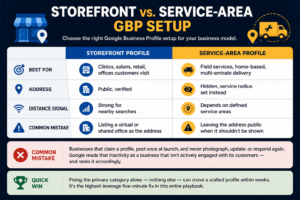
Storefront vs. service-area profiles
If you serve customers at their location rather than your field services, home-based businesses, or multi-emirate delivery, set your profile as a service-area business and hide the public address rather than forcing a storefront listing that misrepresents how customers actually reach you.
Engine 2: Service Pages & Location Pages That Actually Convert
This is where most Dubai local SEO content stops short. “Build local landing pages” gets mentioned as advice, but almost nobody explains the architecture, which is exactly the gap this section fills.
URL and content architecture for multi-area targeting
A workable service-page pattern for many businesses is:
/services/[service]-[area]
For example:
- /web-design-business-bay
- /seo-jlt
- /dental-clinic-dubai-marina
But the URL structure is not the strategy by itself. The value comes from whether the page genuinely deserves to exist.
Build a dedicated page only when one or more of these are true:
- you serve that area consistently
- you have real customer demand there
- you have local proof points for that area
- the page supports a clear conversion journey
Do not publish twenty near-identical area pages just because Dubai has many neighborhoods. Thin pages usually dilute relevance instead of building it.
On-page elements every service or location page needs
- A unique H1 and intro, not a find-and-replace of the area name into a template
- An embedded Google Map for that location or service area
- A local testimonial or case reference specific to that area, where available
- LocalBusiness or Service schema markup
- A clear, singular call to action
Avoiding duplicate content across near-identical pages
The failure mode here is predictable: ten pages that are the same template with the area name swapped. Vary the proof points, imagery, and local context on every page. If two areas don’t have enough genuine demand to justify separate pages, consolidate them into one broader page rather than publishing near-duplicates that compete against each other in search results.
Building the pages is only half the job; they also need to load fast, render cleanly on mobile, and hand off cleanly to a conversion flow. That’s the execution side our web development company in Dubai team handles alongside the SEO architecture.
Engine 3: Reviews, Citations & Local Authority (the Prominence Engine)
If Maps is the visibility engine and Pages are the relevance engine, Reviews are the trust engine.
This is also the most controllable prominence signal for many Dubai businesses.
A Review-Generation System, Not a One-Off Ask
The wrong way to build reviews is to ask occasionally when someone on the team remembers.
The right way is to create a system tied to the natural satisfaction moment. That usually happens right after delivery, completion, approval, or a successful service interaction.
A practical review system includes:
- a defined trigger point
- a direct review link
- a simple ask message
- a follow-up path if the first ask is ignored
- a responsible team owner
For many UAE businesses, WhatsApp performs better than email for review requests because it feels more natural and receives faster attention. That is one reason turning website traffic into WhatsApp conversations is not just a conversion tactic. It can also support review momentum and customer follow-up.
Responding to Reviews, Including Bilingual Signals
Do not respond only to negative reviews.
Reply to positive reviews too. That shows the profile is active and helps reinforce trust. If the customer leaves a review in Arabic, reply in Arabic. If they review in English, reply in English.
This matters for two reasons:
- it signals real engagement to users
- it supports bilingual local relevance in the UAE market
A profile that visibly engages in both English and Arabic often feels more credible to the audience it actually serves.
Citations and UAE-Specific Directory Logic
Citations still matter, but consistency matters more than volume.
Start with the core sources that are actually useful:
- Google Business Profile
- Apple Maps / Business Connect
- relevant UAE directories
- credible sector-specific listings
- Dubai Chamber listing where applicable
A smaller number of accurate listings will usually outperform a larger number of inconsistent ones. This is where many businesses waste time by chasing low-quality directory submissions instead of cleaning up the sources that matter.
Local Backlinks and Digital PR in the UAE
Local backlinks matter because they strengthen prominence and entity trust.
The highest-value opportunities often come from:
- UAE industry publications
- local partnerships
- sponsorships
- events
- regional business associations
- community visibility
- relevant news coverage
A single strong local mention can carry more weight than several generic guest posts on irrelevant sites.
This is also where proof matters. Our work with Alef Education case study is the kind of example that helps demonstrate how local visibility, trust, and authority support broader search performance, not just short-term rankings.
Bilingual Local SEO: Arabic + English Signals for the UAE Audience
Dubai search behavior is bilingual. Many businesses still treat that as optional.
That is a mistake.
In many categories, users search in both English and Arabic, or move fluidly between the two. That means local SEO for UAE businesses should think beyond a single-language listing and a single-language page set.
At a minimum, where the audience supports it:
- add Arabic as a relevant secondary language in GBP where appropriate
- ensure Arabic copy is properly written, not machine-translated filler
- connect Arabic and English pages with proper hreflang
- review mobile UX carefully for RTL presentation
- make sure bilingual contact and conversion flows still feel natural
This is not just a translation exercise. It is a relevance exercise.
If your business serves both language audiences, bilingual readiness is increasingly baseline. For the deeper UX and technical side, see Arabic/English UX and SEO mistakes to avoid.
Local SEO in the Age of AI Overviews: Staying Visible Beyond the Map Pack
AI-generated search results are changing how local businesses get discovered, but the fundamentals have not changed nearly as much as people think.
There is no separate “AI local SEO trick” that replaces good local SEO. The same signals that support Google Maps ranking Dubai businesses care about also support AI visibility:
- structured business data
- clear website content
- citations
- review quality and recency
- strong entity consistency
- trustworthy local signals
What has changed is that structure matters even more.
If your site uses:
- clear headings
- short direct answers
- clean FAQ sections
- schema
- specific local facts
it becomes easier for AI-generated results to interpret and summarize your business correctly.
That is why local SEO and GEO optimization are not competing disciplines. In practice, the same businesses that clean up their Maps, Pages, and Reviews systems often improve their AI visibility too.
For the broader AI-search angle, see staying visible in Google’s AI Overviews.
Measuring Local SEO ROI: What to Track and Why
Local SEO is much easier to defend internally when it is tied to numbers leadership can understand.
Most businesses should measure performance across both platform signals and website conversion signals.
What to Track in Google Business Profile
Track:
- profile views
- calls
- direction requests
- website clicks
- photo engagement
- search visibility trends where available
These metrics help show whether your profile is actually becoming more visible and more useful.
What to Track on the Website
On the website side, measure the actions that matter:
- whatsapp_click
- phone_click
- form_submit
- consult_cta_click
These are not vanity metrics. They are the bridge between local SEO and leads.
What Timeline to Expect
One of the biggest mistakes in local SEO is expecting everything to move on the same timeline.
A category correction, profile cleanup, or review push can show movement within weeks. Stronger service pages, local citations, and authority-building usually take longer. Meaningful local SEO growth often needs three to six months of consistent work.
That does not mean local SEO is slow. It means different parts of the system move at different speeds.
If your team wants both the optimization layer and the measurement layer built together, that is exactly where our SEO company in Dubai approach becomes more useful than “ranking advice” in isolation.
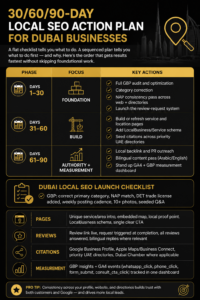
30/60/90-Day Local SEO Action Plan for Dubai Businesses
A flat checklist is less useful than a sequenced plan. Here is the practical version.
Days 1–30
Focus on Maps first:
- audit and fully optimize your Google Business Profile
- correct your primary and secondary categories
- clean up NAP consistency
- upload better photos
- seed Q&A content
- launch a real review-request process
Days 31–60
- Build the Pages engine:
- create or refresh service and location pages
- remove or consolidate weak duplicate pages
- add schema where relevant
- improve internal linking
- align page CTAs to actual local intent
- clean up citation consistency across key UAE sources
Days 61–90
Strengthen the Reviews and authority layer:
- build local backlinks and partnership mentions
- expand review velocity
- improve bilingual content where relevant
- connect GBP insights with GA4 reporting
- review which areas and services are actually converting
This is where a local SEO checklist for Dubai businesses becomes useful only if it is tied to priorities. Otherwise, teams stay busy without getting much movement.
Common Local SEO Mistakes Dubai Businesses Keep Repeating
A few mistakes show up constantly:
- choosing the wrong GBP primary category
- creating service pages with only neighborhood-name swaps
- collecting reviews in bursts and then going silent
- publishing bilingual content without proper hreflang
- listing the business everywhere without fixing consistency
- assuming a claimed profile is an optimized profile
- measuring rankings without measuring leads
These are not small issues. In many cases, they are the exact reason two similar businesses get completely different local visibility outcomes.
Conclusion
Local SEO that produces qualified leads is not a checklist. It is a system made of three engines: Maps, Pages, and Reviews.
That is the central idea most businesses miss. They may have a Google Business Profile, but weak service pages. They may have decent pages, but no review system. They may collect reviews, but fail to build proper local relevance around them. One engine working alone rarely creates durable local search performance.
The Dubai businesses that win tend to do three things well:
- they maintain a high-quality Google Business Profile
- they build service and location pages that actually deserve to rank
- they create ongoing review, citation, and authority signals that support prominence
That is what turns local visibility into booked calls, qualified leads, and measurable pipeline instead of vague “SEO activity.”
If you want a practical audit of your Maps, Pages, and Reviews system, talk to our SEO company in Dubai team. If your business is serious about local growth, this is one of the fastest places to uncover hidden gaps and real lead-generation upside.
FAQs
What is local SEO and why does it matter for Dubai businesses?
Local SEO helps a business rank in Google Maps, the local pack, and location-influenced organic results. In Dubai, where hundreds of thousands of businesses compete for similar searches, it matters because it often determines which business gets the call and which one stays invisible.
How long does local SEO take to show results in Dubai?
Some fixes, especially GBP category changes, profile improvements, and review momentum, can show impact within weeks. Broader gains from pages, citations, and authority building usually take three to six months of consistent work.
How many Google reviews do I need to rank in the Dubai map pack?
There is no fixed number. Review recency, review quality, and steady momentum usually matter more than chasing a single total. A profile with an active stream of recent reviews often outperforms one with a larger but stale review count.
Do I need a separate page for every area I serve in Dubai?
No. Build separate pages only where you have real demand or a meaningful operational reason to target that area. Thin, repetitive pages for every neighborhood usually weaken the overall site instead of helping it.
Does my Google Business Profile need to be in Arabic and English?
If your audience is bilingual, then in many cases yes, it should support both properly. That does not mean a rushed translation. It means well-written bilingual business information that matches how your customers actually search.
What’s the difference between local SEO and regular SEO?
Regular SEO often focuses on broader organic visibility across topics and services. Local SEO focuses more specifically on location-based discovery, Google Business Profile visibility, local intent pages, reviews, citations, and map-pack performance.