

WooCommerce vs Magento: Which Ecommerce Platform Wins in 2026?


If you are weighing WooCommerce vs Magento in 2026, here is the short version: WooCommerce is the practical choice for most startups, SMEs, and content-led brands in the UAE, while Magento — now split between community-maintained Magento Open Source and Adobe’s enterprise-focused Adobe Commerce — makes sense mainly for large, complex, multi-store operations with dedicated technical teams. The comparison has also changed materially in the last few years: Adobe has shifted its investment toward Adobe Commerce as a cloud service, which affects cost, hiring, and long-term planning for anyone considering the Magento route.
Choosing an ecommerce platform is not just a technical decision. For businesses in Dubai and across the UAE, it shapes your operating costs in AED terms, your SEO and content workflow, how easily your team can run the store day to day, and how painful (or painless) scaling will be. At Element8, we specialise in WooCommerce development, so we will be upfront about our vantage point — but this comparison is written to help you make an honest call, including the cases where Magento genuinely is the better fit.
Quick Answer: WooCommerce vs Magento in 2026
For most growing UAE businesses, WooCommerce wins on cost, ease of management, and content-driven SEO. It runs on WordPress, so your store, blog, landing pages, and campaigns live in one system your marketing team already understands.
Magento (Adobe Commerce) is worth considering only if you have:
- a genuinely complex product catalog with advanced pricing rules
- multi-store or multi-region operations under one backend
- advanced B2B requirements such as company accounts and negotiated pricing
- a dedicated technical team or retained development partner
- an enterprise-level platform budget — typically several times a WooCommerce build
If none of those describe your business today, Magento’s extra complexity is cost without benefit. That is the honest heart of this comparison.
What Is WooCommerce?
WooCommerce is an open-source ecommerce plugin that turns a WordPress website into a full online store. Because it inherits the WordPress ecosystem, it keeps products, content, SEO, and campaigns in one place — which is exactly how most growing brands actually market themselves.
WooCommerce is typically the strong fit for:
- startups launching their first online store
- SMEs that need a scalable but cost-conscious platform
- brands already running WordPress
- businesses that grow through SEO, content, and paid campaigns
- teams that want to manage the store themselves day to day
In 2026, WooCommerce also ships with modern essentials that used to require heavy customisation: block-based store editing, built-in analytics, and mature integrations with the payment methods UAE shoppers expect — Apple Pay, Tabby, Tamara, and regional gateways such as Telr and Network International.
What Is Magento Today? An Honest Status Check
This is where the 2026 conversation differs most from older comparisons, and where many articles are out of date. “Magento” now refers to two quite different things:
- Magento Open Source — the free, self-hosted platform. It still exists, but Adobe’s feature investment in it has slowed considerably; recent releases have focused mainly on maintenance, security patches, and compatibility. Much of the platform’s forward momentum now comes from the community, including the independent Mage-OS initiative created to keep the open-source line healthy.
- Adobe Commerce — the paid enterprise product, where Adobe’s roadmap energy is concentrated. Adobe’s strategic direction is Adobe Commerce as a cloud service, a SaaS-style offering tied into the wider Adobe Experience Cloud, aimed squarely at large enterprises.
What this means practically for a UAE merchant evaluating the platform:
- Talent is scarcer. Experienced Magento developers were always more expensive than WordPress/WooCommerce developers; as agencies have migrated away, the regional talent pool has tightened further, which pushes up both build and maintenance costs.
- The upgrade path is a real question. Businesses on Magento Open Source need a view on long-term support — whether via Adobe’s releases, Mage-OS, or an eventual replatform.
- Adobe Commerce pricing is enterprise pricing. Licensing is typically revenue-based, before you count implementation, integrations, and ongoing development.
None of this makes Magento a bad platform. It remains genuinely powerful for complex commerce. But in 2026 it is best understood as an enterprise commitment, not a default option for a growing store.
WooCommerce vs Magento: Side-by-Side Comparison
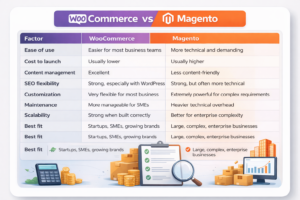
| WooCommerce | Magento / Adobe Commerce | |
|---|---|---|
| Best for | Startups, SMEs, content-led brands | Enterprises with complex, multi-store commerce |
| Base software | Free, open source (WordPress plugin) | Open Source free; Adobe Commerce licensed (revenue-based) |
| Typical build cost | Lower; investment can be phased as you grow | Significantly higher; enterprise infrastructure from day one |
| Ease of management | Familiar WordPress admin; marketing teams self-serve | Steep learning curve; ongoing developer dependency |
| Content & SEO | Excellent — native blogging, landing pages, SEO plugins | Capable but technical; content workflows less convenient |
| Scalability | Strong with good hosting and disciplined builds | Built for large catalogs and multi-store complexity |
| 2026 outlook | Actively developed, huge ecosystem | Adobe focused on Commerce cloud; Open Source community-driven |
| UAE payments | Apple Pay, Tabby, Tamara, Telr, Network International via mature plugins | Supported, but integrations often need custom work |
Pricing and Total Cost of Ownership
The most common mistake is comparing setup quotes instead of the total cost to build, run, improve, and scale over three to five years.
WooCommerce costs are modular: design and development, hosting, premium plugins, payment gateway setup, security, and maintenance. The advantage for UAE SMEs is control — you can launch lean, then invest in growth (SEO, UX, conversion optimisation) as revenue justifies it, rather than sinking the budget into platform overhead up front.
Magento costs stack differently: heavier infrastructure, more development hours, more structured QA and patching, and — on Adobe Commerce — licensing that scales with revenue. With regional Magento specialists scarcer than they once were, day-two costs (changes, upgrades, integrations) tend to climb rather than fall.
For most small to mid-sized UAE businesses, WooCommerce delivers a meaningfully lower total cost of ownership, and, just as importantly, a cost curve that matches how growing companies actually spend.
Ease of Use: Who Runs the Store Day to Day?
This is the clearest practical difference. WooCommerce runs inside WordPress, so product updates, blog posts, landing pages, and promotions are things your own team can do without a ticket queue. Magento is built for trained users; in most Magento environments, meaningful changes flow through developers. If you do not have in-house technical staff, that dependency becomes a monthly cost and a bottleneck for every campaign.
Which Is Better for SEO and Content Marketing?
For content-led growth, WooCommerce has a structural advantage: it inherits the WordPress publishing engine — the strongest blogging, landing-page, and editorial toolset in the industry — plus mature SEO plugins for on-page control. If organic visibility is central to your acquisition strategy, that convenience compounds month after month, especially when paired with a deliberate strategy from an experienced SEO company in Dubai.
Magento can absolutely rank — large Adobe Commerce stores compete in tough categories worldwide — but it is a more technical environment, and content-first teams usually end up bolting on a separate CMS, which adds cost and complexity WooCommerce avoids by design.
Design Flexibility and Customisation
Both platforms are open source and deeply customisable; the difference is the kind of customisation each is built for. WooCommerce excels at practical, brand-led customisation — custom storefronts, campaign pages, tailored checkout flows, and integrations with marketing tools — which is exactly what most brands investing in ecommerce web design actually need. Magento’s depth shows in commerce logic: complex product structures, advanced pricing rules, multiple storefronts, and bespoke B2B workflows. Powerful — but be careful not to buy complexity because it sounds impressive. Unused enterprise capability is just overhead you maintain.
Performance and Scalability
The old shorthand — “WooCommerce for small stores, Magento for scale” — is too simplistic in 2026. WooCommerce scales well when it is built with discipline: quality hosting, sensible plugin choices, caching, and clean code. Most performance horror stories trace back to poor implementation, not the platform. It comfortably supports growing retailers, large content-led catalogs, and traffic driven by SEO and paid campaigns.
Magento earns its keep when scale arrives together with operational complexity: multiple regional stores, advanced B2B structures, and heavy ERP or middleware integration. The honest question is not “will we grow?” but “will we grow into complexity that only Magento handles?” For most UAE merchants, the answer is no — and if it becomes yes, that is usually the point at which enterprise budgets exist to fund the move.
Security, Maintenance, and Compliance
Neither platform is “secure by default” — both reward discipline. WooCommerce security rests on update hygiene, careful plugin selection, hardened hosting, and access control; professionally maintained stores run reliably for years. Magento demands even more structured maintenance — version management, patch testing, and infrastructure oversight — which is manageable for enterprises and burdensome for everyone else.
For UAE merchants there is also a compliance layer: handling customer data responsibly under the UAE’s personal data protection law (PDPL) and using properly integrated, PCI-compliant payment gateways. Both platforms can meet these requirements; what matters is the quality of the implementation and the partner maintaining it.
Which Platform Should a UAE Business Choose?
Choose WooCommerce if you are a startup or SME, you already use WordPress, your growth depends on content and SEO, you want a lower and more controllable total cost, and your team needs to run the store without developer dependency. This describes the majority of businesses comparing the two platforms in Dubai and the wider UAE.
Consider Magento / Adobe Commerce if you operate at enterprise scale with complex catalogs, multi-store or multi-country operations, advanced B2B workflows, and a dedicated technical team — and you have priced in Adobe’s enterprise licensing and the current state of the Magento talent market.
The honest verdict: Magento remains a capable enterprise platform, but its centre of gravity has moved upmarket. For everyone else, WooCommerce delivers what actually drives ecommerce results — speed to market, content and SEO capability, trusted local payment options, and a platform your team can use — without the technical weight.
Build the Right WooCommerce Store
Choosing the platform is only half the decision; the results come from how well it is built. At Element8, we design and develop WooCommerce stores for UAE brands that need strong design, fast performance, and long-term maintainability — backed by the experience of a trusted web design company in Dubai.
If you are planning a WooCommerce website in Dubai or anywhere in the UAE, speak with Element8 about building a solution that fits your business goals.
FAQs
Is WooCommerce better than Magento in 2026?
For most startups, SMEs, and content-led brands, yes. WooCommerce is easier to manage, cheaper to run, and better for SEO-driven growth. Magento (Adobe Commerce) is better only for enterprises with complex catalogs, multi-store operations, and dedicated technical teams to carry its overhead.
Is Magento being discontinued?
No, but it has changed. Adobe’s investment now centres on Adobe Commerce as a cloud service for enterprises, while Magento Open Source receives mainly maintenance and security updates, with community initiatives like Mage-OS driving much of its momentum. Anyone choosing Magento today should plan around that trajectory.
Which platform is more affordable for a UAE business?
WooCommerce, in almost every case. Its costs are modular — development, hosting, plugins, maintenance — and can be phased as you grow. Magento involves heavier infrastructure, more development hours, scarcer specialist talent, and, for Adobe Commerce, revenue-based enterprise licensing on top.
Can WooCommerce handle UAE payment methods like Tabby and Apple Pay?
Yes. Mature, well-supported integrations exist for Apple Pay, Tabby, Tamara, and regional gateways such as Telr and Network International. A properly built WooCommerce checkout can offer the full set of payment options UAE shoppers now expect, including instalment displays on product pages.
Is WooCommerce scalable enough for a growing business?
Yes — with good hosting, disciplined plugin choices, and a professional build, WooCommerce supports substantial catalogs and traffic. The businesses that genuinely outgrow it are those whose complexity (multi-store, advanced B2B, deep ERP integration) grows faster than their traffic, and they are the exception.