

ADHICS & DHA Compliance Checklist for Healthcare Platforms in Dubai (2026)


The digital transformation of Dubai’s healthcare sector has reached an important stage of maturity. Beyond the initial adoption of Electronic Medical Records (EMRs), the current paradigm demands absolute interoperability, uncompromised security, and strict regulatory compliance. For a Hospital Chief Information Officer (CIO) or Compliance Director in the United Arab Emirates, managing an IT infrastructure is no longer about operational efficiency; it is about absolute regulatory alignment.
Navigating the intersection of Dubai Health Authority (DHA) mandates, the National backbone for Integrated Dubai Health (NABIDH), and Abu Dhabi’s Abu Dhabi Healthcare Information and Cyber Security (ADHICS) standard will require a strong, proactive approach. While ADHICS originated in Abu Dhabi, its exhaustive framework has become the de facto standard for data security across multi-emirate healthcare groups operating in Dubai.
To stay compliant in 2026, hospital platforms must go beyond superficial checkboxes. They will need to integrate an architecture that easily connects to the central health information exchange, enforces localized data residency, and deploys advanced cybersecurity paradigms such as Zero Trust and automated digital traceability.
As healthcare organizations accelerate their digital transformation initiatives, partnering with an experienced technology provider becomes critical. At Element8, we help healthcare providers build secure, scalable, and compliance-ready digital platforms that align with evolving DHA, NABIDH, and ADHICS requirements while delivering seamless patient experiences.
In this blog, we will define the 2026 Hospital CIO checklist for building, deploying, and maintaining an ADHICS-compliant website within Dubai’s ecosystem and healthcare platform.
Unified HIE & NABIDH Integration
Achieving absolute DHA compliance is impossible without an easy, certified connection to the National Backbone for Integrated Dubai Health (NABIDH). As a unified Health Information Exchange (HIE), NABIDH can ensure that patient records are securely accessible across Dubai’s healthcare ecosystem, reducing diagnostic duplication and improving clinical outcomes. Large healthcare organizations across the UAE are already investing in advanced digital ecosystems that prioritize interoperability, patient experience, and compliance. Projects such as the Aster DM Healthcare demonstrate how modern healthcare platforms can support large-scale operational requirements while maintaining a seamless digital experience.
Real-Time Synchronization without Latency
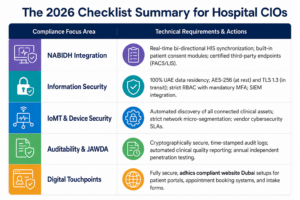
Your Hospital Information System (HIS) and EMR platforms cannot rely on batch processing or end-of-day data dumps. In 2026, compliance demands real-time, bi-directional synchronization.
- Every inpatient admission, outpatient encounter, laboratory result, and emergency department visit must stream into NABIDH instantly.
- The underlying API layer must feature high availability and failover mechanisms to handle peak clinical volumes without data drops or latency.
Granular Patient Consent Management
Sharing data requires explicit compliance with patient autonomy rules. Hospital platforms should deploy a dedicated, automated consent-tracking module embedded directly within the EMR and the patient-facing portal.
- The system must record and timestamp a patient’s opt-in or opt-out preferences regarding data distribution across the UAE health ecosystem.
- This module must dynamically restrict or allow data visibility to clinicians based on the patient’s active consent status, maintaining an unalterable log for audit purposes.
Security Certification for Third-Party Endpoints
A healthcare platform is only as secure as its weakest integration. Every peripheral digital service, such as telemedicine applications, Laboratory Information Systems (LIS), and Picture Archiving and Communication Systems (PACS), must undergo strict security validation. Before any third-party tool interfaces with your primary HIS, it must pass the necessary NABIDH security certification protocols to eliminate vulnerabilities at the endpoint layer.
Information Security & ADHICS Alignment
Although developed by the Department of Health (DoH) Abu Dhabi, the ADHICS framework can provide the most comprehensive cybersecurity guidelines in the region. For hospital networks operating across Dubai or aiming for gold-standard security, implementing ADHICS controls is important for safeguarding Protected Health Information (PHI).
Absolute UAE Data Residency
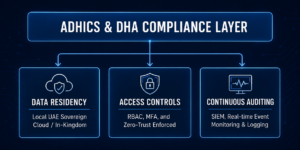
The UAE has strict sovereign data protection laws. Under DHA and ADHICS guidelines, all PHI, including patient medical history, billing details, and diagnostic imaging, should be hosted on secure servers located within the UAE. If your hospital uses cloud architecture, it should be deployed via a local cloud provider or a certified in-country data center. Storing data or international public clouds without specific local regulatory approval is a severe compliance violation.
Advanced Access Controls & Multi-Factor Authentication (MFA)
Credential stuffing and compromised passwords can remain prime vectors for healthcare data breaches. Hospital CIOs must enforce Zero-Trust architecture:
- Role-Based Access Control (RBAC): Clinicians, administrative staff, and third-party vendors must access only the minimum data required to perform their specific duties.
- Mandatory MFA: Multi-Factor Authentication must be non-negotiable for every login attempt, whether an internal clinical workstation or a remote telemedicine portal.
- Encryption Standards: All PHI must be protected using AES-256 encryption at rest and TLS 1.3 encryption in transit.
Continuous Technical Auditing and SIEM
Static annual policy reviews are no longer enough to stop modern threats. Hospitals should transition to continuous technical auditing. By integrating your infrastructure with a Security Information and Event Management (SIEM) system, your IT team can monitor data access patterns in real time. The SIEM should use machine learning to automatically flag and isolate suspicious behaviors such as unusual bulk downloads of patient files or cross-border login attempts.
Medical Device & Internet of Medical Things (IoMT) Security
As hospitals deploy more connected infrastructure, the surface area for cyberattacks can increase exponentially. Smart infusion pumps, digital ventilators, and networked imaging machines can present unique challenges or vulnerabilities as they often run legacy firmware that cannot support traditional security agents.
Automated Asset Discovery and Network Segmentation
You cannot protect what you cannot see. Hospital CIOs should deploy specialized network visibility tools that can automatically discover, categorize, and map every connected medical device across the facility. Once mapped, the IoMT devices should be rigidly isolated from the primary hospital IT and public Wi-Fi networks using virtual local area networks (VLANs). If an administrative workstation is compromised, micro-segmentation prevents the threat from moving laterally into critical life-support machinery.
Vendor Risk Management Frameworks
When procurement teams source new clinical equipment or software, cybersecurity compliance must be added to the evaluation criteria. Vendors should provide comprehensive documentation detailing how their systems store, transmit, and protect data. Procurement contracts should include legally binding SLAs ensuring that software patches and vulnerability updates are delivered promptly, maintaining compliance with ADHICS and DHA standards throughout the delivery life cycle.
Continuous Auditability & JAWDA Compliance
Regulators in Dubai and the wider UAE have pivoted their focus from passive, paper-based compliance checks to the active inspection of real-world operational effectiveness.
Digital Traceability and Unalterable Audit Trails
Every clinical interaction, prescription alteration, and diagnostic update across your healthcare platforms should be fully digitally traceable. Your HIS should automatically generate cryptographically secure, time-stamped logs that record who accessed a record, what changes were made, and when the event occurred. This forms a reliable, unalterable audit trail that satisfies both legal inquiries and regulatory inspections.
Automated Evidence Collection for JAWDA
The JAWDA framework tracks clinical quality and patient outcomes across the UAE. Instead of putting your compliance teams through stressful, manual data aggregation before a regulatory audit, your healthcare platforms should build automated evidence-collection workflows. By tracking and compiling clinical quality indicators during everyday operational activities, your platform can generate real-time compliance dashboards, reducing friction during official inspections.
Beyond compliance, healthcare organizations must also focus on accessibility, patient engagement, and community impact. Initiatives such as the Friends of Cancer Patients showcase how digital platforms can support healthcare-related organizations through secure, user-centric experiences.
Structured Vulnerability Assessments and Penetration Testing
An architecture is only compliant if it is proven to be secure against active threats. Hospital CIOs should mandate independent, third-party penetration testing and vulnerability assessment at least once a year. These rigorous tests should actively probe patient portals, EHR integrations, internal databases, and telemedicine web frameworks to discover and remediate edge-case security vulnerabilities before unauthorised actors can exploit them.
Designing an ADHICS-Compliant Web Architecture
For many patients and external auditors, the hospital’s website and patient portal serve as the primary entry points to the digital ecosystem. This can make maintaining an ADHICS-compliant website in Dubai the core requirement for modern healthcare organizations.
When configuring the public-facing portal, standard web hosting solutions are insufficient. The front-end user interface must connect securely to the backend system through encrypted APIs. Healthcare organizations are increasingly modernizing patient-facing digital touchpoints through secure, integrated platforms. The HealthHub (HHD) case study highlights how healthcare providers can create user-friendly digital experiences while maintaining strict operational and security requirements. Patient intake forms, telemedicine scheduling tools, and prescription renewal pages should process data through secure channels that transmit data immediately to the UAE-hosted databases. Web servers should also feature Web Application Firewalls (WAF), Distributed Denial-of-Service (DDoS) protection, and regular configuration audits to prevent data leaks or unauthorized script injections.
Partnering with an experienced digital agency like Element8 ensures that your public web footprint matches the security standards of your internal hospital information systems.
Artificial Intelligence in Dubai Healthcare: The 2026 Compliance Horizon
The integration of Artificial Intelligence (AI) into Dubai’s healthcare sector introduces a newer layer of compliance responsibilities. From AI-driven diagnostic tools in radiology to predictive analytics for patient bed management, machine learning models will require vast amounts of data to operate effectively.
According to regional insights of Healthcare AI in Dubai, incorporating AI into the clinical environment will need strict adherence to regulatory standards. Hospital CIOs should ensure that AI tools do not process sensitive clinical data on external cloud networks outside the UAE. The data pipeline supplying these algorithms should anonymize or pseudonymize PHI before it is analyzed by machine learning models.
Furthermore, any automated decision-making system should maintain complete explainability and auditability. If an AI system is suggesting a treatment path or flags a diagnostic anomaly, the logic behind that conclusion must be traceable. This can prevent “black box” scenarios and aligns with the data security guidelines outlined by both the DHA and ADHICS frameworks.
Securing the Future of Dubai Healthcare
Achieving compliance with ADHICS and DHA mandates in 2026 requires moving away from static, reactive IT strategies. For hospital CIOs and compliance directors, ensuring data security involves a comprehensive approach that protects every layer of the digital ecosystem, from internal medical devices to public-facing websites.
By prioritizing real-time NABIDH synchronization, enforcing strict UAE data residency, isolating IoMT devices, and choosing specialized development partners, your hospital can build a secure, compliant infrastructure. This approach mitigates regulatory risks while establishing a trustworthy foundation for modern patient care in Dubai.
FAQs
What are the primary differences between DHA and ADHICS requirements for Dubai hospitals?
The Dubai Health Authority (DHA) primarily regulates healthcare licensing, operational quality, and mandatory integration with Dubai’s local health information exchange, NABIDH. Conversely, ADHICS (Abu Dhabi Healthcare Information and Cyber Security) is a detailed cybersecurity standard created by the Abu Dhabi Department of Health (DoH). However, because ADHICS provides a highly rigorous framework for protecting health information, multi-emirate healthcare groups and advanced hospitals in Dubai widely adopt its controls to meet or exceed DHA’s data protection goals.
How can a hospital ensure its public patient portal functions as an ADHICS-compliant website in Dubai?
To maintain an ADHICS-compliant website in Dubai, the patient portal must run on infrastructure hosted within the UAE. It must enforce Multi-Factor Authentication (MFA) for patient logins, encrypt all data transfers using TLS 1.3, and use Role-Based Access Controls to protect sensitive data. Additionally, any web forms that collect patient data must connect directly to secure backend databases, protected by a Web Application Firewall (WAF) and regular vulnerability scans.
Can our hospital use international cloud providers such as AWS or Azure to store patient data?
You can use international providers only if they host your data within their certified, physically isolated data centers located inside the UAE. Under UAE data preservation laws and ADHICS/DHA frameworks, patient Protected Health Information (PHI) cannot be transferred outside the country without explicit authorization from local regulators. Any cloud architecture you deploy must guarantee local data residency.
What steps are required to integrate a legacy Electronic Medical Record (EMR) system with NABIDH?
Integrating a legacy EMR requires configuring secure API layers that can transform data into HL7 or FHIR international healthcare standards used by NABIDH. The integration must support real-time data streaming for patient encounters and pass strict endpoint security certifications. If a legacy system cannot handle these secure, real-time connections, a middleware solution must be deployed to ensure safe compliance and data translation.
How does the JAWDA framework impact the daily operations of a hospital IT department in Dubai?
The JAWDA framework focuses on clinical quality, patient safety, and operational performance indicators. For IT departments, this means your healthcare platform must automatically collect, log, and report quality metrics during daily workflows. Systems must provide digital traceability with immutable audit trails, allowing regulatory inspectors to easily verify performance data without disrupting hospital operations.