
WordPress VIP vs. Self-Hosted Enterprise WordPress in the UAE: Hosting, Security, and Support SLAs Compared


Large-scale enterprises operating in the United Arab Emirates face a uniquely demanding digital landscape. As Dubai and Abu Dhabi solidify their positions as hyper-connected global economic hubs, regional enterprises are confronted with surging concurrent web traffic, sophisticated cyberattack vectors, and the operational imperative to deliver flawless, zero-latency, localized digital experiences. For organizations preparing for public listings or large-scale digital transformation initiatives, the infrastructure decisions behind enterprise websites have become increasingly strategic. In this high-stakes environment, selecting the foundational content management architecture for the brand’s digital ecosystem is no longer merely an execution-level IT task; it has become a critical boardroom decision impacting risk mitigation, regulatory compliance, and fiscal efficiency.
For large-scale organizations, government entities, and multinational conglomerates that use WordPress to run their digital storefronts, portals, or multi-site networks, two distinct architectural pathways emerge. On the one hand, WordPress VIP (WPVIP) is a fully managed, premium enterprise Software-as-a-Service (SaaS) platform built specifically to insulate organizations from infrastructure complexities, making it a popular choice for enterprises seeking dedicated WordPress VIP development services and managed infrastructure support. On the other hand, Self-Hosted Enterprise WordPress is an open-source (WordPress.org) framework deployed via highly engineered, custom cloud infrastructure (Infrastructure-as-a-Service, or IaaS) managed either by an internal DevOps team or a specialized digital agency partner.
The main conflict between these two options extends far beyond a simple licensing budget question. It presents a profound strategic trade-off between absolute operational convenience and total infrastructural control, heavily shaped by the transforming regulatory landscape of the Middle East. This comparative analysis provides a granular look at how WordPress VIP and Self-Hosted Enterprise WordPress perform across three foundational pillars: Hosting and Infrastructure, Security and Compliance, and Support Service Level Agreements (SLAs), evaluated specifically within the UAE business ecosystem.
The Core Architectural Definitions
To establish a rigorous technical baseline for evaluation, it is necessary to formally define both operational models and highlight how they shift accountability between your internal teams and external providers.
- WordPress VIP (WPVIP): This is a fully managed, proprietary enterprise SaaS layer wrapping the open-source WordPress core. Under this model, the underlying containerization, database clustering, cloud orchestration, and performance fine-tuning are fully abstracted. WordPress VIP enforces strict code standards and controls the deployment pipeline, transforming WordPress into a highly scalable, turnkey cloud application with 100% outsourced infrastructure management.
- Self-Hosted Enterprise WordPress: This model utilizes the decoupled, open-source WordPress.org software framework. For organizations evaluating ownership, flexibility, and long-term scalability, it is useful to compare WordPress against alternative website platforms.
- At the enterprise scale, this is not basic shared web hosting; it involves high-availability web node clusters, isolated database instances (such as Amazon RDS), elastic load balancers, and decoupled cloud storage pipelines. The organization maintains complete ownership of the entire stack, shifting all operational, maintenance, and optimization overhead to the internal IT department or a retained technical partner.
Deep-Dive Comparison Pillars
Hosting & Infrastructure: Global Edge vs. Local Latency
The infrastructural demands of the enterprise websites expand far beyond basic hosting. Large-scale organizations will need continuous uptime, rapid content delivery, easy scalability, and the ability to handle unpredictable traffic surges without service disruption. This is where WordPress VIP and Self-Hosted Enterprise WordPress differ significantly in their architectural approaches.
WordPress VIP: Built for Global Scale
WordPress VIP addresses enterprise infrastructure requirements through a fully integrated global edge network designed for performance and resilience.
Key advantages include:
- Enterprise-grade built-in CDN with more than 300 global edge locations.
- Custom object caching to improve page rendering and database efficiency.
- Automated horizontal scaling that dynamically allocates resources during traffic spikes.
- Containerized infrastructure that eliminates the need for manual server management.
For example, when a major regional product launch, national media campaign, or viral marketing initiative generates an unexpected surge in traffic, the WPVIP platform automatically scales resources without requiring intervention from an internal infrastructure team. This significantly reduces operational overhead while maintaining consistent website performance.
Self-Hosted Enterprise WordPress: Optimized for Regional Performance
Unlike WordPress VIP, Self-Hosted Enterprise WordPress places architectural control directly in the organization’s hands. While this requires greater technical responsibility, it also creates a distinct advantage for businesses serving highly localized audiences.
Organizations can deploy their application stacks within:
- Local UAE hosting providers such as AEserver.
- The AWS UAE Region.
- Microsoft Azure regions in Dubai and Abu Dhabi.
- Other specialized regional infrastructure providers.
This localized deployment strategy offers several benefits:
- Single-digit millisecond latency for users in the GCC region.
- Reduced dependence on international network routing paths.
- Faster application response times for regional visitors.
- Greater control over infrastructure optimization and performance tuning.
For enterprises whose primary audience is concentrated within the UAE and broader Middle East, local hosting can sometimes outperform globally distributed infrastructure by eliminating unnecessary international network hops.
The UAE Regulatory Nuance: Data Localization and Compliance
In the UAE, data residency is rapidly evolving from a technical consideration into a regulatory requirement.
Under:
- UAE Federal Decree-Law No. 45 of 2021 on Personal Data Protection (PDPL).
- Regulatory frameworks established by the Telecommunications and Digital Government Regulatory Authority (TDRA).
Certain sectors are required to retain and process user data within the UAE borders. These sectors commonly include:
- Government departments.
- Semi-government organizations.
- Banking and financial institutions.
- Critical healthcare providers.
- Other regulated entities handling sensitive personal information.
Because WordPress VIP primarily operates on a centralized global cloud infrastructure, achieving strict and isolated UAE data residency can introduce legal, compliance, and architectural complexities.
For organizations operating under stringent regulatory requirements, a self-hosted deployment within local infrastructure providers such as AEserver, AWS UAE, or Azure UAE often becomes the most practical, and sometimes the only compliant solution.
Security & Compliance: Controlled SaaS vs. Custom Hardening
Enterprise websites face an increasingly sophisticated threat landscape. Security strategies must account for:
- Distributed Denial-of-Service (DDoS) attacks.
- Code injection vulnerabilities.
- Malware infections.
- Unauthorized access attempts.
- Data breaches and compliance violations.
WordPress VIP and Self-Hosted Enterprise WordPress take fundamentally different approaches to addressing these risks.
WordPress VIP: A Controlled and Highly Secure Environment
WordPress VIP follows a highly governed security model that prioritizes platform integrity and risk reduction.
Key security controls include:
- Read-only filesystem architecture that prevents direct modification of production files.
- Restrictions on changes to core files, active themes, and plugins in live environments.
- Automated code reviews and security audits for all custom code.
- Manual code validation before deployment approval.
- Enterprise-grade Web Application Firewall (WAF) protection.
- Advanced DDoS mitigation infrastructure.
This approach dramatically reduces the risk of:
- File-injection malware.
- Unauthorized code changes.
- Vulnerable plugin deployments.
- Security misconfigurations in production environments.
Every custom theme and plugin must pass rigorous security and quality checks before reaching production, ensuring a consistently secure operational environment.
The Trade-Off: Reduced Development Flexibility
While the WordPress VIP model offers exceptional security, it introduces operational limitations that may affect organizations requiring rapid innovation.
Common constraints include:
- Extended deployment timelines due to mandatory code reviews.
- Restrictions on unsupported custom plugins.
- Limited compatibility with legacy integrations.
- Reduced flexibility for unconventional development workflows.
Organizations with highly customized technology stacks may find these restrictions challenging when integrating proprietary business systems or deploying specialized functionality.
Self-Hosted Enterprise WordPress: Complete Architectural Freedom
Self-hosted enterprise deployments provide organizations with total control over their technology environment.
This flexibility allows teams to:
- Deploy bespoke legacy plugins.
- Implement complex reverse-proxy configurations.
- Customize server environments extensively.
- Execute direct, high-performance database queries.
- Integrate deeply with ERP, CRM, and other enterprise systems.
For organizations with unique business processes, legacy dependencies, or extensive customization requirements, this level of control can be a significant strategic advantage.
The Security Responsibility Shift
The freedom provided by self-hosting comes with a substantial operational burden.
Unlike WPVIP, where the platform largely manages security controls, self-hosted deployments place responsibility squarely on the organization or its agency partner.
Key responsibilities include:
- Configuring and maintaining stateful firewalls.
- Implementing File Integrity Monitoring (FIM).
- Managing WordPress core updates.
- Maintaining plugin and theme patching schedules.
- Conducting vulnerability assessments.
- Monitoring system logs and security events.
- Performing regular code audits and penetration testing.
The consequences of inadequate maintenance can be severe. A single outdated or vulnerable plugin can expose the entire enterprise environment to malware infections, data breaches, compliance violations, and significant reputational damage.
Ultimately, the decision comes down to a trade-off between platform-managed security and governance versus maximum flexibility and infrastructure control.
Financial Blueprint: Transparent Premium vs. Variable OpEx
To understand the long-term financial impacts of these models requires a move beyond the initial licensing fees to calculate the true Total Cost of Ownership (TCO).
WordPress VIP relies on a predictable, premium flat annual subscription model. Pricing typically ranges from $25,000 to $30,000+ USD per year, increasing with monthly page view metrics, aggregate bandwidth utilization, and the complexity of multi-site installations. This model turns hosting and application maintenance into a predictable operating expense (OpEx), encompassing infrastructure, CDN licensing, automated backups, and dedicated enterprise support into a singular, predictable line item.
Self-Hosted Enterprise WordPress features low upfront software licensing fees and operates on a flexible, pay-as-you-go cloud consumption framework. While the initial monthly billing from cloud providers for raw compute and storage units may appear significantly lower than that of a WPVIP subscription, this discrepancy often creates a costly financial illusion for enterprise tech leaders.
To accurately calculate the enterprise TCO for self-hosted architecture, CTOs should factor in the hidden, ongoing operational engineering costs. The real TCO formula should account for specialized internal engineering hours allocated to system administration, routine DevOps maintenance, manual deployment pipeline management, security patching, and emergency system remediation. An enterprise-grade, highly available self-hosted cluster requires continuous, expert human oversight. When internal developer overhead, specialized premium plugin licensing, and agency retainers are aggregated, the financial variance between the two models often narrows substantially.
Migration Considerations: Moving to WordPress VIP or Self-Hosted Infrastructure
For many organizations, the decision is not between two new platforms—it is about migrating an existing enterprise website to a more scalable and compliant architecture.
Before selecting either model, enterprises should evaluate:
Existing Technology Stack
- Legacy CRM integrations
- ERP connectivity
- Authentication systems
- Custom plugins and middleware
Compliance Requirements
- UAE data residency mandates
- Internal security governance
- Industry-specific regulations
Infrastructure Complexity
- Multi-site deployments
- High-traffic publishing requirements
- Multi-region content delivery
Operational Readiness
- Availability of internal DevOps resources
- Third-party agency support
- Long-term maintenance capabilities
A thorough technical audit often reveals hidden dependencies that can significantly impact migration timelines, implementation costs, and platform suitability.
Industry-Specific Recommendations for UAE Enterprises
Different industries face different operational and regulatory challenges. As a result, there is rarely a one-size-fits-all answer when choosing between WordPress VIP and Self-Hosted Enterprise WordPress.
Government & Public Sector
Government portals typically require strict compliance with UAE data residency requirements and extensive control over infrastructure configurations. Self-hosted deployments within UAE-based cloud environments are often the preferred approach.
Banking & Financial Services
Financial institutions must manage sensitive customer data while maintaining rigorous security controls. Self-hosted enterprise environments frequently provide the flexibility required to satisfy internal compliance teams and regulatory auditors.
Healthcare Organizations
Healthcare providers handling patient records and sensitive information often require localized infrastructure and customized security controls that favor self-hosted deployments.
Media & Publishing Companies
Media organizations experiencing high volumes of traffic during breaking news events frequently benefit from WordPress VIP’s automated scaling, global CDN infrastructure, and managed support services.
Enterprise Ecommerce
Large-scale ecommerce businesses should evaluate customer geography, compliance obligations, and integration complexity before selecting a platform. Both approaches can be viable depending on operational priorities.
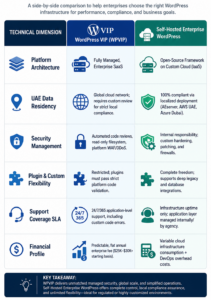
Strategic Comparison Matrix
Why UAE Enterprises Partner with Element8 for Enterprise WordPress Development
Selecting the right platform is only one part of the equation. Successful enterprise deployments depend on architecture planning, infrastructure optimization, security hardening, and long-term operational support.
Element8 helps enterprises:
- Design high-availability WordPress infrastructures
- Implement UAE-compliant hosting architectures
- Perform WordPress VIP migrations
- Build enterprise-grade WordPress applications
- Integrate ERP, CRM, and legacy business systems
- Conduct security audits and hardening initiatives
- Optimize performance for high-traffic environments
Whether your organization requires a fully managed WordPress VIP environment or a custom-engineered self-hosted enterprise deployment, our team provides the technical expertise needed to ensure long-term scalability, compliance, and performance.
Conclusion & Strategic Recommendation
The Strategic Decision Framework
- Select WordPress VIP if your enterprise prioritizes the reduction of internal operational overhead, requires guaranteed application-level uptime for a high-volume global audience, operates outside heavily regulated data-localization sectors, and prefers a predictable, flat annual SaaS subscription fee.
- Select Self-Hosted Enterprise WordPress if your organization must maintain absolute compliance with strict UAE data localization mandates (TDRA / PDPL), requires complex, non-standard legacy database integrations, demands full control over the underlying infrastructure stack, and possesses the internal DevOps maturity—or a trusted agency partner—to manage continuous application security and maintenance.
Navigating the deployment of enterprise-grade web architecture within the region requires deep local expertise. As a leading digital agency in Dubai, Element8 provides the specialized engineering and strategic guidance required to successfully deploy either environment. Whether architecting high-availability, fully compliant self-hosted local cloud environments or implementing a secure WordPress VIP migration, Element8 provides enterprise-grade consulting, infrastructure planning, and WordPress VIP implementation services.
Ready to evaluate your organization’s digital architecture? Contact the enterprise web development and cloud infrastructure team at Element8 today to schedule a comprehensive technical audit.
FAQs
Is WordPress VIP compliant with UAE data protection laws and local residency mandates?
WordPress VIP operates primarily on a global cloud network, which means achieving compliance with strict UAE data localization laws (such as the UAE Data Protection Law/PDPL and TDRA frameworks) requires custom evaluation. For government agencies, healthcare organizations, and financial institutions legally mandated to store personal data within the UAE, WordPress VIP may require complex legal mapping or may not meet strict local residency requirements. In these highly regulated sectors, deploying Self-Hosted Enterprise WordPress in local data centers such as AEserver or local AWS UAE nodes is the standard method for ensuring compliance.
What is the primary difference between WordPress VIP and self-hosted WordPress for UAE enterprises?
The primary difference lies in operational control, application-level support, and data residency compliance. WordPress VIP is an enterprise SaaS platform that fully manages hosting, global scaling, and security auditing, but restricts plugin flexibility and stores data across a global network. Self-Hosted Enterprise WordPress runs on an open-source framework via custom cloud infrastructure (such as AWS Dubai or AEserver), providing complete code flexibility, database integrations, and absolute compliance with UAE data localization laws, while shifting all security and infrastructure management to the enterprise or a digital agency.
How does hosting data localization affect enterprise WordPress performance in Dubai?
Hosting data localization directly reduces network latency for regional users. Deploying a Self-Hosted Enterprise WordPress stack within local data centers in Dubai or Abu Dhabi allows traffic to bypass international routing paths. This hyper-local hosting yields single-digit millisecond latency and rapid page load times across the Middle East, while meeting the legal compliance requirements established by the TDRA for processing and storing personal data within the UAE.
What are the hidden costs of managing a Self-Hosted Enterprise WordPress platform?
The hidden costs of Self-Hosted Enterprise WordPress center on internal engineering overhead, system administration, and continuous DevOps resource allocation. Unlike the flat annual SaaS fee of WordPress VIP, a self-hosted platform requires dedicated investment for configuring high-availability servers, continuous vulnerability scanning, manual deployment cycles, and emergency application troubleshooting. These developer salary hours and specialized support agency retainers form the true Total Cost of Ownership (TCO) for a self-hosted enterprise setup.
Can an enterprise run third-party custom plugins and custom CRM integrations on WordPress VIP?
Yes, but with strict platform limitations. WordPress VIP requires all custom code, third-party plugins, and external API integrations to undergo rigorous automated and manual security reviews before deployment. Plugins that use unoptimized database queries or break WPVIP’s read-only filesystem architecture will be blocked. Enterprises requiring deep legacy database connections or highly customized plugins often choose Self-Hosted Enterprise WordPress to retain full control over code and infrastructure configuration.