
AI Website Builders vs WordPress: Prototype vs Production (2026 Guide)
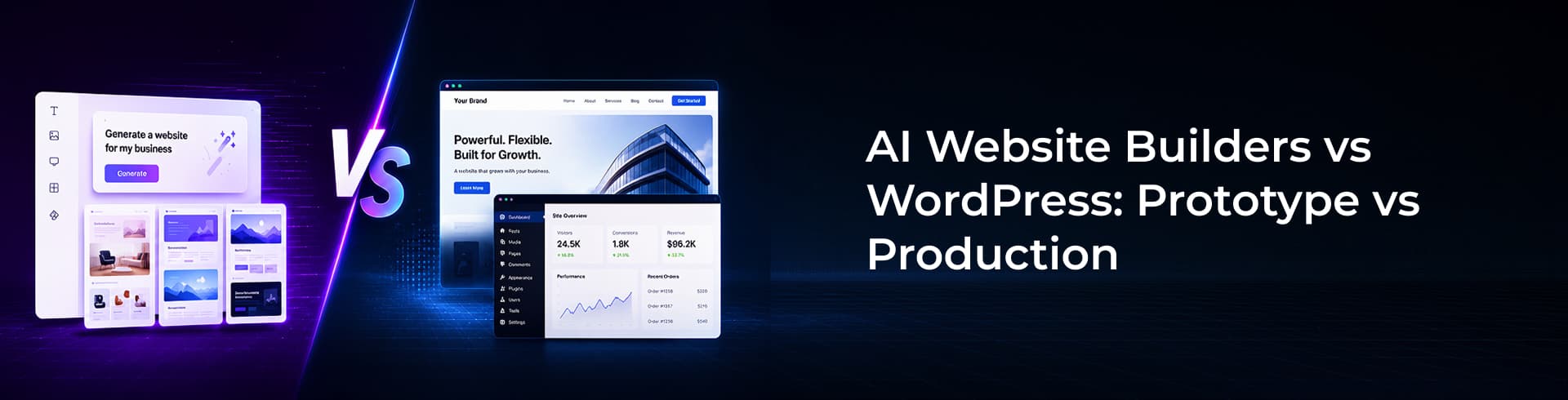


AI website builders changed how fast teams can launch ideas. In hours, you can go from prompt to published pages, basic branding, and early campaign traffic. For startups and small teams, that speed feels transformative.
But speed at launch is not the same as readiness for production.
As soon as websites become business-critical systems, the questions change. Teams now need stable governance, technical SEO control, secure integrations, scalable architecture, predictable release workflows, and long-term portability. This is where the prototype-vs-production distinction becomes critical.
This guide explains the real trade-off with an enterprise lens: where AI builders are strong, where they often break, and why WordPress remains a preferred production platform for many organizations. It builds on the same strategic theme from our pillar on WordPress development in the AI era: modern speed matters, but controllable systems matter more.
Why This Comparison Matters in the AI Era
Most teams evaluating website platforms today are under two pressures:
- Ship faster than before
- Reduce long-term technical and operational risk
AI tools solve the first problem well. They do not automatically solve the second.
In real business environments, websites are connected to many systems:
- CRM and sales flows
- Marketing automation
- Analytics and attribution
- Payment and commerce journeys
- SEO workflows
- Security and compliance controls
- Editorial governance
So the decision is not just “Can this platform generate pages quickly?”
The decision is “Can this platform run a production-grade digital program for the next 2 to 3 years?”
That is why “AI Website Builders vs WordPress” is less about trend and more about operating model fit.
Prototype vs Production: The Decision Most Teams Miss
Many organizations unintentionally choose a production platform using prototype criteria.
Prototype criteria usually include:
- How fast can we launch?
- Can non-technical team members edit easily?
- Does it look good quickly?
- Is the cost low in month one?
Production criteria are different:
- Can we govern access and releases safely?
- Can we support advanced SEO at scale?
- Can we integrate deeply across business systems?
- Can we maintain performance under growth pressure?
- Can we control data and architecture decisions long term?
The trap is common: a tool that is perfect for early validation can become expensive and fragile when the business scales. This does not make AI builders “bad.” It means they solve a different stage of the lifecycle.
A useful mindset is:
- Prototype: optimize for speed of learning.
- Production: optimize for reliability of growth.
Where AI Website Builders Win
AI website builders have legitimate strategic value. Teams should use that value where it fits.
1) Rapid concept-to-launch cycles
AI builders can compress the initial website cycle dramatically.
Instead of weeks of design and copy drafting, teams can create first-pass pages in hours and test early positioning quickly.
2) Lower initial friction for non-technical teams
These tools reduce dependence on engineers at the earliest stage.
For internal pilots, landing tests, and temporary campaign microsites, that speed can be excellent.
3) Faster messaging and layout experimentation
Prompt-driven generation enables more content and layout variants at lower effort. Teams can test value propositions and offer framing quickly before investing in larger builds.
4) Useful for pre-production discovery
AI builders are strong for:
- MVP website prototypes
- temporary launch pages
- idea validation before architecture commitment
This is a major advantage, especially when teams need confidence before investing in larger web development initiatives.
Where AI Website Builders Usually Break at Scale
As traffic, complexity, and stakeholder count increase, AI-generated convenience often meets operational limits.
Governance and workflow limitations
Production websites need structured governance:
- role-based permissions
- approval workflows
- staged release discipline
- auditability of critical changes
Many AI builder workflows prioritize speed over governance depth. That is fine early. It becomes risky later when multiple teams touch revenue-critical journeys.
Integration and extensibility limitations
At scale, websites rarely stand alone. You need deep integrations with:
- CRM
- ERP or operational systems
- custom analytics pipelines
- marketing automation
- regional service providers
If integration flexibility is constrained, teams create fragile workarounds. Over time, these workarounds increase costs, delay campaigns, and introduce reliability risk.
Portability and lock-in risk
Every platform has lock-in of some kind, but managed AI builders can create sharper dependency on proprietary workflows. Migration then becomes harder and more expensive once content volume and structural complexity grow.
This is why ownership-oriented planning usually appears in mature platform evaluations, including comparisons like WordPress vs Webflow/Wix/Shopify.
Why WordPress Still Wins for Production Systems
WordPress is not “new,” but its production value is exactly why it remains dominant for many serious websites.
1) Ownership of stack, data, and deployment choices
With WordPress, teams can choose hosting, security layers, deployment models, and optimization strategies based on their own business constraints. That flexibility is valuable for regional requirements, scaling plans, and long-term cost control.
2) Ecosystem maturity + extensibility
WordPress has a large ecosystem for:
- SEO and schema operations
- content workflows
- multilingual delivery
- automation and custom integrations
- eCommerce expansion
When used with governance discipline, this ecosystem accelerates production development significantly.
3) Multiple architecture paths
WordPress supports traditional, hybrid, and headless patterns.
For teams needing modern frontend control, headless WordPress + Next.js architecture can offer strong performance and UX while preserving editorial strengths.
4) Operational security maturity
WordPress can be highly secure when run with strong controls.
Teams that adopt structured hardening, patch policy, and incident readiness can achieve enterprise-grade resilience, as covered in our WordPress security hardening guide.
SEO Reality: Can AI-Built Sites Compete Long-Term?
AI tools can generate content quickly. But long-term SEO success depends on system-level quality.
Content velocity is not content authority
Publishing more pages faster is not enough.
High-performing SEO programs require:
- intent-aligned topic strategy
- consistent internal linking
- strong topical clusters
- quality governance
- technical SEO reliability
If your strategy depends on sustainable organic growth, your platform must support editorial and technical discipline at scale.
Technical SEO control matters more as competition grows
In competitive markets, teams need reliable control over:
- canonicals and indexation behavior
- schema patterns
- template-level metadata
- performance stability
- crawl efficiency and structural consistency
This is where many organizations combine platform strategy with technical SEO operations and deeper guidance from resources like the headless SEO guide.
Internal linking operations must be scalable
AEO/GEO-era search visibility depends heavily on content graph quality.
Platforms used for production must enable systematic internal linking across pillar-cluster structures, not just manual one-off edits.
Security and Compliance Comparison (Business + Enterprise Lens)
Security is often underestimated during platform selection.
Prototype tools typically focus on quick output and simplified publishing.
Production systems require defense-in-depth and operational rigor.
For enterprise readiness, evaluate:
- privileged access governance
- patch/update lifecycle control
- logging and monitoring visibility
- incident response readiness
- backup and recovery testability
- vendor and integration risk management
If your website supports regulated workflows, sensitive user data, or high-value conversions, these requirements are non-negotiable. Teams that need broader protection strategy often coordinate with dedicated cyber security services alongside platform engineering.
Performance and Scalability Comparison
AI-generated websites can look fast at low scale because complexity is still limited. Performance usually becomes difficult when:
- traffic spikes increase
- scripts and integrations accumulate
- dynamic templates multiply
- localization and personalization grow
WordPress can handle high-scale demands when performance is engineered intentionally: caching, database tuning, script governance, and infrastructure planning.
For commerce-specific workloads, this becomes even more important. See the full WooCommerce at scale checklist for detailed controls.
Total Cost of Ownership: 3-Month vs 3-Year View
The most common evaluation mistake is over-weighting initial speed and under-weighting long-term change cost.
3-month view (often optimized in AI builder decisions)
- quick launch
- low early effort
- reduced dependency on engineering
3-year view (what leadership should optimize)
- integration change cost
- migration risk and complexity
- SEO scalability
- security and governance overhead
- architecture adaptability
- compounding operational efficiency
For businesses expecting stable growth, long-term economics usually matter more than initial launch savings. The right platform is the one that minimizes future friction, not only present friction.
Best Hybrid Model: AI for Prototype, WordPress for Production
For many teams, the smartest strategy is hybrid:
- Use AI builders to validate early messaging and conversion ideas quickly.
- Use those learnings to inform a structured WordPress production build.
- Implement governance, security, and SEO controls before scale pressure arrives.
- Keep AI in the workflow for ideation and operational acceleration, not as the entire production foundation.
This approach captures the strengths of both worlds:
- AI speed for discovery
- WordPress control for durable execution
Teams comparing architecture depth can also evaluate adjacent models such as WordPress vs Strapi CMS architecture and broader headless CMS strategy.
Migration Playbook: AI Builder to WordPress Safely
If you already launched on an AI builder and are now outgrowing it, migrate deliberately.
Phase 1: Discovery and mapping
- Audit existing URLs, templates, assets, and structured content
- Identify conversion-critical journeys
- Map all third-party integrations
- Define SEO migration scope (redirects, canonicals, metadata, schema)
Phase 2: Production architecture design
- Define content model and governance roles
- Choose traditional vs headless WordPress model
- Plan performance and security baselines
- Define release workflow and rollback paths
Phase 3: Build and QA
- Build templates and content structures
- Implement integration connectors
- Validate technical SEO and internal links
- Run performance and security checks
- Perform staging-based UAT with stakeholders
Phase 4: Cutover and stabilization
- Launch with redirect and indexation controls
- Monitor conversion, crawl health, and errors closely
- Triage and patch fast in post-launch window
- Establish monthly governance cadence
If you need support on this transition, structured WordPress development delivery and headless WordPress implementation planning can prevent expensive rework.
Decision Framework: 10 Questions Before You Choose
Use these questions internally before committing to a platform:
- Is this website a temporary campaign asset or a long-term growth system?
- How critical is organic search to revenue over the next 24 months?
- How many integrations do we need now vs in 12 months?
- Do we require structured editorial governance?
- How strict are our security and compliance expectations?
- How much customization do conversion journeys need?
- Can we tolerate platform dependency if requirements shift?
- How likely are we to replatform in 18–24 months?
- Are we optimizing for launch speed or operational durability?
- Which option gives us better control over total cost of change?
If most answers point to complexity, ownership, and durability, WordPress is often the safer long-term production choice.
Final Verdict: Choose the Platform That Matches Your Risk Profile
AI website builders are excellent for prototypes.
WordPress is often better for production.
That is the cleanest summary.
If your immediate goal is fast validation, AI builders can save time.
If your goal is long-term digital infrastructure with scalable SEO, secure operations, and integration freedom, WordPress is usually the stronger foundation.
The strongest strategy for many organizations is not choosing one side as ideology. It is sequencing correctly:
- Prototype fast with AI.
- Move to production on a platform built for control.
If you want a practical roadmap for your specific business case, contact our team and we can map the right transition path based on your growth plan, risk profile, and architecture requirements.
FAQs
Are AI website builders good enough for production business websites in UAE?
They are often good for early-stage launches and prototypes. For long-term production systems with complex SEO, integrations, governance, and security requirements, many UAE businesses prefer WordPress for stronger operational control.
When should a company move from an AI website builder to WordPress?
Consider migration when platform limitations start affecting SEO growth, integration needs, performance, governance, or security posture. A common signal is when change requests become costly and slow despite the “easy” builder experience.
WordPress better than AI website builders for long-term SEO growth?
In many cases, yes. WordPress typically provides deeper control over content architecture, technical SEO workflows, and internal linking operations at scale, which are important for long-term organic growth.
What are the biggest risks of using AI website builders for enterprise projects?
Key risks include limited governance depth, integration constraints, portability/lock-in pressure, and difficulty adapting architecture when business complexity increases.
What is the best hybrid approach: AI prototyping + WordPress production?
Use AI tools for rapid ideation, message testing, and early landing validation, then move validated requirements into a WordPress production build with formal SEO, security, performance, and release governance.