
Migrating from Drupal, AEM, or Custom .NET: A Zero-Downtime Playbook for Enterprise Web Replatforming in the GCC
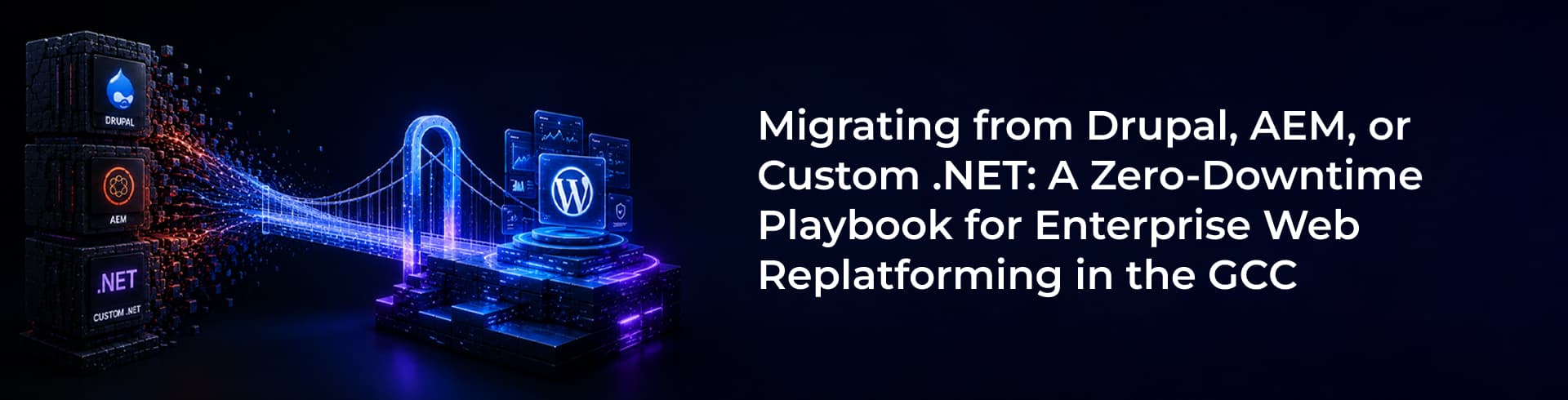


Many enterprise websites in the UAE and wider GCC still depend on legacy platforms such as Adobe Experience Manager (AEM), older Drupal environments, or custom-built .NET frameworks. While these systems may have supported business needs in the past, they often become difficult to scale, integrate, and maintain as digital operations grow.
Today, regional enterprises and government entities are managing higher transaction volumes, multilingual audiences, omnichannel experiences, and stricter compliance expectations. Driven by initiatives such as the UAE’s Digital Government Strategy and Saudi Arabia’s Vision 2030, organizations are under increasing pressure to modernize their digital infrastructure without interrupting business continuity.
For CTOs, digital transformation leaders, and enterprise marketing teams, however, replatforming is rarely a simple technical upgrade. A poorly planned migration can lead to website downtime, broken user journeys, lost revenue, damaged brand trust, and a sudden drop in organic search visibility. The traditional “big bang” launch model, where systems are taken offline and DNS records are switched in one high-risk move, is no longer suitable for mission-critical enterprise websites.
To scale without disruption, modern enterprises are moving toward zero-downtime website migration strategies. By running legacy and new platforms in parallel, using structured data migration workflows, and adopting decoupled, API-driven architectures, organizations can modernize their web platforms while protecting uptime, SEO equity, compliance, and customer experience.
As part of a broader enterprise website development strategy, zero-downtime replatforming helps GCC businesses move from rigid legacy systems to scalable digital infrastructure built for performance, flexibility, and long-term growth.
What Is Zero-Downtime Website Migration?
Zero-downtime website migration is a structured replatforming approach that allows an enterprise website to remain live and accessible while the new platform is being built, tested, and prepared for launch.
Instead of taking the existing website offline during migration, the legacy platform and the new platform run in parallel. Content, media, user data, integrations, and key workflows are gradually moved and synchronized in the background. This allows teams to test the new system thoroughly before switching live traffic to the modernized platform.
For enterprise websites, this approach is especially important because even a short period of downtime can affect revenue, customer trust, search visibility, lead generation, and internal operations. A zero-downtime strategy helps reduce these risks by replacing the traditional “big bang” launch with a controlled, phased migration process.
In practical terms, zero-downtime migration usually includes content audits, URL mapping, data synchronization, staging validation, SEO redirect planning, final delta syncs, and CDN or DNS-level traffic routing. When executed correctly, users and search engines experience a seamless transition from the old platform to the new one.
Architectural Mapping & Auditing
A zero-downtime migration is won or lost in the discovery phase. Before executing a single line of code or setting up staging environments, data structures across your legacy environments must be systematically audited and normalized. Legacy platforms handle data in fundamentally incompatible ways as compared to modern, composable architectures.
AEM to Modern CMS: JCR Node Normalization
Adobe Experience Manager relies heavily on a hierarchical Java Content Repository (JCR) database structure. In this framework, content, layout components, and configurations are stored as deeply nested tree nodes. When migrating to a modern, decoupled CMS such as a modern Drupal configuration or an API-first headless system, these abstract, nested component arrays must be flattened and transformed into standardized schemas.
Drupal & Custom .NET Structural Audits
For older, monolithic Drupal versions (such as Drupal 7) or custom-built .NET architectures, the technical debt often resides within fragmented database tables and localized custom business logic.
- Custom .NET Stacks: These typically bundle data access layers, proprietary C# routing logic, and presentation views into a single, tightly coupled repository. A thorough audit must catalog every hardcoded headless endpoint, internal webhook, and external web service integration.
- Legacy Drupal Systems: Systems built with older field structures require deep taxonomy architecture mapping to ensure content relationships remain sound.
The goal of this phase is to systematically replace rigid, platform-locked custom components with reusable, composable elements that cleanly expose content via JSON: API or GraphQL endpoints.
Data Residency & Regional Compliance
In the GCC, architectural mapping must occur in tandem with a strict legal review. The UAE Personal Data Protection Law (PDPL – Federal Decree-Law No. 45 of 2021), combined with recent mandates such as the Central Bank of the UAE’s sovereign financial cloud framework, imposes strict legal limits on cross-border data transfers. Regulated sectors—including banking, government, healthcare, and telecommunications are mandated to store and process personal, financial, and state-classified data strictly within national borders.
Critical Compliance Target: Organizations that fail to document data processing paths or are found to transfer sensitive user data outside local jurisdictions without explicit, validated contractual safeguards face severe operational audits and legal liabilities under regional cybercrime laws.
Consequently, your target architecture must feature Sovereignty by Design. This means provisioning stateful application databases and hosting environments on local cloud nodes, such as the AWS Middle East (UAE) region (me-central-1), du’s National Hypercloud, or Microsoft Azure UAE North, ensuring zero compliance leakage during or after the data migration pipeline. Selecting the right hosting architecture is equally important when planning a replatforming initiative. Organizations evaluating modern CMS platforms should also assess the differences between WordPress VIP vs self-hosted enterprise WordPress models, particularly regarding data residency, compliance, and infrastructure control within the UAE.
The Zero-Downtime Migration Playbook
Attempting to freeze content production and migrate terabytes of database entries and media libraries over a single weekend causes severe technical bottlenecks. The sheer volume of network data transfer inevitably extends past the maintenance window, leading to unexpected downtime. A resilient enterprise migration circumvents this via a multi-phased “twin system” methodology, running the legacy and target platforms in parallel.
Phase 1: Incremental Replication & ETL Pipelines
The migration process begins by establishing an automated, asynchronous Extract, Transform, Load (ETL) pipeline. An initial baseline import extracts the entire historical database and media repository from the production system to populate the new target staging environment. Because this occurs in the background, live operations continue completely uninterrupted.
To bridge the gap between the baseline snapshot and the final live launch, continuous Incremental “Delta” Syncs are established. Using advanced mechanisms like Change Data Capture (CDC) or specialized CMS tools (such as custom source and process plugins within the Drupal Migrate API framework), the migration engine scans for data modifications in real time.
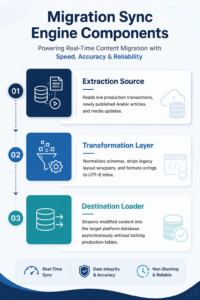
This continuous delta sync loop ensures the twin systems remain perfectly mirrored right up to the minute of launch, rendering a prolonged content freeze unnecessary.
Phase 2: Parallel Testing & Automated Quality Gates
With the twin systems synchronized, the target platform undergoes rigorous end-to-end evaluation in an isolated, production-parity staging environment. Enterprises deploy automated quality gates to execute structural validation at scale:
- Referential Integrity Scans: Scripted sweeps trace all internal entity references to ensure that nested content components, taxonomies, and author profiles are mapped accurately with zero orphaned assets.
- Media Rendition Audits: Programmatic checks verify that legacy Digital Asset Management (DAM) files, images, and localized documents have generated their respective modern responsive image variants and are delivered correctly via local CDN endpoints.
- Link Continuity Crawls: Automated bots crawl the staging environment to catch broken internal paths, absolute legacy domain references, and malformed queries before traffic routing occurs.
Phase 3: Orchestrated DNS Cutover
The actual launch is not a volatile, blind toggle; it is a highly choreographed network transition.
By reducing the Domain Name System (DNS) Time to Live (TTL) settings to 300 seconds, roughly 48 to 72 hours prior to cutover, you ensure that network changes propagate across global internet service providers (ISPs) almost instantly.
During the launch window, the legacy platform’s administrative backend is briefly toggled to a “Read-Only” state. A rapid, final delta sync catches any remaining micro-transactions. Finally, traffic routing policies within your primary Web Application Firewall (WAF) or Content Delivery Network (CDN), such as Cloudflare or AWS CloudFront, are updated to point to the new platform’s production IP. Traffic shifts seamlessly within minutes, completely invisible to end users.
SEO Equity & Redirect Strategy
A technical platform shift poses a significant threat to an enterprise’s organic search footprint if executed carelessly. When search engine indexing crawlers encounter sudden 404 errors or broken localized pathways, domain authority can plummet rapidly. Preserving SEO equity demands a meticulous redirect roadmap tailored to the GCC market’s multilingual realities.
Comprehensive URL Inventory and Mapping
Enterprise sites often harbor tens of thousands of indexed URLs across multiple localized segments. The first step is to perform an exhaustive crawl of the legacy system to generate a baseline URL inventory and match historical content paths to their newly engineered decoupled endpoints.
In the GCC, this mapping must explicitly protect regional search intent. For instance, legacy AEM URLs often contain deeply nested, platform-specific strings:
www.element8.ae/content/element8/en/services/enterprise-modernization.html
These must map directly and cleanly to modern, keyword-optimized API paths or slug structures:
www.element8.ae/en/services/enterprise-modernization
Multilingual Right-to-Left (RTL) Path Routing
Because regional search traffic relies heavily on Arabic queries, maintaining URL parity for both English and Arabic language trees is non-negotiable. Hierarchical translation paths must be explicitly preserved at the database and application levels.
Both paths must include explicit cross-language reference tags (hreflang) in the HTML head or in XML sitemaps to signal to search engines that the localized variations are structurally identical, thereby preventing duplicate content penalties and maintaining search visibility across regional demographics.
CDN Edge Routing for Zero Latency
Executing thousands of 301 (permanent) redirects directly within an application or CMS database layer, introduces significant processing overhead, adding hundreds of milliseconds of Time to First Byte (TTFB) latency. For an enterprise site, this latency degrades user experience and harms Core Web Vitals rankings.
The solution is offloading the complete 301 redirect map directly to the CDN edge layer using edge workers or router functions. When a user or crawler hits an outdated legacy link, the CDN intercepts and processes the redirect instantly at the network edge, returning a clean 301 status code in under 20 milliseconds without ever touching the origin CMS application server.
Enterprise-Wide Cultural Alignment
Technology is only one facet of a successful zero-downtime migration. Enterprise digital transformation projects fail when organizational workflows and human processes are treated as an afterthought.
Cross-Functional Team Synergy
A decoupled modernization initiative requires breaking down traditional enterprise silos. Organizations must assemble unified, cross-functional teams where infrastructure engineers, backend developers, frontend UI architects, security officers, and regional marketing leads collaborate under a single governance model. This prevents a common pitfall: developers deploying clean technical API structures that inadvertently disrupt the marketing department’s daily publishing velocity.
Production-Ready Preview Environments for Editors
The operational shift from a traditional, visual “What You See Is What You Get” (WYSIWYG) monolithic page builder (like AEM’s layout mode) to a structured component system requires active training. Content editors must be provided with specialized staging environments featuring real-time, decoupled preview-rendering pipelines.
This is particularly vital for managing Arabic right-to-left (RTL) typographic layout constraints. Editors need to see exactly how dynamic text, bilingual headings, and media elements align across web and mobile viewports before changes go live, eliminating layout friction early in the transition.
Staged Rollout Wave Patterns
Minimizing operational risk for massive regional portals involves executing an incremental, wave-based rollout rather than deploying the entire infrastructure at once.
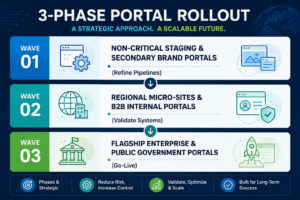
By launching less critical digital properties first, the implementation team can thoroughly stress-test the continuous ETL pipelines, monitor server loads across local GCC cloud nodes, and validate edge redirect rules under real-world conditions. Lessons learned from early waves are used to optimize the pipeline, ensuring absolute stability during migrations of high-traffic flagship portals.
Monolithic to Modern Decoupled Architecture
Stepping away from monolithic enterprise giants like AEM or legacy .NET systems means fundamentally reimagining how content is created, managed, and delivered across the enterprise ecosystem.
The Shift from Monolithic Java to Composable PHP & APIs
Monolithic platforms run as tightly integrated, vertical applications in which the data repository, core logic, and presentation views are bound to a single runtime environment (such as Java-based OSGi bundles in AEM). A modernization strategy decouples these layers completely.
By transitioning the backend to a highly optimized, API-first PHP environment—such as a modern, headlessly configured Drupal system—the CMS transforms into an agile content engine focused entirely on data modeling, strict access controls, and editorial workflows. Content is exposed via performant JSON: API or GraphQL endpoints, feeding lightweight frontend frameworks (such as Next.js, Nuxt, or React) that render pages rapidly at the edge.
These modern architectures also create the foundation for enterprise AI integration, enabling organizations to deliver personalized content, intelligent search experiences, predictive recommendations, and automated workflows across digital touchpoints.
Component Translation via Drupal Paragraphs and Schemas
To maintain structural consistency without platform lock-in, proprietary visual interfaces are rebuilt using structured, programmatic components. In modern Drupal architectures, this is achieved via the Paragraphs module or native custom layout schemas.
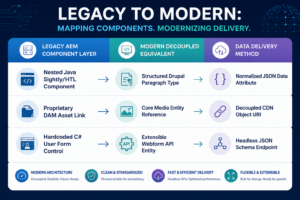
This approach abstracts the content payload from the presentation framework. If the frontend design needs a complete overhaul in the future, the core enterprise content database remains untouched and readily available via APIs.
Accelerating Delivery with Proven Migration Services
Building custom, one-off migration scripts from scratch to unpack complex enterprise databases introduces significant delivery risks and extended development timelines. To de-risk delivery, enterprises use established, production-tested frameworks and migration service providers.
Specialized migration partners, such as Metadrop, bring proven migration methodologies and pre-built tooling to manage the entire lifecycle of complex enterprise replatforming. Success also depends on selecting the right implementation partner. Organizations planning large-scale digital transformations should establish a structured enterprise vendor onboarding process to evaluate technical capabilities, compliance readiness, governance frameworks, and long-term support models.
The Metadrop Framework: Utilizing specialized toolsets built around the Drupal Migrate API, their approach automates the extraction, transformation, and direct SQL-based ingestion of legacy datasets. This eliminates manual intermediary exports, guarantees referential data integrity across complex language trees, and provides comprehensive validation logging out of the box.
Partnering with migration specialists allows GCC enterprises to bypass the common architectural pitfalls of custom script development, significantly accelerating project timelines while maintaining zero-content-loss fidelity throughout the replatforming journey.
Looking to refine specific architectural components of your migration strategy? Connect with experts at Element8 today!
FAQs
What is a zero-downtime web migration, and how does it work for enterprise sites?
A zero-downtime web migration is a strategic deployment methodology that ensures an enterprise website remains fully accessible to users and search engines throughout a platform transition. Instead of taking the site offline during a cutover, a “twin system” approach is used. The new platform is built and continuously synchronized with the live legacy site in the background using automated data sync pipelines. When the new platform is fully validated, network traffic is instantly rerouted at the CDN or DNS level, making the transition completely seamless for end users.
How do UAE data sovereignty laws affect enterprise web hosting and migrations?
The UAE Personal Data Protection Law (PDPL) and sector-specific mandates (such as the Central Bank of the UAE’s financial cloud framework) require that personal, financial, and government-classified information be stored and processed within the UAE’s geographic borders. During a web replatforming, enterprises must ensure that their target hosting architecture is deployed locally on sovereign cloud nodes—such as AWS Middle East (UAE), du’s National Hypercloud, or Microsoft Azure UAE North—to remain fully compliant with regional data residency regulations.
Why does migrating from AEM to a decoupled Drupal CMS reduce platform vendor lock-in?
Adobe Experience Manager (AEM) relies on a proprietary, monolithic Java-based architecture where content storage, business logic, and page rendering are tightly coupled. Migrating to a decoupled, API-first Drupal CMS separates your core content repository from the presentation layer. Drupal stores and structures data using open, standard relational models and exposes it via platform-agnostic JSON: API or GraphQL endpoints. This allows you to update or completely change your frontend interface in the future without needing to rebuild your underlying content database.
How can an enterprise preserve its Google Search rankings during a major CMS replatforming?
Preserving SEO rankings requires comprehensive URL inventory mapping and edge-layer routing. Every single legacy URL structure must be mapped to its corresponding path on the new platform, maintaining exact cross-language hreflang tags for English and Arabic pages. To prevent crawl latency and avoid overloading the origin server, these 301 redirect maps should be deployed and executed directly at the network edge via a CDN such as Cloudflare or AWS CloudFront.
What are continuous “delta” syncs, and why are they necessary in an enterprise migration?
Continuous delta syncs are automated background processes that continuously copy new content edits, transactional updates, and media uploads from the live legacy platform to the new staging environment. This is accomplished using Extract, Transform, Load (ETL) pipelines or Change Data Capture (CDC) mechanisms. Delta syncs ensure that both systems remain perfectly up to date in the weeks leading up to launch, eliminating the need for a prolonged content freeze or sudden site maintenance windows.
What role do migration frameworks like Metadrop play in enterprise replatforming?
Enterprise migration frameworks, such as those provided by Metadrop, use highly optimized toolsets built on the Drupal Migrate API to automate data migration. Rather than relying on fragile, manual text exports, these specialized services extract data directly at the database layer, transform legacy component trees into modern structured schemas, and load them with full relational integrity. This specialized approach eliminates data loss, protects complex multilingual configurations, and significantly reduces project delivery risks.