

Enterprise AI Integration in MENA Websites: n8n, LLMs, and HubSpot Workflows Inside Compliance Boundaries


Artificial Intelligence is no longer a future initiative discussed in innovation workshops. Across the UAE and wider MENA region, organizations are actively investing in AI-powered customer experiences, workflow automation, lead qualification systems, and operational efficiency programs.
Yet many enterprise leaders are discovering that deploying AI is not the difficult part.
The difficult part is integrating AI into existing business processes without compromising governance, security, compliance, or customer trust.
While startups can experiment rapidly with public AI tools, enterprise organizations operate under different realities. Customer data must be protected. Workflows must be auditable. Decisions must remain accountable. Regulatory obligations must be respected.
This is why enterprise AI integration is increasingly becoming an architecture challenge rather than simply a technology challenge.
Organizations that approach AI as part of a broader digital transformation strategy are significantly more likely to generate measurable business outcomes than those treating AI as a standalone initiative.
In this guide, we explore how organizations across the MENA region can integrate Large Language Models (LLMs), HubSpot, and n8n workflow automation into enterprise websites and digital ecosystems while maintaining operational control and compliance.
The Shift from AI Experiments to Enterprise AI Programs
A few years ago, most conversations about AI focused on possibilities.
Today, the conversation has changed.
Executives are asking:
- How can AI improve customer experience?
- Can AI reduce operational costs?
- Which business processes should be automated?
- How can AI support digital transformation initiatives?
- What governance controls are required before deployment?
These are practical business questions rather than technology questions.
The reality is that AI is no longer competing with traditional digital transformation programs. It is becoming part of them.
Organizations investing in enterprise website development are increasingly evaluating how AI can improve customer interactions, automate workflows, and support internal operations throughout the customer lifecycle.
At the same time, AI readiness is becoming an important consideration in broader platform modernization initiatives. Organizations evaluating enterprise content management systems often discover that future AI capabilities influence platform decisions as much as content publishing requirements. Similar considerations are discussed in our analysis of Headless WordPress vs Sitecore vs AEM, where scalability, integration flexibility, and future digital capabilities increasingly shape enterprise platform selection.
The question is no longer whether AI should be adopted.
The question is where AI can create value without introducing unnecessary risk.
Why Enterprise AI Projects Fail
Despite significant investment across industries, many AI initiatives never progress beyond proof-of-concept stages.
Interestingly, the problem is rarely the AI technology itself.
Modern LLMs are powerful. Workflow automation platforms are mature. Cloud infrastructure is readily available.
The real challenges emerge elsewhere.
Organizations Start with Technology Instead of Business Problems
Many projects begin with the wrong question.
Instead of asking:
“What business challenge are we trying to solve?”
organizations ask:
“Which AI model should we use?”
This leads to solutions searching for problems.
Successful AI initiatives usually begin with clear objectives such as:
- Improving lead qualification accuracy
- Reducing customer support workloads
- Accelerating document processing
- Enhancing customer self-service experiences
- Improving internal knowledge accessibility
When business outcomes are clearly defined, technology decisions become much easier.
Governance Is Often an Afterthought
One of the most common enterprise mistakes is implementing AI before establishing governance.
Different departments begin experimenting independently.
Marketing adopts one tool.
Sales adopts another.
Customer support introduces a third.
Within months, organizations find themselves managing disconnected systems with inconsistent policies and unclear accountability.
Enterprise AI requires governance frameworks covering:
- Data access controls
- User permissions
- Approval processes
- Audit trails
- Prompt management
- Content review procedures
- Risk management
Without governance, scaling AI becomes increasingly difficult.
Data Quality Is Poorer Than Expected
Many organizations discover that their biggest challenge is not AI.
It is their data.
Customer records are incomplete.
Knowledge bases are outdated.
Internal documentation lacks consistency.
Workflow logic is undocumented.
AI systems amplify both strengths and weaknesses within existing information ecosystems. Poor data quality inevitably produces poor outcomes.
Human Oversight Is Removed Too Quickly
Some organizations view AI as a replacement for human expertise.
The most successful organizations view AI differently.
They use AI to enhance human decision-making rather than replace it.
This approach is particularly important in regulated industries where accountability cannot be delegated to automated systems.
The most effective enterprise AI deployments use Human-in-the-Loop models that combine automation with professional oversight.
Understanding Compliance Requirements Across MENA
For enterprise leaders, compliance concerns often represent the biggest barrier to AI adoption.
These concerns are entirely reasonable.
AI systems frequently interact with customer information, business records, contracts, operational data, and sensitive organizational knowledge.
Without proper controls, AI initiatives can create regulatory and operational risks.
UAE Personal Data Protection Law (PDPL)
Organizations implementing AI-powered workflows must carefully evaluate how information is collected, processed, stored, and accessed.
Questions worth asking include:
- What information enters AI systems?
- How is customer data processed?
- Where is information stored?
- Who has access to outputs?
- How long is information retained?
- Are adequate audit records maintained?
These questions should be addressed during planning rather than after deployment.
Data Residency Considerations
Many organizations operating within the GCC maintain requirements regarding where data is processed and stored.
This consideration becomes increasingly important when evaluating:
- AI service providers
- Cloud environments
- CRM platforms
- Workflow automation tools
- Customer-facing applications
Enterprise leaders are increasingly prioritizing architectures that provide visibility and control over information flows throughout the organization.
Healthcare Compliance Requirements
Healthcare organizations face additional responsibilities when deploying AI-powered systems.
Patient communications, appointment workflows, inquiry management systems, and digital engagement platforms must align with healthcare governance frameworks.
Organizations evaluating AI initiatives within healthcare environments may also benefit from understanding the broader compliance considerations discussed in our guide to ADHICS and DHA-Compliant Healthcare Platforms in Dubai.
Governance for Public Companies and Pre-IPO Organizations
Transparency and accountability become increasingly important for organizations preparing for public markets.
As AI becomes embedded within customer-facing operations and internal workflows, governance frameworks must evolve accordingly.
Many of the same principles discussed in our article on Building IPO-Ready Websites in the GCC apply directly to enterprise AI initiatives, particularly around accountability, auditability, and operational controls.
The key lesson is simple:
Compliance cannot be added later.
It must be designed into the architecture from the beginning.
Enterprise AI Architecture: Beyond the Chatbot
One of the biggest misconceptions surrounding AI is that implementation begins and ends with a chatbot.
Enterprise AI is significantly more sophisticated.
The real value emerges when AI becomes integrated into business systems, workflows, and operational processes.
A typical enterprise architecture may look like this:
Website
↓
HubSpot CRM
↓
n8n Workflow Layer
↓
LLM Processing Layer
↓
Human Review
↓
ERP / Operational Systems
Each layer serves a specific purpose.
Website Layer
For most organizations, the website remains the primary entry point into the digital ecosystem.
Visitors:
- Submit inquiries
- Request consultations
- Download resources
- Complete applications
- Engage with customer support
Organizations investing in enterprise website development increasingly expect these interactions to trigger intelligent workflows rather than simply generate email notifications.
Modern websites are becoming operational gateways rather than static marketing assets.
HubSpot as the Customer Intelligence Layer
HubSpot’s role extends far beyond contact management.
When integrated into enterprise AI workflows, it becomes a centralized customer intelligence platform.
Organizations can use HubSpot to:
- Consolidate customer information
- Trigger automated workflows
- Manage lead qualification processes
- Personalize engagement strategies
- Track customer interactions
This creates a single source of truth across departments.
Why n8n Is Emerging as an Enterprise Automation Layer
Workflow orchestration is often the missing component in enterprise AI strategies.
This is where n8n is gaining significant attention.
Rather than acting as a simple automation platform, n8n enables organizations to connect:
- Websites
- CRM platforms
- Databases
- ERP systems
- Internal applications
- AI services
into structured business workflows.
For organizations seeking greater visibility, flexibility, and control over automation processes, this capability is increasingly valuable.
The LLM Processing Layer
This layer performs AI-driven reasoning tasks.
Depending on the workflow, the model may:
- Classify inquiries
- Summarize documents
- Generate responses
- Extract structured information
- Support decision-making processes
Importantly, the AI model should not become the system of record.
It should function as one component within a larger enterprise architecture.
Human Review and Approval
This is the layer that separates enterprise AI from consumer AI experimentation.
Human review provides:
- Accountability
- Quality assurance
- Risk mitigation
- Compliance oversight
For regulated industries, this step is often essential.
Rather than slowing innovation, it builds organizational trust.
Integration with Business Systems
Ultimately, AI only creates value when it influences business outcomes.
The final stage involves connecting AI insights to operational systems such as:
- ERP platforms
- Service management systems
- Procurement workflows
- Customer support platforms
- Financial systems
This is where organizations begin realizing measurable returns on AI investments.
As enterprises evaluate long-term AI initiatives, these investments should be assessed similarly to broader platform modernization programs. Organizations planning budgets may find useful parallels in our analysis of Total Cost of Ownership for Enterprise Web Platforms in Dubai, where operational sustainability often matters more than initial implementation costs.
Why n8n Is Emerging as an Enterprise Workflow Automation Platform
For many organizations, AI is not the hardest part of the implementation journey.
The harder challenge is connecting AI to existing systems in a controlled, scalable, and maintainable way.
This is where workflow orchestration platforms have become increasingly important.
Historically, organizations relied on custom integrations or lightweight automation tools to move information between systems. While these approaches can work for isolated processes, they often become difficult to maintain as automation requirements grow.
n8n has gained significant traction because it offers a middle ground between rigid no-code platforms and expensive custom development.
For enterprise organizations, several characteristics stand out.
Greater Control Over Data Flows
Enterprise leaders want visibility into how information moves between systems.
A typical AI workflow may involve:
- A website inquiry
- Customer data stored in HubSpot
- AI-powered classification
- Human approval
- CRM updates
- ERP integration
Without orchestration, these interactions become fragmented and difficult to govern.
n8n enables organizations to design, monitor, and control these workflows through a centralized automation layer.
Flexibility for Complex Business Processes
Enterprise workflows rarely follow simple linear paths.
For example, a healthcare inquiry may require:
- Initial classification
- Compliance review
- Department routing
- Human approval
- Follow-up communication
Similarly, a procurement inquiry may require multiple validation steps before progressing.
Unlike many traditional automation platforms, n8n allows organizations to build workflows that reflect real business processes rather than forcing processes to fit platform limitations.
AI as Part of a Larger Workflow
One of the biggest misconceptions about enterprise AI is that the AI model should become the center of the system.
In reality, AI is often just one step within a broader workflow.
The workflow remains the primary business asset.
The AI component simply enhances decision-making, classification, summarization, or communication within that process.
Organizations that understand this distinction tend to achieve significantly better outcomes.
n8n vs Zapier vs Custom Development
Enterprise leaders evaluating automation strategies often encounter three common approaches.
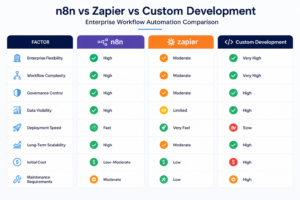
There is no universally correct choice.
The right approach depends on business objectives, compliance requirements, technical resources, and long-term digital strategy.
Organizations already investing in enterprise-grade digital platforms often find that workflow orchestration tools provide the balance of flexibility and governance required for sustainable AI adoption.
Enterprise Use Cases for AI Workflow Automation
The most successful enterprise AI projects solve real operational problems.
They are not implemented because AI is fashionable.
They are implemented because they improve efficiency, reduce friction, and enhance customer experiences.
Intelligent Lead Qualification
One of the most immediate opportunities exists within sales and marketing operations.
Consider a typical website inquiry.
Traditionally:
- A form submission generates an email.
- A sales representative reviews the inquiry.
- The lead is manually categorized.
- Follow-up actions are assigned.
With AI-enabled workflows:
- Website inquiries are captured automatically.
- HubSpot records are enriched.
- AI evaluates intent and qualification criteria.
- Leads are routed to appropriate teams.
- Follow-up actions are triggered automatically.
This accelerates response times while improving lead management consistency.
Organizations investing in enterprise website development increasingly view this type of automation as a competitive necessity rather than a future enhancement.
Healthcare Inquiry Management
Healthcare providers often manage large volumes of patient inquiries across multiple channels.
AI-powered workflows can assist with:
- Appointment requests
- Service inquiries
- Department routing
- Information classification
- Response prioritization
However, healthcare organizations must balance efficiency gains with governance obligations.
This is why compliance frameworks remain essential.
Organizations evaluating healthcare automation initiatives should consider the same governance principles discussed in our guide to ADHICS and DHA-Compliant Healthcare Platforms in Dubai.
The goal is not simply faster responses.
The goal is controlled, compliant automation.
Real Estate Lead Routing
Large developers frequently receive inquiries relating to:
- Multiple projects
- Geographic regions
- Investment categories
- Buyer profiles
AI workflows can evaluate incoming inquiries and route prospects to appropriate teams based on predefined business rules.
This improves responsiveness while reducing administrative effort.
More importantly, it ensures that high-value opportunities receive immediate attention.
Government and Semi-Government Services
Government entities face unique operational challenges.
Large volumes of citizen inquiries often require:
- Classification
- Prioritization
- Routing
- Documentation
AI can assist with these tasks while maintaining oversight and accountability.
However, governance remains critical.
Transparency, auditability, and process control should remain central components of any public-sector AI initiative.
Education and Admissions Workflows
Educational institutions often manage:
- Admission inquiries
- Student applications
- Program information requests
- Scholarship inquiries
AI-enabled workflows can improve responsiveness while reducing manual workloads for admissions teams.
Importantly, automation should support staff rather than replace them.
Human expertise remains essential for decision-making and relationship building.
Building an Enterprise AI Governance Framework
Technology alone does not create trust.
Governance does.
As AI becomes embedded within enterprise operations, organizations require frameworks that ensure accountability and control.
The most successful organizations approach AI governance as a business discipline rather than a technical requirement.
Human-in-the-Loop Controls
Human oversight remains one of the most effective risk management mechanisms available.
Not every AI output requires review.
However, organizations should clearly identify processes where human approval is mandatory.
Examples include:
- Customer-facing communications
- Financial decisions
- Healthcare interactions
- Regulatory reporting
- Procurement approvals
Human review should be viewed as a safeguard rather than a limitation.
Audit Logging
Enterprise leaders must understand:
- What happened?
- When did it happen?
- Why did it happen?
- Who approved it?
Audit logs provide this visibility.
Without auditability, organizations struggle to investigate issues, demonstrate compliance, and improve operational performance.
Access Management
Not every employee requires access to every AI capability.
Governance frameworks should define:
- User roles
- Access permissions
- Escalation procedures
- Administrative controls
Strong access management reduces operational risk while improving accountability.
Prompt Governance
As organizations deploy AI at scale, prompt management becomes increasingly important.
Different teams may create prompts that influence outputs in different ways.
Without governance, inconsistency emerges.
Organizations should establish standards for:
- Prompt design
- Testing procedures
- Version control
- Approval processes
This creates greater consistency across AI-enabled operations.
Continuous Monitoring
AI deployment is not a one-time project.
It is an ongoing operational capability.
Organizations should monitor:
- Output quality
- Workflow performance
- User adoption
- Risk indicators
- Compliance metrics
Monitoring ensures that AI systems continue delivering value as business requirements evolve.
Governance as a Competitive Advantage
Many organizations view governance as a barrier to innovation.
The reality is often the opposite.
Strong governance frameworks enable organizations to scale AI initiatives with greater confidence.
This becomes particularly important for enterprises operating within regulated industries, public markets, or complex operational environments.
The same governance principles that support AI initiatives also support broader digital transformation objectives. Similar themes emerge in our discussion of IPO-Ready Websites in the GCC, where accountability, transparency, and operational resilience are critical to long-term success.
Organizations that establish governance early typically move faster later because trust has already been built into the foundation of their systems.
Enterprise AI Implementation Roadmap
One of the most common mistakes organizations make is attempting to deploy AI across multiple departments simultaneously.
While ambitious transformation programs can be successful, most organizations achieve better outcomes through phased implementation.
Enterprise AI should be approached as a structured business transformation initiative rather than a technology rollout.
Phase 1: Discovery and Opportunity Assessment
Before selecting tools, organizations should identify opportunities where AI can deliver measurable value.
Questions worth asking include:
- Which business processes consume the most time?
- Where do operational bottlenecks exist?
- Which workflows involve repetitive manual effort?
- What customer interactions could be improved?
- Which processes already have well-defined rules and governance?
The objective is to identify high-impact, low-risk opportunities that can generate visible results.
This phase should involve stakeholders from:
- IT
- Operations
- Customer Service
- Marketing
- Sales
- Compliance
- Executive Leadership
Successful AI programs begin with business alignment rather than technology selection.
Phase 2: Pilot Implementation
Once opportunities have been identified, organizations should launch a focused pilot.
Examples include:
- Lead qualification automation
- Customer inquiry classification
- Internal knowledge search
- Service request routing
- Document summarization
The purpose of a pilot is not simply to validate technology.
It is to validate governance, workflows, user adoption, and business outcomes.
Organizations should define clear success metrics before implementation begins.
Examples include:
- Reduction in response times
- Increase in lead conversion rates
- Reduced manual processing effort
- Improved customer satisfaction
- Faster access to information
Small wins create organizational confidence.
Phase 3: Governance and Compliance Expansion
Once pilot programs demonstrate value, governance frameworks should be formalized.
This phase includes:
- Access controls
- Approval workflows
- Audit logging
- Security reviews
- Compliance assessments
- AI usage policies
Many organizations attempt to implement governance after large-scale deployment.
This often creates unnecessary risk.
Governance should scale alongside adoption.
Phase 4: Enterprise Rollout
After governance foundations are established, organizations can begin expanding AI capabilities across departments.
Common expansion areas include:
- Marketing automation
- Sales operations
- Customer support
- Procurement
- HR workflows
- Internal knowledge management
At this stage, workflow orchestration platforms such as n8n become increasingly valuable because they provide centralized visibility across multiple business processes.
Organizations working with an experienced web development company in Dubai often integrate AI initiatives alongside broader digital transformation programs to ensure technology, processes, and governance remain aligned.
Phase 5: Optimization and Continuous Improvement
AI implementation is never truly finished.
Models evolve.
Business requirements change.
Customer expectations increase.
Successful organizations continuously review:
- Workflow performance
- AI accuracy
- User adoption
- Governance effectiveness
- Operational outcomes
The goal is not simply automation.
The goal is continuous operational improvement.
Enterprise AI Readiness Checklist
Before deploying AI-powered workflows, enterprise leaders should evaluate organizational readiness.
Strategy and Business Alignment
- Business objectives clearly defined
- Executive sponsorship secured
- Success metrics established
- High-value use cases identified
Data and Systems Readiness
- CRM data quality assessed
- Website and customer data reviewed
- Internal knowledge sources identified
- Integration requirements documented
- Data ownership defined
Governance and Compliance
- AI governance framework established
- Human review requirements identified
- Access controls implemented
- Audit logging configured
- Compliance review completed
- Data residency considerations addressed
Technology and Operations
- Workflow orchestration platform selected
- AI provider evaluation completed
- Security review conducted
- Monitoring processes established
- Incident response procedures documented
Organizational Readiness
- Internal stakeholders aligned
- Employee training planned
- Change management strategy developed
- Operational ownership assigned
Organizations that complete this checklist before implementation are significantly more likely to achieve sustainable long-term outcomes.
The Future of Enterprise AI in MENA
The conversation around AI is evolving rapidly.
The earliest wave of adoption focused on experimentation.
The next wave focuses on operational integration.
Organizations are increasingly asking:
- How can AI improve customer experiences?
- How can AI accelerate internal operations?
- How can AI support digital transformation programs?
- How can AI be deployed responsibly?
These questions reflect maturity.
The future belongs to organizations that can integrate AI into business operations while maintaining trust, governance, and accountability.
Technology alone will not create competitive advantage.
Execution will.
Conclusion
Enterprise AI adoption is no longer about implementing chatbots or experimenting with generative AI tools.
It is about building intelligent, governed, and scalable digital ecosystems that improve business performance.
The organizations seeing the greatest success are not necessarily those with the most advanced AI models.
They are the organizations that combine:
- Strong governance
- Clear business objectives
- Reliable data foundations
- Human oversight
- Scalable architecture
Platforms such as HubSpot, workflow orchestration tools like n8n, and modern LLM technologies provide powerful capabilities. However, sustainable success depends on how these capabilities are integrated into broader business processes.
As enterprises continue modernizing their digital ecosystems, AI should be viewed as a strategic capability that complements existing investments in websites, customer experience platforms, CRM systems, and operational technologies.
Organizations already investing in Enterprise Website Development are increasingly incorporating AI readiness into their digital strategies, ensuring future platforms can support automation, personalization, and intelligent decision-making at scale.
Planning Enterprise AI Initiatives in the UAE or MENA?
Whether you’re exploring AI-powered lead qualification, workflow automation, customer service enhancement, or enterprise governance frameworks, successful implementation requires more than selecting the right tools.
It requires architecture, compliance planning, workflow design, and operational oversight.
Element8 helps organizations design and implement secure, scalable, and compliance-aligned digital platforms that support long-term business growth.
Request an Enterprise AI Discovery Workshop to explore how AI can be integrated into your organization’s digital ecosystem while maintaining governance, security, and customer trust.
FAQs
What is enterprise AI integration?
Enterprise AI integration is the process of connecting artificial intelligence technologies with websites, CRM platforms, workflow automation tools, and business systems to automate processes, improve decision-making, and enhance customer experiences while maintaining governance and operational control.
How can enterprises use n8n to automate AI workflows?
n8n enables organizations to connect websites, CRM platforms, databases, ERP systems, and AI services into structured workflows. Enterprises commonly use n8n for lead qualification, customer support automation, document processing, and operational workflow orchestration.
Is enterprise AI automation compliant with UAE PDPL requirements?
Enterprise AI automation can support compliance objectives when implemented with appropriate governance controls. Organizations should evaluate data processing practices, access controls, auditability, retention policies, and data residency considerations before deployment.
What are the benefits of integrating HubSpot with AI-powered workflows?
Integrating HubSpot with AI workflows can improve lead qualification, customer segmentation, marketing automation, sales efficiency, and customer engagement by combining customer intelligence with automated decision support.
What governance controls should enterprises implement before deploying AI workflows?
Organizations should establish governance frameworks covering access management, audit logging, approval workflows, prompt governance, human oversight, compliance reviews, and ongoing performance monitoring.
What industries benefit most from enterprise AI workflow automation?
Healthcare, financial services, government, education, real estate, logistics, manufacturing, and professional services can all benefit from AI-powered workflow automation when deployed with appropriate governance controls.
How should organizations evaluate enterprise AI implementation partners in the UAE?
Organizations should evaluate partners based on enterprise architecture expertise, integration capabilities, governance experience, compliance awareness, workflow automation knowledge, and their ability to align AI initiatives with broader digital transformation objectives.