
Enterprise Website Cost in Dubai: 3-Year TCO Analysis for CIOs & CFOs


For Chief Financial Officers (CFOs), Procurement Directors, and Chief Information Officers (CIOs) in the UAE, evaluating the digital infrastructure will need the same financial discipline as acquiring physical assets, such as real estate or industrial assets. In Dubai’s enterprise landscape, a corporate web application or digital commerce hub is no longer merely a line-item marketing expense. It has become the core, revenue-generating infrastructure.
A common and expensive pitfall in enterprise procurement is focusing exclusively on the initial build proposal, the upfront capitalized expenditure (CapEx). This perspective ignores the trailing operational expenditure (OpEx) tail required to run, secure, optimize, and manage the system.
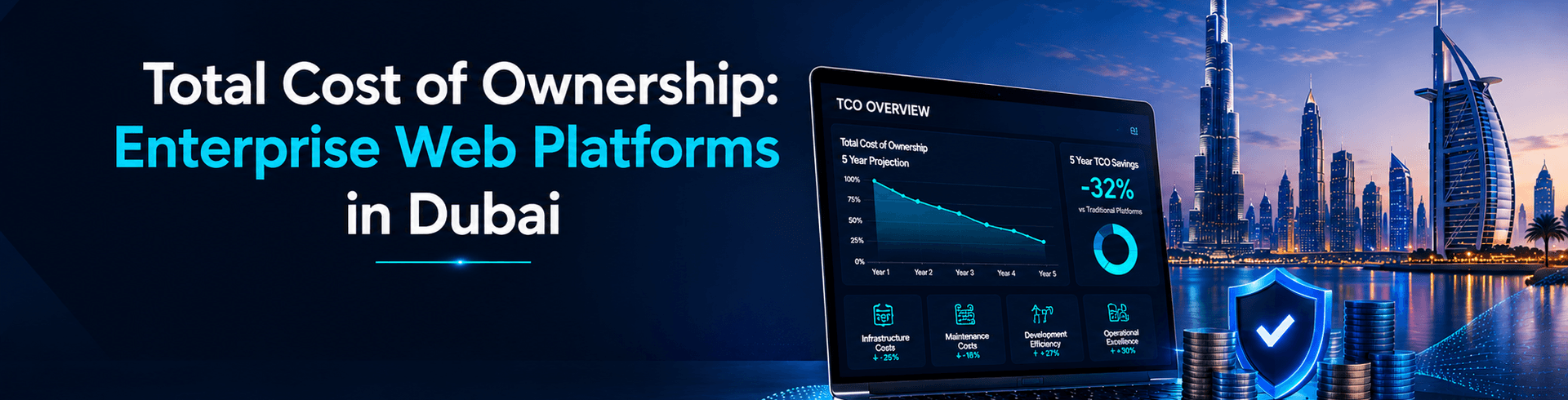
Over a standard three-year horizon, the realistic Total Cost of Ownership (TCO) for a custom enterprise digital platform in Dubai can range from AED 360,000 to over AED 2,200,000. To establish predictable forecasting, eliminate budget overruns, and increase return on investment (ROI), this comprehensive guide deconstructs enterprise web platform costs into three core pillars: Build (CapEx), Run (OpEx), and Maintain (OpEx).
Understanding the true cost of ownership begins with understanding the underlying architecture. Enterprise platforms are significantly more complex than traditional websites, requiring scalable infrastructure, deep integrations, compliance-ready frameworks, and long-term operational planning. Explore how modern approaches to enterprise website development are reshaping digital infrastructure strategies for organizations across the UAE.
The Iceberg of Enterprise Web Development
Enterprise-grade systems differ fundamentally from mid-market websites because of their architectural depth. To senior executives, the user interface (UI) represents only the visible tip of a deep, complex structure. Beneath the surface lie multi-layered technical systems, compliance requirements, and integration frameworks.
The Presentation Layer (The Tip)
- User Interface (UI) & User Experience (UX): These are the public-facing brand equity assets. In the UAE, this requires native bilingual design that fluidly adapts between Right-to-Left (RTL) Arabic typography and Left-to-Right (LTR) English layouts. It must adhere to Web Content Accessibility Guidelines (WCAG 2.2) and maintain sub-second loading speeds over local cellular networks.
- Frontend for Backend (BFF): A dedicated orchestration layer composed of APIs and micro-frontends. The BFF layer aggregates data from disparate backend systems, formatting it specifically for the client interface to minimize client-side processing and reduce battery consumption on mobile devices.
Business Logic & APIs (Just Below the Surface)
- Microservices Architecture: Monolithic software structures are decoupled into modular, domain-specific services (e.g., identity, checkout, inventory). They run independently, letting engineering teams update individual modules without causing a full platform breakdown.
- API Gateways: Centralized reverse proxies that manage incoming traffic. They handle routing, protocol translation, security and authentication, and rate limiting to protect internal services from distributed denial-of-service (DDoS) attacks.
- Integration Layer (ESB / iPaaS): The middleware framework (such as MuleSoft or custom-built enterprise service buses) that bridges the web frontend to legacy core systems, including Enterprise Resource Planning (ERP) databases (SAP, Oracle) and Customer Relationship Management (CRM) platforms (Salesforce).
Data Management & Orchestration (Deep Waters)
- Distributed Databases & Synchronization: Engineering complex data environments to maintain real-time ACID (Atomicity, Consistency, Isolation, Durability) compliance across regional or global cloud zones, preventing data conflicts during multi-location transactions.
- Data Lakes & Lakehouses use open table formats, such as Apache Iceberg, to bring together raw, unstructured transactional data. This lets real-time BI systems and machine learning models analyze operational data stores directly for their queries.
- Event-Driven Architecture: Implementing asynchronous message brokers like Apache Kafka or RabbitMQ. This ensures that when an action occurs (e.g., a customer completes a corporate transaction), downstream inventory, billing, and notification engines process the event asynchronously without freezing the user experience.
Governance, Security & Operations (The Mariana Trench)
- Compliance & Data Privacy: Compliance with UAE Federal Decree-Law No. 45 of 2021 on Personal Data Protection (PDPL) and regulatory frameworks from bodies like the Dubai Electronic Security Center (DESC). These require stringent data sovereignty controls and regular security auditing.
- Identity & Access Management (IAM): Integration with enterprise directories (Active Directory, Azure AD) via single sign-on (SSO) protocols, multi-factor authentication (MFA), and granular role-based access control (RBAC) powered by platforms like Auth0 or Okta.
- Observability & Monitoring: Automated tracing, telemetry, and log aggregation using enterprise software platforms (e.g., Datadog, Splunk) to maintain a targeted 99.99% system availability SLA.
- For DevSecOps & CI/CD Pipelines, automated setups do continuous integration and deployment. These embed auto security checks, code analysis, and regression testing right into the code release process.
The Build Phase (Upfront CapEx Allocation)
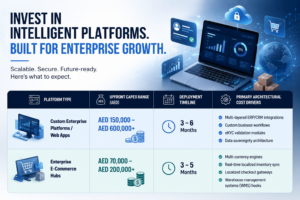
The capitalized expenditure in building an enterprise platform in Dubai is driven by architectural complexity, backend integrations, and compliance engineering, rather than visual design variations.
Key UAE Cost Drivers Explained
-
Backend Complexity and Government Integrations
Connecting the web platform with localized corporate legacy stacks and municipal or federal APIs, such as UAE Pass, for secure digital identity verification or eKYC compliance, requires advanced integration architecture. This engineering overhead increases the initial development hours but ensures long-term operational automation.
-
Multi-Language Localization and True RTL Parity
True bilingual development is not merely a translation overlay. It must be designed and developed with bidirectional stylesheets. Mirroring user interfaces for Arabic right-to-left (RTL) reading patterns while maintaining design consistency, font weights, and layout performance typically adds 15–25% to the initial UX design and front-end engineering budgets.
-
Sovereign Cloud Infrastructure Alignment
Under UAE data protection regulations, sensitive corporate data and transaction logs must be stored on cloud infrastructure physically located within the UAE. Provisioning cloud environments specifically inside local data centers (such as AWS Middle East – UAE Region or Microsoft Azure UAE Regions) requires a distinct architectural design from the first line of code. Failing to design for data residency from day one results in expensive infrastructure overhauls later.
The Run Phase (Annual Infrastructure OpEx)
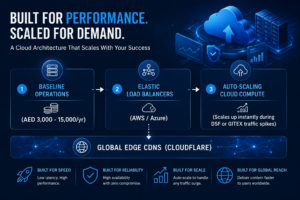
At the enterprise tier, cloud hosting is never a fixed monthly fee. Infrastructure costs scale based on compute capacity, data egress, storage, and availability requirements. In Dubai, infrastructure should be engineered to handle major regional demand spikes, such as the Dubai Shopping Festival (DSF) or GITEX Global, without performance degradation.
Core Infrastructure Cost Centers
- Enterprise Cloud Hosting (Compute & Storage): Baseline operations for a standard enterprise platform range from AED 3,000 to AED 15,000+ per year. However, this represents the idle baseline. To prevent downtime during major traffic spikes, platforms utilize cloud-native, auto-scaling configurations that dynamically adjust compute resources based on real-time CPU and memory utilization.
- Domain & Enterprise SSL/TLS Certificates: AED 200 to AED 1,500 per year. Enterprise-grade Extended Validation (EV) certificates and Wildcard SSL structures are mandatory for securing sensitive transactional channels and protecting customer records across all corporate subdomains.
Advanced Infrastructure Scaling Requirements
Load Balancing & Content Delivery Networks (CDNs)
To mitigate latency and defend against infrastructure saturation, enterprise platforms are using localized CDN networks and Advanced Traffic Managers such as Cloudflare Enterprise and AWS CloudFront. CDNs cache static and dynamic assets at edge servers in Dubai, serving local users within milliseconds. Enterprise CDN configurations and Web Application Firewalls (WAF) are approximately AED 4,000 to AED 18,000+ annually, depending on data transfer volumes and inspection profiles.
Relying on standard community forum support is an unmitigated operational risk for enterprise systems. Premium infrastructure support plans (such as AWS Enterprise Support or Microsoft Enterprise Support) guarantee access to dedicated cloud architects and fast technical intervention response times (often under 15 minutes for critical production issues). These support mechanisms typically cost 10% of monthly cloud utilization spend or a fixed minimum threshold ranging from AED 3,600 to AED 12,000 per year.
Multi-Region Server Redundancy & High Availability
To maintain a 99.99% uptime SLA, infrastructure requires active-passive or active-active multi-region server redundancy. In this setup, data is synchronously replicated between primary and secondary geographic availability zones (e.g., between Dubai and Abu Dhabi cloud nodes). If a localized data center experiences a connectivity failure or blackout, automated DNS failover systems route all corporate traffic to the secondary cloud node within seconds. This high-availability architecture multiplies baseline compute and database licensing costs, adding an incremental AED 8,000 to AED 25,000+ annually.
The Maintain Phase (Continuous OpEx & Risk Mitigation)
Once a web platform goes live, it enters a continuous state of operational maintenance. Software platforms, third-party code packages, security dependencies, and integrations require regular updates to patch vulnerabilities, preserve system performance, and safeguard brand value.
The Industry Rule of Thumb: Annual software and platform maintenance typically requires 15% to 20% of the original upfront software build cost.
In the Dubai enterprise market, this continuous maintenance is structured through a legally binding Annual Maintenance Contract (AMC), the local market baseline for an enterprise-tier AMC averages between AED 15,000 and AED 60,000+ per year. Before evaluating support proposals, procurement teams should understand the scope of a comprehensive WordPress maintenance SLA, including security patching, performance monitoring, incident response commitments, and infrastructure maintenance responsibilities.
An enterprise-tier AMC covers specific operational tasks:
- Security Patching & Dependency Updates: Proactive hotfixes for underlying framework vulnerabilities and third-party library updates to prevent cross-site scripting (XSS), SQL injection, or supply-chain security threats.
- API and Integration Preservation: Continuous refactoring of internal data hooks as external systems (such as corporate ERP upgrades or updated banking payment structures) modify their API endpoints.
- Database Optimization: Scheduled indexing, log clearing, query tuning, and database optimization routines to prevent speed degradation as data volumes grow over time.
- SLA-Backed Technical Support: Contractually guaranteed response times for technical support, ensuring that business-critical issues are diagnosed and resolved within a defined window.
Financial Modeling: The 3-Year Projection Matrix
To demonstrate how these distinct CapEx and OpEx categories blend over a mid-term corporate budgeting lifecycle, the financial matrix below models a mid-tier, custom enterprise platform build. This scenario assumes an initial capitalized build cost of AED 300,000, baseline hosting and infrastructure scaling fees of AED 6,000 per year, and a standard enterprise agency AMC of AED 45,000 per year.
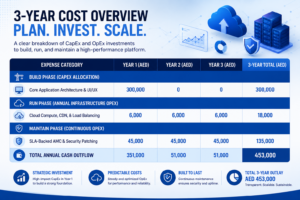
This financial model highlights that while the upfront build cost is the largest initial cash outflow, trailing operational run and maintenance costs account for over 33% of the platform’s total cost by the end of Year 3. This underscores the risk of evaluating web proposals solely on initial development quotes.
Hidden Cost Drivers in the UAE Ecosystem
Regional Payment Gateways and Financial Middleware
Integrating payment systems in the Middle East introduces unique transactional and integration friction compared to North American or European setups. Incorporating regional gateway providers such as PayTabs, Telr, or Noon Pay alongside Buy Now Pay Later (BNPL) platforms (like Tabby and Tamara) will require a distinct integration architecture.
Beyond initial engineering costs, procurement teams must factor in regional transactional fees. Merchant accounts typically incur transaction charges ranging from 2.5% to 3.5% plus AED 1.00 per transaction. For enterprise-scale business volumes, these transaction costs can significantly affect gross margins if they are not planned for in the platform’s operating budget.
The Staffing Paradox: Retained Specialized Agency vs. In-House Engineering
When reviewing long-term platform support, CIOs and CFOs often choose between hiring an in-house engineering team and partnering with a specialized enterprise digital agency. The financial metrics of this staffing choice heavily favor the agency model over a three-year timeline.
A qualified senior software engineer or DevOps specialist based in Dubai commands a monthly salary between AED 10,000 and AED 25,000+. When accounting for mandatory corporate overheads, including UAE residency visa processing, corporate medical insurance policies, annual flights, workplace infrastructure, and statutory end-of-service gratuity provisions, the true fully burdened cost of just two internal technical staff members easily scales to AED 480,000 to over AED 1,020,000 per year.
Over three years, building an in-house team dramatically increases fixed operating costs. In contrast, partnering with a retained enterprise agency gives corporate entities fractional access to a full team of software architects, security engineers, frontend developers, and QA testers for a predictable fraction of the cost.
Strategic Procurement Checklist for UAE Executives
To safeguard corporate capital and guarantee platform predictability, enterprise procurement teams should use this operational checklist before signing off on web development proposals:
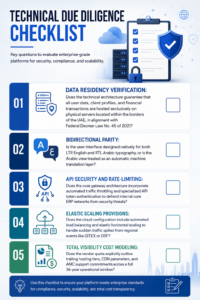
Effective enterprise web platform procurement is a balancing act between short-term development agility and long-term financial predictability. By mapping out the complete 3-year TCO ledger across the Build, Run, and Maintain phases, enterprise leadership can transform their digital presence from an unpredictable capital drain into a structured, scalable corporate asset.
Ready to develop a highly accurate, line-item financial model for your upcoming platform infrastructure? Connect with the corporate systems architects today to arrange a detailed structural review tailored to your transaction volumes, traffic projections, and core enterprise integration requirements.
FAQs
What is the average 3-year TCO for an enterprise web platform in Dubai?
The 3-year Total Cost of Ownership for a custom enterprise web platform typically ranges from AED 360,000 to over AED 2,200,000. This comprehensive total includes the upfront capitalized software build (CapEx), cloud infrastructure hosting expenses, localized CDN defenses, and annual SLA-backed maintenance contracts (OpEx).
How does the UAE Data Protection Law affect web hosting costs for enterprise platforms?
The UAE Federal Decree-Law No. 45 of 2021 on Personal Data Protection (PDPL) requires corporate platforms that collect sensitive user data to maintain data residency on sovereign cloud servers physically located within the UAE. Hosting in local cloud zones (such as AWS or Azure UAE regions) meets these data governance standards but incurs a premium compared to generic overseas shared hosting solutions.
Why do annual maintenance contracts (AMC) in Dubai cost 15% to 20% of the initial website build?
Enterprise platforms interact with changing digital environments, including browser updates, modified third-party API configurations, and evolving security threats. A standard enterprise AMC ensures continuous security patching, API refactoring, and database optimization. This proactive maintenance safeguards corporate brand equity and protects internal networks from system failure.
What are the main hidden infrastructure costs when scaling a web application in the UAE?
The primary hidden costs include advanced Content Delivery Network (CDN) licenses, Web Application Firewall (WAF) traffic inspections, premium cloud enterprise support plans, and multi-region database replication. These components are essential for maintaining system responsiveness and zero-downtime failover during major regional traffic spikes, such as the Dubai Shopping Festival.
Is it more cost-effective for a Dubai corporation to hire an in-house development team or retain an agency?
For most corporations, retaining an enterprise digital agency is far more cost-effective. The fully burdened cost of a small in-house engineering team in Dubai easily exceeds AED 480,000 per year, including salaries, visa fees, insurance, and end-of-service gratuities. An agency model delivers a broader range of specialized expertise under a predictable, fractionally priced annual contract.