

Enterprise Vendor Onboarding: What Procurement Teams Should Demand From Web Agencies in the UAE


To enter into an enterprise web development contract in the UAE is far more than just a creative partnership. It is a high-stakes vendor relationship carrying significant legal, data privacy, and operational implications. Yet, many enterprise procurement teams are onboarding web development agencies using standard, one-size-fits-all software vendor templates. This oversight can fail to account for strict local legal mandates, evolving data sovereignty regulations, and complex code ownership technicalities.
Businesses seeking scalable and secure digital ecosystems should partner with specialists in enterprise website development to ensure compliance, performance, and long-term operational flexibility.
To mitigate third-party risk and protect long-term digital investments, UAE procurement leads, Vendor Management Officers, and Chief Procurement Officers (CPOs) must enforce a specialized vetting framework. Standardizing these rigours requirements safeguards the organization’s digital ecosystem, eliminates under-qualified suppliers at the gate, and establishes a secure foundation for digital transformation.
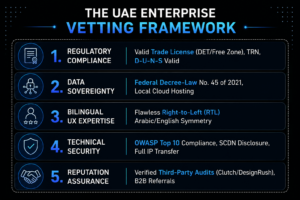
5 Pillars of Enterprise Vetting for UAE Web Agencies
Vetting a web agency in the UAE region will need a comprehensive evaluation of their local corporate validity, data handling procedure, technical execution capabilities, and localized linguistic expertise. Procurement teams should scrutinize these five operational pillars to ensure the chosen vendor can legally operate, scale, and effectively engage the regional market.
1. Regulatory & Trade Compliance
A legitimate enterprise partner should be authorized to operate within the specific Emirate where they conduct business. Procurement leads should institute a hard gate checking the following:
- Trade License Verification: Validate the agency’s commercial license directly through official registries like Dubai Department of Economy and Tourism (DET) or premium Free Zone authorities such as DMCC, DAFZ, TECOM, or ADGM, etc. this can eliminate shell entities and unregulated freelance networks masquerading as corporate agencies.
- National Media Council (NMC) / Ministry of Media Compliance: If the agency can provide content creation, copywriting, or digital media strategy, make sure they possess the necessary permission to adhere to local corporate media guidelines and cultural standards.
- Corporate Workforce Structure: Demand a clearer breakdown of the agency’s workforce. Procurement should verify if the production team has full-time, in-house developers under company sponsorship or if they rely on outsourced third-party freelancers. Relying on unvetted freelancers can introduce immediate risk to quality, control, communication timelines, and intellectual protection.
2. UAE & GCC Data Sovereignty
Data protection in the GCC is very highly regulated, and data mishandling carries severe civil and criminal penalties.
- Federal Decree-Law No. 45 of 2021 (PDPL): The agency must present documented workflows aligning with the UAE Data Protection Law. Their development blueprints must incorporate Privacy by Design principles, matching the stringent compliance baselines found in the EU’s GDPR.
- Local In-Country Hosting Ecosystems: For government, semi-government, and regulated financial entities, user data must reside within national borders. Ensure the agency’s technical architects are certified to deploy systems on localized cloud infrastructures, such as UAE-based Amazon Web Services (AWS) or Microsoft Azure data centers located in Dubai and Abu Dhabi.
3. Localized Bilingual & Cultural Expertise
An enterprise web application customized for the Middle East cannot rely on basic machine-translated text. A flawed user interface alienates key regional demographics and damages corporate reputation. Agencies working across the GCC must also demonstrate experience delivering localized digital solutions for large-scale regional initiatives. Element8’s collaboration with Green Riyadh reflects strong expertise in bilingual UX execution, regional audience engagement, and enterprise-level project scalability.
- True Right-to-Left (RTL) Arabic Design Symmetry: Review the agency’s portfolio for native Arabic UI/UX execution. True RTL competence requires complete layout mirroring, tailored typography that balances English and Arabic font weights, and adapted navigation flows that feel natural to regional users.
- Localization Nuances: The vendor must demonstrate a clear understanding of regional consumer behavior, transaction habits, and search intent. Search dynamics and digital interaction models differ heavily between the UAE, the broader GCC, and Western markets.
4. Technical Track Record & Enterprise Security
Procurement teams must audit a vendor’s technical infrastructure to prevent hidden engineering debt and post-launch operational failures. Procurement teams should prioritize vendors capable of delivering technically scalable and performance-driven digital systems. Enterprise projects such as IMAR showcase Element8’s ability to build secure, structured, and conversion-focused enterprise platforms tailored for long-term operational efficiency.
- Live Portfolio Verification: Reject static UI screenshots or design mockups. Demand live, high-traffic URLs from their current enterprise portfolio. Run independent performance audits on these platforms to analyze mobile responsiveness, Core Web Vitals, and structural SEO health.
- Enterprise Platform Hardening: Assess their engineering experience across enterprise Content Management Systems (CMS), decoupled/headless architectures, and customized frameworks. The agency must provide a clear blueprint for Secure Sockets Layer (SSL/TLS) protocols, Distributed Denial of Service (DDoS) mitigation, and automated, encrypted off-site backup routines.
- Total Cost of Ownership (TCO) Transparency: The Service Level Agreement (SLA) must clearly define domain ownership, hosting maintenance packages, third-party API licensing costs, and hourly rates for custom feature adjustments to avoid unexpected post-launch fees.
5. Client Reputation & Dispute History
A thorough background check ensures the agency delivers complex enterprise projects on time and within the allocated budget. Enterprise procurement teams should also review the agency’s ability to deliver projects for globally recognized institutions. Element8’s work with Carnegie Mellon University in Qatar (CMU-Q) demonstrates experience in handling structured enterprise-grade digital ecosystems within highly professional academic environments.
- Verified B2B Market Reviews: Cross-reference the vendor’s case studies by auditing verified evaluations on independent global B2B platforms like Clutch and DesignRush. Look for patterns regarding project management, technical accountability, and budget management.
- Direct Local Reference Consultations: Request formal client references from active enterprise, government, or semi-government businesses within the MENA region. Connect directly with their procurement or IT leads to evaluate the agency’s communication transparency, milestone reliability, and post-launch technical support.
Technical Vetting: Overcoming Legal Risk and Technical Debt
To move past general capabilities, procurement teams must enforce specific technical and financial protection within the Request for Proposal (RFP) and contract phases.
1. Corporate Legal Integrity & Financial Standing
- Tax Registration Documentation: Mandate the collection of the agency’s official UAE Federal Tax Authority (FTA) Tax Registration Number (TRN). This ensures all Corporate Tax and Value Added Tax (VAT) invoicing complies with federal fiscal laws.
- Financial Health Screening: Screen vendors via the Dun & Bradstreet UAE network or mandate a valid D-U-N-S number. This step guarantees that the digital agency maintains the cash flow, working capital, and organizational stability necessary to sustain a multi-month enterprise build without risk of insolvency.
2. Information Security and Security Audits
- OWASP Top 10 Adherence: The Statement of Work (SOW) must legally obligate the agency to develop all web applications in strict compliance with the Open Web Application Security Project (OWASP) Top 10 vulnerabilities framework.
- Independent Penetration Testing: Demand documented proof of recent, independent third-party penetration testing executed on their core deployment configurations to ensure defenses hold against SQL injections, cross-site scripting (XSS), and broken authentication vectors.
3. Mitigating Technical Debt and Securing Source Code Ownership
A major hidden risk in enterprise web development is “vendor lock-in.” This occurs when an agency builds an environment using proprietary logic, undocumented custom code, or restrictive configurations, leaving the enterprise unable to switch partners or manage the platform internally. Selecting enterprise-ready CMS platforms is equally important when reducing long-term technical debt and vendor dependency. This Sitecore enterprise implementation guide outlines how scalable enterprise architectures support governance, customization, and operational flexibility.
To preserve technical agility, enforce the following legal safeguards:
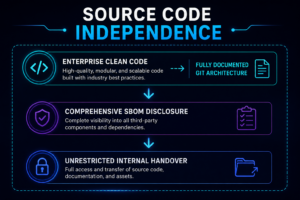
- Absolute Intellectual Property (IP) Transfer: The SOW must explicitly state that all custom source code, bespoke design components, database configurations, and assets become the sole intellectual property of the hiring enterprise immediately upon milestone payment clearance.
- Software Bill of Materials (SBOM) Disclosure: Enforce a mandatory, fully documented disclosure of all open-source libraries, modules, and dependencies utilized during development. The agency must guarantee that no highly restrictive or unmaintained copyleft licenses (such as specific GPL variants) slip into the enterprise ecosystem, creating legal non-compliance or security vulnerabilities.
4. SLA Structure, Support Windows, and Financial Alignment
Enterprise procurement must reject front-loaded payment frameworks that reduce vendor accountability.
- Milestone-Based Retainers: Structure the financial schedule around strict, phased delivery milestones with clear acceptance criteria. Payments should link directly to functional approvals:
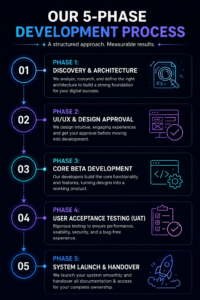
- Corporate Payment Alignment: Map these milestones cleanly to standard corporate Net 30 or Net 60 payment terms, ensuring payment follows validation from internal IT and business stakeholders.
- Rigid Service Level Agreements (SLAs): Hardwire technical support metrics into the main contract. The SLA must specify system uptime guarantees, defined support tiers, and explicit bug-resolution windows, requiring critical security patches to deploy within 24 hours of notification.
Modernizing the Vendor Onboarding Workflow
To manually track multi-point compliance checklists, legal registrations, and financial credentials across dozens of digital vendors can create administrative bottlenecks. Modern procurement teams avoid these delays by upgrading to automated platforms.
By utilizing automated Vendor Management Software and corporate spend systems, which are similar to the agile financial tracking model introduced by regional fintech pioneers, enterprises can manage vendor onboarding. Automating documents validation, trade license tracking, and compliance checks can reduce onboarding times from weeks to days.
This automation will allow procurement teams to focus on technical evaluation and risk management rather than administrative paperwork, which can ensure every web agency entering the corporate ecosystem meets the enterprise’s exact security, financial, and legal standards.
Conclusion & Actionable Next Steps
Enforcing a rigorous vetting framework protects your organization’s digital ecosystem and separates enterprise-ready agencies from unverified provider networks. By prioritizing trade validity, data sovereignty compliance, absolute IP ownership, and structured SLAs, procurement teams safeguard long-term digital investments and eliminate third-party risk.
Are you looking for an enterprise web development partner in the UAE that is already fully vetted, compliant, and enterprise-ready?
Contact the enterprise digital team at Element8 today to review our compliance credentials, local corporate case studies, and enterprise governance frameworks.
FAQs
What are the penalties for a web agency violating the UAE Data Protection Law (Federal Decree-Law No. 45 of 2021)?
Violations of the UAE Personal Data Protection Law (PDPL) carry severe financial penalties determined by the UAE Data Office. Depending on the severity of the breach, the data exposure, or non-compliance regarding cross-border data transfers, administrative fines can scale significantly. For enterprise organizations, onboarding a non-compliant agency introduces substantial vicarious liability and reputational damage.
Why is a UAE Trade License from the DET preferred over unauthorized offshore development frameworks?
A trade license issued by the Dubai Department of Economy and Tourism (DET) or a designated premium Free Zone ensures the web agency is a legally recognized entity operating under UAE jurisdiction. This provides the enterprise with direct legal recourse within UAE courts in the event of contractual breaches, intellectual property disputes, or non-delivery. Offshore networks or unauthorized freelance setups operate outside these legal frameworks, exposing the organization to unrecoverable losses.
How does in-country cloud hosting impact web development configuration for UAE government or semi-government entities?
UAE data sovereignty regulations mandate that sensitive user data, financial records, and government-linked profiles remain within national borders. When onboarding a web agency, procurement must ensure the team is certified to configure and maintain local cloud environments, such as the AWS or Microsoft Azure data centers in Dubai and Abu Dhabi. Agencies without local deployment experience risk building architectures that fail mandatory security compliance audits.
What is an SBOM, and why should UAE procurement leads demand one from digital agencies?
An SBOM, or Software Bill of Materials, is a comprehensive inventory listing all open-source code libraries, modules, components, and third-party plug-ins embedded within a web application. Procurement leads must demand this document to verify that the agency has not used unmaintained, vulnerable, or legally restrictive open-source code that could expose the enterprise to cyber threats or patent infringement risks.
Can a web agency issue legally valid VAT invoices without a verified TRN in the UAE?
No. Any business operating in the UAE with taxable supplies and imports exceeding the mandatory registration threshold must register for VAT and obtain a Tax Registration Number (TRN) from the Federal Tax Authority (FTA). Procurement teams must reject invoices from vendors charging VAT without a verified, active TRN, as processing these payments breaches local tax regulations and compromises corporate financial audits.