

How to Run a Web Agency RFP in the UAE: Enterprise Procurement Guide


For enterprise procurement directors, chief technical officers (CTOs), and IT buyers across the UAE’s semi-government and large private conglomerates, executing a digital transformation project is a high-stakes endeavor. In a market characterized by hyper-accelerated national digital strategies, such as Dubai’s Digital Strategy and Abu Dhabi’s digital transformation mandates, a failed enterprise web project carries immense exposure. Selecting an unvetted vendor can lead to severe regulatory non-compliance, costly security vulnerabilities, and missed commercial launch targets.
To shift, though, a bloated agency portfolio rarely reveals actual enterprise delivery capabilities. To de-risk your procurement lifecycle, you must deploy a structured, localized Request for Proposal (RFP) framework that addresses the unique technical and regulatory realities of the UAE market.
Organizations planning enterprise website development should establish clear procurement, compliance, and governance processes before selecting a technology partner.
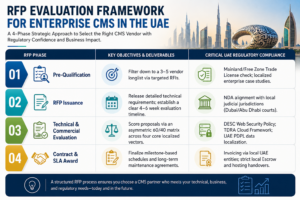
The table below explains an executive-level summary of the end-to-end web agency RFP blueprint optimized for UAE compliance and procurement structure.
Defining the Scope: The UAE Digital Landscape
Executing a successful enterprise web development initiative in the UAE will require looking past the standard software development lifecycle (SDLC). Your technical scope should be strictly anchored to the regional legislative framework governing digital assets, data privacy, and cloud infrastructure.
For organizations replacing outdated digital platforms, procurement planning should also consider migration complexity, business continuity, and infrastructure modernization. Our guide to Zero-Downtime Enterprise Web Replatforming explains how enterprises can modernize legacy platforms while minimizing operational risk.
Data Sovereignty and Local Hosting
Data residency is no longer a thought; it has become a strict prerequisite for corporate governance. Under the UAE Federal Personal Data Protection Law (PDPL), organizations must comply with strict controls on the collection, processing, and cross-border transfer of personal data.
For enterprise procurement, this dictates exactly where your website’s hosting infrastructure, databases, and content management systems (CMS) can physically reside:
- Government & Semi-Government Entities: Public sector platforms, sovereign wealth funds, and critical infrastructure organizations are legally mandated to retain all data within national boundaries. This requires hosting on localized, government-certified cloud platforms such as Moro Hub, Khazna, or the dedicated, local AWS Middle East (UAE) Region (uaenorth in Dubai) or Microsoft Azure UAE regions.
- Private Enterprise & Regulated Sectors: While private entities enjoy greater flexibility, sectors regulated by the UAE Central Bank, the Dubai International Financial Center (DIFC), or the Abu Dhabi Global Market (ADGM) must use local hosting models to protect consumers’ financial identifiers.
Your RFP must explicitly require the bidding web agency to provide fully mapped architectural diagrams demonstrating that primary tenant data, metadata, encrypted backups, and system logs remain entirely within the UAE.
Compliance and Security Standards
Public-facing digital portals operating within the UAE must satisfy precise cybersecurity standards to mitigate the risk of perimeter breaches and data leaks:
- Dubai Electronic Security Center (DESC) Guidelines: Any web application developed for Dubai government, semi-government, or critical infrastructure entities must align with the DESC Web Security Policy. This framework mandates specific application security parameters across website code, API integration points, mobile-responsive hooks, and database access layers.
- Abu Dhabi Systems & Information Center (ADSIC / ADCCE): Abu Dhabi-based entities must comply with the Abu Dhabi Information Security Standards, which require rigorous verification of encryption at rest, secure transport protocols (TLS 1.3), and automated threat logging.
- TDRA Cloud Computing Regulatory Framework (CCRF): The Telecommunications and Digital Government Regulatory Authority (TDRA) establishes the baseline for data classification. Bidding web agencies must prove their deployment methodologies, categorize, and protect web-app information strictly according to these national standards
Step-by-Step Framework for the RFP Process
An enterprise-grade procurement lifecycle avoids open-ended, unstructured bidding. It uses a phased filtering framework designed to protect internal resources while systematically eliminating unqualified vendors.
Phase 1: Pre-Qualification (RFI Stage)
Before issuing a comprehensive, hundreds-of-pages RFP document, execute a streamlined Request for Information (RFI) to filter the open market down to a qualified longlist of 3 to 5 agencies. Your RFI must filter for these non-negotiable prerequisites:
- Trade License Verification: Ensure the agency holds a valid mainland Department of Economy and Tourism (DET) license or an equivalent Free Zone license (e.g., DTEC, ADGM, DIFC) that explicitly permits commercial activities in IT, software design, or digital development.
- Proven Local Enterprise Track Record: Eliminate agencies that cannot produce at least three live, verified enterprise-scale case studies deployed within the GCC region, preferably with the UAE government or top-tier enterprise entities.
- In-House Engineering Capacity: Ensure the vendor relies on permanent, on-shore, or structured hybrid teams rather than unvetted third-party subcontracting networks.
Phase 2: Issuing the RFP & Timeline Expectations
Enterprise corporate structures in the region feature multi-layered stakeholder approval matrices (spanning IT, procurement, legal, and C-suite executives). Once the preferred vendor has been selected, organizations should establish a structured onboarding process covering governance, technical discovery, stakeholder alignment, and compliance planning. Read our guide on Enterprise Web Agency Vendor Onboarding for best practices. Your RFP timeline must reflect this operational reality. Provide a minimum of 4 to 6 weeks from issuance to final submission, structured with explicit, non-negotiable milestones:
- RFP Issuance & Non-Disclosure Agreement (NDA) Execution
Week 1: Distribute the RFP package to pre-qualified longlist vendors via your internal procurement portal. Require signed NDAs governed by local UAE judicial jurisdictions (e.g., Dubai Courts or ADGM Courts) before releasing technical API specifications.
- Structured Clarification & Vendor Q&A Window
Week 2: Allow agencies a dedicated 5-day window to submit technical queries regarding existing databases, legacy systems, and integration environments.
- Consolidated Addendum Distribution
Week 3: Anonymize all received questions and issue a unified, transparent clarification addendum to all bidding agencies simultaneously, maintaining structural equity.
- Dual-Envelope Proposal Submission
Week 5: Mandate a strict dual-envelope submission protocol where Technical Proposals and Commercial Bids are delivered as separate, decoupled files.
Phase 3: The Evaluation Matrix
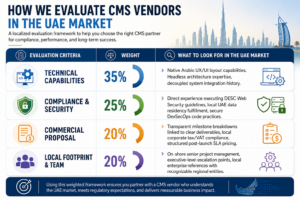
To maintain absolute objectivity, decoupled proposals must be graded independently using an asymmetric scoring system weighted in favor of technical architecture and compliance capabilities.
Procurement Insight: In the UAE enterprise sector, neglecting native Arabic design in the initial UI/UX phase is the leading cause of project delays. Ensure your RFP mandates a “Mobile-First, Arabic-First” design philosophy rather than treating translation as a post-development afterthought.
Evaluating UAE-Based Agencies vs. Offshore Models
A frequent dilemma faced by procurement teams is the cost delta between local, UAE-domiciled agencies and lower-cost offshore development shops. While offshore rates can appear financially attractive, an enterprise-level analysis reveals substantial operational and compliance friction that can quickly turn a cost savings into a liability risk. Selecting a local partner with proven enterprise delivery capabilities ensures smoother onboarding, stronger compliance, and faster project execution. Organizations investing in enterprise website development benefit from agencies that understand UAE regulations, Arabic-first UX, and enterprise security standards.
The RTL Arabic Design Pitfall
Arabic typography and user interface behaviors differ fundamentally from Latin text configurations. Offshore agencies routinely approach localization by simply applying a machine-translation layer or using basic CSS mirroring techniques (e.g., dir=”rtl”).
This approach systematically breaks visual hierarchies, causes structural overlaps across interactive buttons, distorts forms, and alienates local users. A local agency deeply embedded in the cultural and linguistic nuance of the GCC region approaches UI from a native, Arabic-first perspective. This ensures that layout ergonomics, asset positioning, and microcopy alignment are optimized for regional user behaviors from day one.
Agile On-Site Alignment
Large-scale digital transformations within semi-government or enterprise conglomerates require tight integration across multiple internal departments (legal, IT, marketing, and business intelligence). Having access to an onshore project management team and technical architects who can arrive at your offices in Downtown Dubai, Dubai Internet City, or Abu Dhabi Global Market within hours streamlines the feedback loop. This direct alignment eliminates communication delays across conflicting time zones, accelerates complex integration workshops, and ensures accountability throughout the project lifecycle.
Summary Checklists and FAQs
Use these targeted answers and quick reference points to optimize your search for information and validation.
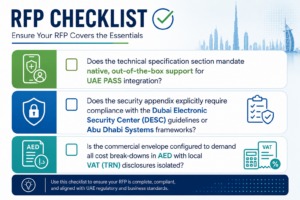
Enterprise Pre-Flight Checklist
Before finalizing your procurement packet, verify that your document satisfies these three core checkpoints:
Choose the Right Enterprise Web Partner with Element8
Selecting the right web development partner is about more than evaluating technical capabilities or comparing pricing; it requires choosing an agency that understands the UAE’s unique regulatory landscape, enterprise expectations, and digital transformation goals. A well-structured RFP helps organizations identify vendors capable of delivering secure, scalable, and future-ready digital platforms while ensuring compliance with local standards such as UAE PDPL, DESC, TDRA, and UAE PASS integration requirements.
At Element8, we combine deep expertise in enterprise web development with extensive experience serving organizations across the UAE. Our team specializes in designing and developing high-performance, Arabic-first, enterprise-grade websites built on modern headless architectures, secure DevSecOps practices, and scalable cloud infrastructure. From discovery and UX strategy to development, compliance, deployment, and long-term support, we deliver solutions tailored to the unique needs of government entities, large enterprises, and regulated industries.
Whether your organization is planning a complete digital transformation, modernizing an existing platform, or preparing an enterprise RFP, Element8 offers the expertise needed to deliver secure, compliant, and scalable digital platforms. Explore our Enterprise Website Development Services to discover how we help organizations across the UAE build future-ready enterprise websites.
FAQs
What are the UAE data residency requirements for web agencies?
Under the UAE Federal Personal Data Protection Law (PDPL) and sector-specific regulations (such as Central Bank cloud mandates), web agencies must ensure that platforms that handle personal or financial data host their primary production data, backups, and user logs within the UAE. Government and semi-government entities are strictly required to use verified local cloud infrastructure such as Moro Hub, Khazna, or local UAE regions of AWS and Azure.
How does DESC compliance affect enterprise web development in Dubai?
The Dubai Electronic Security Center (DESC) Web Security Policy sets forth mandatory cybersecurity controls for all government and semi-government web applications. Web agencies must build systems that comply with DESC rules regarding input validation, secure API integrations, multi-factor authentication (MFA), and data encryption. Before any platform goes live, it must pass rigorous penetration testing and vulnerability assessments conducted by an independent, DESC-accredited security auditor.
Why is a local trade license mandatory for web development vendors in the UAE?
A valid trade license issued by the Dubai Department of Economy and Tourism (DET), the Abu Dhabi Department of Economic Development (ADDED), or a recognized local Free Zone (e.g., DTEC, DIFC, ADGM) confirms that the vendor is a legally recognized entity with a corporate structure. It guarantees compliance with local corporate tax frameworks, validates their ability to issue legal tax invoices with a valid Tax Registration Number (TRN), and ensures that any contractual or IP disputes can be effectively settled within UAE courts.
How should a UAE web RFP handle Arabic right-to-left (RTL) requirements?
An enterprise web RFP must mandate a native “Arabic-First, Mobile-First” design process. Agencies must demonstrate true RTL layout expertise rather than relying on automated translation plug-ins or basic structural mirroring. This includes optimizing localized typographic tracking, adjusting the structural alignment of media elements, and validating form layouts to ensure an intuitive digital experience for regional users.
Can we legally award a semi-government web development contract to an offshore agency?
While technical components can sometimes be supported via hybrid delivery models, semi-government entities generally require the primary contracting entity to hold a valid, onshore UAE trade license. Furthermore, because data sovereignty and DESC/NESA compliance necessitate local infrastructure management, onshore project managers and technical architects are usually required to ensure direct accountability, local security clearance, and successful integration with national systems such as UAE PASS.