

Government and Semi-Government Web Procurement in the UAE: Vendor Qualification, Tendering, and Delivery
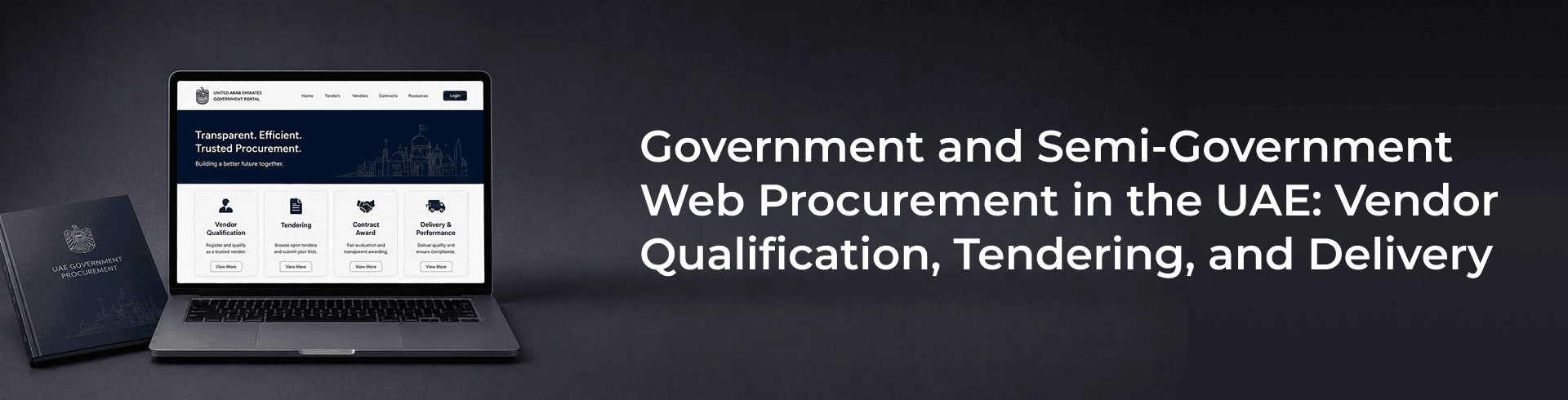


Government and semi-government website projects in the UAE often fail before tender evaluation even begins. In many cases, the problem is not vendor interest but unclear scope, incomplete qualification criteria, weak compliance framing, or procurement pathways that vary by authority.
For CIOs, procurement teams, and digital stakeholders, the challenge is not only finding a capable web partner. It is making sure the project is structured in a way that allows qualified vendors to bid properly, technical risk to be evaluated early, and delivery expectations to stay clear after contract award.
Before entering the procurement process, many organizations prepare a detailed Request for Proposal (RFP) to define scope, technical requirements, evaluation criteria, and delivery expectations.
If your team is still shaping the procurement brief, our guide on Enterprise Web Agency RFPs in the UAE provides a practical framework for defining requirements before tender release. For government CIOs and tender offices, this early planning matters because even a strong digital proposal may never reach evaluation if registration, qualification, or commercial eligibility issues are missed.
Navigating the procurement lifecycle for government website development in the UAE requires strict adherence to specific operational benchmarks across three distinct phases: vendor qualification, tendering, and delivery.
More importantly, it shows what buyers should clarify before launching a tender, what qualification signals matter most, and where project risk tends to appear between procurement and delivery.
The UAE Has No Single Procurement System
There is no single UAE-wide procurement route for all government and semi-government website projects.
For buyers, this matters because supplier registration, portal access, tender workflow, and qualification requirements often depend on whether the project sits at federal, emirate, municipal, or semi-government level. A procurement approach that works for one authority may not map cleanly to another.
The first point buyers and vendors should understand is that UAE public procurement operates across federal and emirate-level systems, each with its own rules, registration pathways, and supplier portals.
At the federal level, procurement for ministries and federal entities is centralized through the Ministry of Finance’s Digital Procurement Platform, which operates under Federal Decree-Law No. 11 of 2023 on Federal Government Procurement, which sets the general legal framework. Vendors across federal entities are provided the registration to stay current, since suppliers must renew their registration in the Federal Supplier Register every year to remain eligible.
At the emirate level, each government runs its own system:
- Abu Dhabi uses the Abu Dhabi Government Procurement Gate (ADGPG), built on SAP Ariba/ADERP. Suppliers with a valid Abu Dhabi DED license can start registration via a Self-Registration Request, while those without one must use an entity-specific request route.
- Dubai manages procurement through the Dubai Smart Supplier Portal and entity-specific tender boards, such as the Dubai Municipality Tenders & Biddings Portal, for infrastructure work.
- Sharjah, Ajman, and Ras Al Khaimah each maintain separate eProcurement or vendor registration systems through their respective Departments of Finance, with RAK’s registration free of charge but subject to specific submission criteria.
- Semi-government entities, utilities, free zone authorities, health and education bodies frequently run independent vendor portals layered on top of (or alongside) the emirate-level system, each with its own document checklist.
In practice, this means procurement planning should start with authority mapping. Before drafting the technical scope, buyers should confirm which registration system applies, whether the target entity uses an independent vendor portal, and what eligibility conditions may affect which agencies can participate.
Vendor Qualification: The Gatekeeping Criteria
Vendor qualification is the stage where procurement teams decide which agencies are commercially credible, technically suitable, and operationally ready to deliver inside public-sector constraints.
For government and semi-government website projects, weak pre-qualification often creates problems later in the tender. Buyers may receive proposals from agencies that look capable on paper but lack regulated delivery experience, bilingual implementation maturity, or the operational structure needed for a complex public-sector rollout.
Before a digital agency can participate meaningfully in many federal, emirate-level, or entity-led tenders, it may need to pass through supplier registration and pre-qualification filters first.
At a minimum, buyers should use qualification criteria to assess four things: commercial stability, relevant delivery experience, local compliance readiness, and the ability to support post-award governance.
Financial and Corporate Due Diligence
Financial and corporate due diligence helps buyers filter for continuity, accountability, and execution resilience, not just agency size or brand presentation.
For public-sector website procurement, this review is important because the selected vendor may be responsible not only for design and development, but also for regulated hosting coordination, security validation support, stakeholder approvals, and long-term maintenance commitments.
Tender offices evaluate an agency’s long-term operational stability. Vendors must present:
- Audited financial statements for the past 2 to 3 fiscal years to prove liquidity and operational stability.
- Valid commercial licenses registered within the respective emirate’s economic department (e.g., Dubai DET) or federal free zones, explicitly covering “Web Design and Development” or “IT Consultancy” activities.
- Documented corporate capability showing an established, in-house technical team, eliminating the risk of unapproved secondary subcontracting.
Technical Credentials & Local Footprint
A proven track record within the GCC region is mandatory. Pre-qualification requires:
- A comprehensive portfolio showing successful delivery of highly scalable, multi-tenant architectures or public sector deployments.
- Local hosting capabilities and data residency strategies that align directly with UAE data protection laws.
- Active vendor registrations on designated government procurement portals, such as the Federal Procurement Portal, Dubai’s eSupply (Tejari), or Abu Dhabi’s Darahem/Tamm platform.
The Tendering Phase: Compliance as a Prerequisite
When evaluating the responses to a government website development tender, the Tender Office balances two separate assessment tracks: the Technical Bid and the Financial Bid. In the public sector, technical compliance is always the primary gatekeeper. A low financial bid cannot salvage a technically deficient proposal.
Essential Technical Specifications for the UAE Public Sector
- Strict Data Sovereignty & UAE Cloud Compliance: All data, including citizen records, transactional logs, and system cache, must reside within the UAE. Vendors must demonstrate full compatibility with government-approved cloud infrastructures (such as Moro Hub or local instances of Microsoft Azure/AWS in the UAE) that adhere to TDRA data classification policies.
- Native Bilingual UX and RTL Architecture: Multi-language functionality requires native right-to-left (RTL) layout engineering for Arabic, rather than automated plugin translations. Content Management Systems (CMS) must maintain identical typography weights, asset scaling, and component alignment across both English and Arabic interfaces.
- Mandatory G2G Framework Integrations: Digital platforms must connect cleanly with the UAE’s centralized identity and transaction ecosystems. Modern government platforms are also increasingly expected to support AI-powered citizen services, intelligent search, document automation, and multilingual digital assistants. Learn how organizations across the MENA region are preparing their platforms through Enterprise AI Integration for Websites. This includes native integration with UAE PASS (the national digital identity solution) and secure payment processing through eDirham, DubaiPay, or Abu Dhabi Pay.
- Cybersecurity Standards (SIA/NESA): Web architectures must align with the Signals Intelligence Agency (SIA), formerly NESA, its regulations, and local information security standards (such as the Dubai ISR). Bidders must provide clear validation workflows, data encryption mechanisms (AES-256 at rest and TLS 1.3 in transit), and a commitment to undergo independent Vulnerability Assessment and Penetration Testing (VAPT).
Delivery and Governance Frameworks
For UAE government and semi-government website projects, delivery risk does not disappear once the contract is awarded. In many cases, the biggest delays and quality issues appear after award, when approvals, compliance validation, integration ownership, and release responsibility are not clearly structured.
This is why delivery governance should be treated as part of procurement planning, not as a post-award administrative detail. Buyers need to know how decisions will be approved, how security and accessibility checks will be handled, who owns integration dependencies, and what conditions must be met before go-live.
Once the contract is awarded, the delivery phase should follow a governance model that aligns with the authority’s approval structure, compliance controls, and operational risk profile. In public-sector website projects, a purely informal delivery approach is often not enough, because audit requirements, stakeholder review layers, security validation, and launch controls all need clear ownership.
From a buyer’s perspective, this stage is about protecting delivery quality. Even a technically strong vendor can struggle if the project lacks clear sign-off paths, unrealistic approval timing, undefined testing responsibilities, or weak change-control rules. Governance is what turns technical capability into controlled execution.
Phased Implementation Strategy
- Discovery & Information Architecture (IA) Approval: Weeks 1–4
Detailed mapping of citizen user journeys and service delivery pathways. Final technical blueprints and wireframes will need formal sign-off from both the Department CIO and the Communication team.
- Secured Sandbox Development & Integration: Weeks 5–16.
Core system engineering occurs inside an isolated, secure staging environment. This phase will include building custom API connections for federal databases, UAE PASS authentication nodes, and central transactional flows.
- Accessibility & Compliance Verification: Weeks 17–20.
Rigorous front-end testing to verify absolute compliance with WCAG 2.1 AA standards. This step can ensure easy keyboard navigation, screen-reader optimization, and high-contrast operations for People of Determination.
- VAPT Auditing & Official Clearance: Weeks 21–24.
An independent, third-party cybersecurity firm executes a full Vulnerability Assessment and penetration Testing (VAPT) audit. The vendor should fix any identified vulnerabilities to receive official security clearance before moving to production.
- Staged Deployment & Go-Live Transition: Week 25+.
Data migration and system launch follow a phased roll-out plan on UAE-hosted cloud infrastructure, coordinated alongside comprehensive internal training for the government entity’s digital teams.
The Strategic Vendor Matrix
For procurement teams and digital stakeholders, vendor comparison should go beyond price, portfolio aesthetics, or proposal polish. A stronger evaluation matrix helps buyers assess whether an agency is commercially stable, technically qualified, operationally ready, and capable of delivering within public-sector governance constraints.
Supplier Registration
- verify: eligibility on the relevant procurement or supplier platform
- why it matters: a strong proposal has no value if the vendor cannot participate properly
Public-Sector or Regulated-Sector Experience
- verify: relevant delivery examples, not just generic corporate websites
- why it matters: regulated delivery environments require more than creative capability
Technical Delivery Capability
- verify: architecture approach, CMS suitability, staging model, QA process
- why it matters: buyers need confidence that the vendor can deliver maintainably, not just launch visually
Arabic-English UX Readiness
- verify: native RTL handling, bilingual governance, content workflow readiness
- why it matters: bilingual delivery errors can affect usability, trust, and rollout quality
Hosting and Data Residency Readiness
- verify: infrastructure assumptions, local hosting readiness, residency planning
- why it matters: these issues should be resolved before award, not discovered during deployment
Integration Capability
- verify: experience with identity, payment, API, and legacy-system integrations
- why it matters: integration complexity often creates hidden delivery risk
Cybersecurity and Validation Process
- verify: secure development practice, documentation standards, VAPT readiness
- why it matters: security clearance can affect launch timing and acceptance
Accessibility Delivery Readiness
- verify: WCAG implementation process, testing approach, remediation ownership
- why it matters: accessibility is not a cosmetic layer; it affects compliance and public usability
Governance and Approval Discipline
- verify: sign-off workflow, change control, issue management, stakeholder coordination
- why it matters: weak governance often causes delays after award
Post-Launch Support Model
- verify: maintenance scope, response model, training, handover clarity
- why it matters: the delivery partner should support operational continuity, not just go-live
A strong government website vendor should be evaluated across eligibility, compliance readiness, technical capability, bilingual delivery, security process, and post-launch governance, not cost alone.
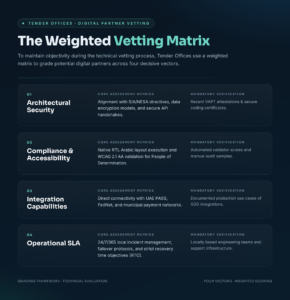
Used correctly, a vendor matrix helps procurement teams avoid a common mistake: selecting the most attractive proposal before checking whether the agency can operate within the authority’s technical, security, and governance realities. It also makes internal approval easier by showing that vendor selection is being assessed through structured criteria rather than price pressure alone.
The weighting of these criteria may vary by authority, project type, and procurement model, but buyers should define them before tender evaluation begins.
By enforcing these technical and structural standards early in the pre-qualification and tendering stages, UAE government and semi-government entities ensure their digital platforms remain secure, accessible, and aligned with the nation’s digital strategy.
Organizations planning upcoming government or semi-government digital transformation projects should begin with a well-structured procurement strategy. Our Enterprise Web Agency RFP Guide explains how to define technical requirements, vendor evaluation criteria, governance models, and project scope before initiating the tender process.
FAQs
What are the mandatory web design guidelines for UAE government websites?
UAE government websites must follow the official guidelines set by the Telecommunications and Digital Government Regulatory Authority (TDRA). The core requirements include providing a fully bilingual experience (English and native Right-to-Left Arabic layouts), ensuring accessibility for People of Determination by meeting WCAG 2.1 AA standards, and integrating native digital government services like UAE PASS for identity verification and DubaiPay or Abu Dhabi Pay for financial transactions. Furthermore, the website’s hosting infrastructure must comply with national data sovereignty laws by keeping all data within the UAE.
How does the UAE procurement process evaluate tenders for government website development?
The UAE public sector evaluates digital procurement tenders through a dual-envelope system that separates the Technical Bid from the Financial Bid. The Technical Bid is assessed first and carries the most weight, typically accounting for 70%-80% of the total score. Bidders must meet a strict minimum technical threshold by demonstrating full compliance with SIA/NESA cybersecurity guidelines, TDRA web standards, and data residency laws. The Financial Bid envelope is only opened and evaluated if the vendor’s technical proposal passes this initial compliance gate.
What data residency and cloud compliance laws apply to UAE semi-government websites?
Websites operating under UAE government and semi-government jurisdictions must comply with federal laws regarding data sovereignty and protection, specifically TDRA policies and the UAE Data Protection Law. All citizens’ personal data, financial records, and official credentials must be stored and processed on cloud servers located physically within the UAE. Vendors must deploy these digital platforms on approved national cloud infrastructures, such as Moro Hub or localized, secure nodes of public cloud providers within the country.
What cybersecurity frameworks must a web developer follow for Dubai government projects?
Web development vendors working on Dubai government projects must align their code and server architectures with the Dubai Information Security Regulation (ISR) and federal Signals Intelligence Agency (SIA) directives. Before a public web platform can go live, the vendor must provide clean documentation for secure API data transfers, implement AES-256 encryption for data at rest, and pass a comprehensive third-party Vulnerability Assessment and Penetration Testing (VAPT) audit to get official security clearance.
Why is WCAG 2.1 AA compliance required for public digital portals in the UAE?
In line with the UAE’s national strategy to empower People of Determination, all federal and local government web portals must comply with the Web Content Accessibility Guidelines (WCAG) 2.1 Level AA. This technical standard ensures public digital services are fully accessible to users with visual, auditory, motor, or cognitive impairments. Mandatory features include complete keyboard navigation, high color-contrast options, alternative text for all media elements, and clean source code compatible with screen-reading software.